CPS: 5 Questions to End “No Solutions” and Drive Action 🎯

🔥 The Real Reason Solutions Don’t Emerge: Change How You Define the Problem, and Execution Will Follow
This article is for leaders and project members who are asking:
👉 “Why is my project stuck, even though we have so many meetings?”
It’s not your team’s lack of skill. It’s the definition.
The answer is simpler than you think:
❌ It’s not a lack of capability or budget.
✅ It’s that the problem hasn't been defined at a level where someone can actually take action.
In this article, I share:
🚀 5 Practical Questions to transform vague complaints into executable solutions.
💡Introduction | Why Problem Definition Is the Key
Have you ever experienced this?
"We spent two hours discussing the problem, but no one left with a clear task."
"We agreed on a 'solution,' but a month later, nothing has changed."
"The same issues keep popping up in every weekly sync."
I have facilitated over 300 CPS (Customer Planning Session) workshops. From that experience, I can clearly state:
80% of the reason solutions don’t emerge is poor problem definition.
If the problem is vague, the consequences are inevitable:
Solutions become vague (e.g., "We need to communicate better").
Execution becomes impossible (No one knows who should do what).
The same discussion repeats (The root cause is never touched).
In this article, I will show you how to define problems using real business examples so that your team can finally move from "talking" to "doing."
👉 CPS overview (free section):
https://note.com/shunichi_ohyabu/n/ndfe5bdf5e437
💡 Common Failures: The "Vague Problem" Trap
❌ Typical vague expressions that kill progress:
“Progress is delayed.”
“Team motivation is low.”
“Other departments are not responsive.”
Why these fail:
In this state, you don't know who is involved, how serious it is, or what success looks like. As a result, no one takes ownership.
💡 Bad vs. Good: A Real-World Comparison
Goal: Start development in 2026 and achieve 99.9% accuracy.
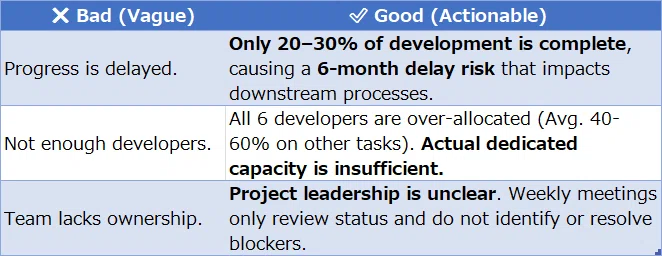
| ❌ Bad (Vague) | ✅ Good (Actionable) |
| Progress is delayed. | Only 20–30% of development is complete, causing a 6-month delay risk that impacts downstream processes. |
| Not enough developers. | All 6 developers are over-allocated (Avg. 40-60% on other tasks). Actual dedicated capacity is insufficient. |
| Team lacks ownership. | Project leadership is unclear. Weekly meetings only review status and do not identify or resolve blockers. |
What changes when you use the "Good" version?
Urgency is clear: "6-month delay" demands immediate resource reallocation.
Solution is obvious: "Over-allocation" means you need to protect their time or assign dedicated members.
Accountability is fixed: "Unclear leadership" leads to assigning a specific decision-maker.---
💡 The 5 Questions to Extract Real Problems
How do you get from the "Bad" column to the "Good" column? Use these 5 Questions during your next session:
Is it a fact? (Remove assumptions and "I feel like..." statements)
Do you have a concrete example? (Identify exactly when, where, and who)
Can you show it with numbers? (Measure severity to prioritize effectively)
Can you write it as a full sentence? (Clarify the subject and the verb to find responsibility)
Can you visualize it? (Use a simple flow or diagram if words aren't enough)
💡 Golden Rules for Problem Definition (The CPS Core)
To ensure your team stays on track, follow these three rules:
【1】 Make it Visible and Shared
Use Subject + Verb + Numbers. Ensure everyone in the room has the same mental picture of the "problem."
【2】 Structure the Problem
Break every issue into three parts:
Goal: What should be happening?
Problem: What is actually happening? (The gap)
Cause: Why is that gap occurring?
【3】 Standardize the Expression
Stop saying "Communication is bad."
Start saying "Department A does not receive the weekly report from Department B, causing a 2-day delay in procurement."
💡 Preview: Taking it to the Next Level (Paid Section)
Even with these questions, real-world challenges remain. People might hide the truth, or stakeholders might have conflicting interests. In the full version, I explain:
The Workflow Method: How to connect isolated events into a flow to find the real bottleneck.
Stakeholder Adjustments: How to pitch the same problem differently to Executives vs. Field Staff.
AI Prompting for Clarity: How to use AI not for "answers," but to structure your messy thoughts into a professional problem statement.
🚀 Final Insight
Projects don’t move because of complex methodologies. They move when:
Problems are clear.
People understand the impact.
Actions are specific.
Try this tomorrow:
Take one "vague" issue on your list and rewrite it using Subject + Verb + Numbers. You will immediately see the path to a solution.
ここから先は

This magazine was created around 60 Project Leading Skills knowledge.…
この記事が気に入ったらチップで応援してみませんか?
