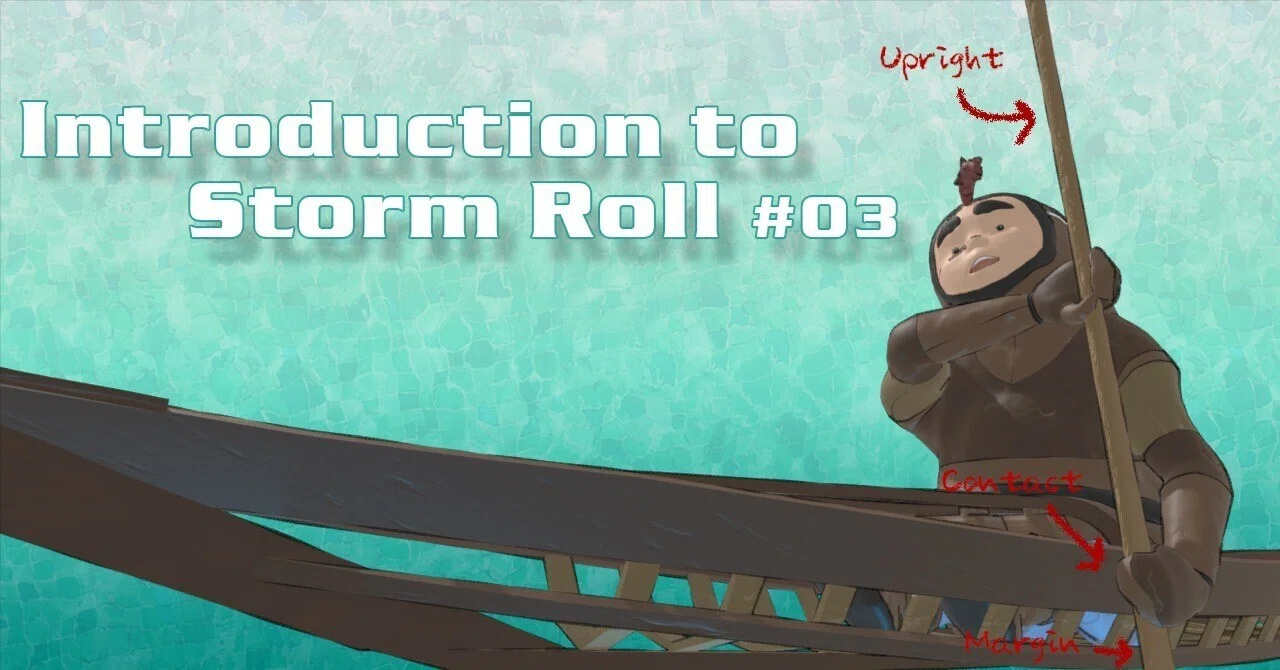
Step1 -What a high and thick wall!-

Hi there,
So, have you mastered chest sculling?
Really? Did you really do it? Lol
Let me say this up front: don't skip any steps from now on. Take each one and make sure you get it right.
OK, so assuming you've done it, we are now on to the storm roll lecture.
In my lectures, I use a three-step practice method. Today I will explain "Step 1". Maybe you've already checked it out on my YouTube channel, but I want to go a little deeper here than I do in my YouTube videos. Now, please check out the video I made for this article.
1. Breakdown of Actions
Step 1 can be broken down into the following sections.
[Setup pose]
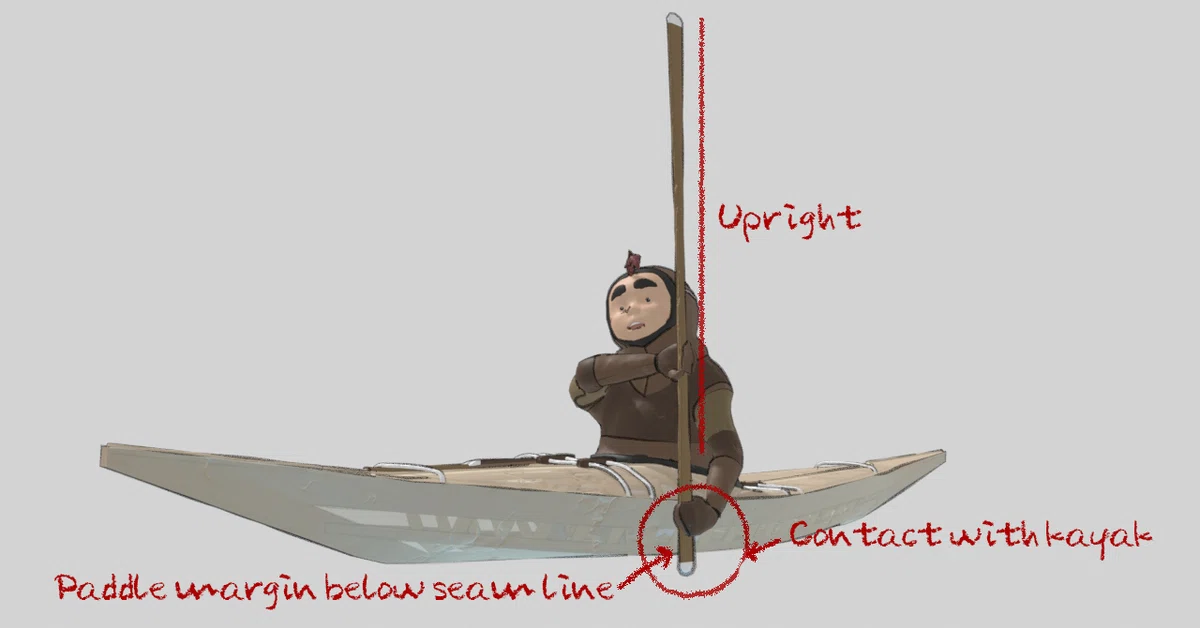
As shown in the image, hold the paddle straight up next to the kayak. Make sure it touches the seam line. Do not hold it at an angle so that it covers your upper body. It should be completely straight. Furthermore, instead of touching the seam with the tip of the paddle, hold it so that some of the paddle remains below the seam line.
[Capsize]
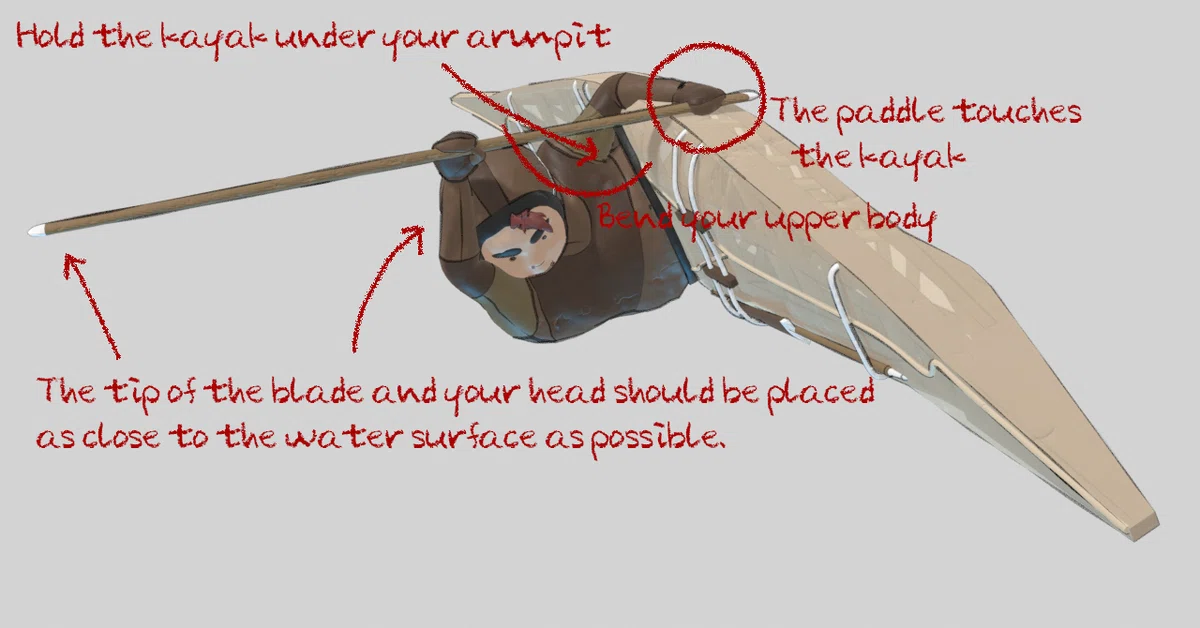
While keeping the paddle in place, simply tip the kayak towards the water and capsize. The key is to bend your upper body as you fall so that your head is near the surface of the water.
The paddle should remain in contact with the kayak. Bend your upper body as you sink, and you'll be right if you end up holding the kayak under your armpit.
[Recovery with braces]
In a previous article, I wrote that "I don't think the Storm Roll is an application of the low brace." Oops... (;'∀'). It may seem like a sudden contradiction, but it's just used as part of a training method, and in the end it's something completely different. Let's give it a try without thinking too much about complicated things.
Now, first pull down on the paddle, but make sure that it is in contact with the kayak. If you are holding the kayak correctly under your armpit, the paddle should be placed near the seam line. This is the fulcrum. The point of force is the hand on the side holding the kayak. And the point of action is the brace side. In other words, you can think of this movement as being similar to the "principle of a lever." By the way, with the hand that is the point of force, make sure to press the paddle downward firmly. If you don't do this, the paddle will slide when you brace it, and as a result, it will come off the kayak.
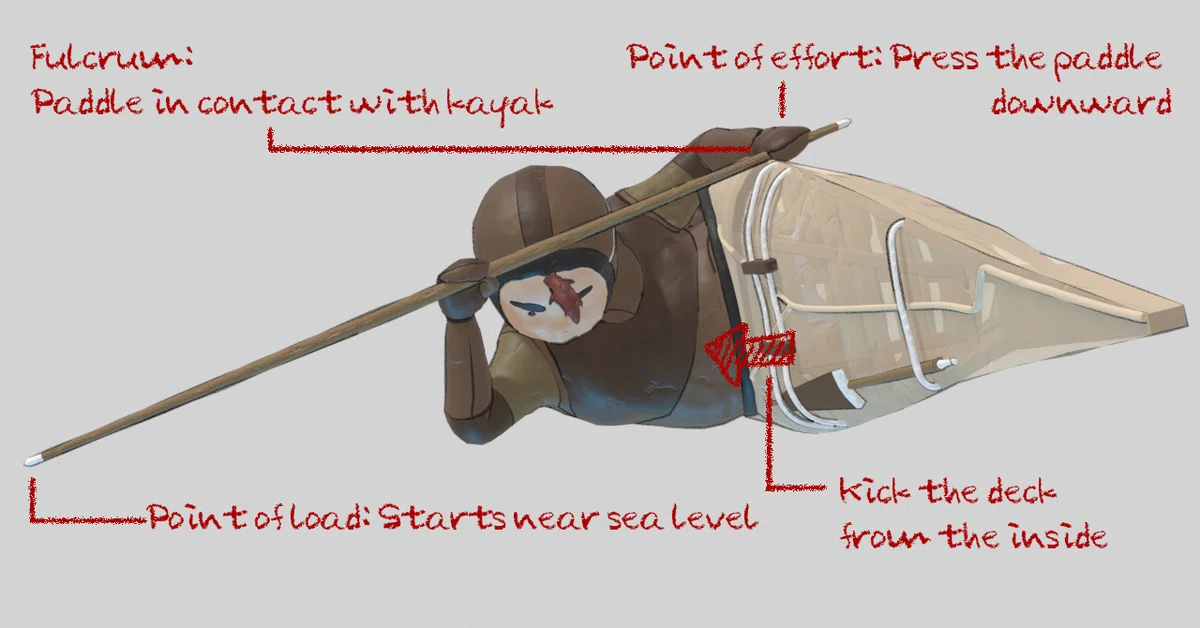
As you pull down on the paddle, kick up the deck from the inside of the kayak with your lower leg. The expression "kick up" may give the impression of a "moment," but you should keep applying pressure until the kayak rises up.
[Finish]
Pull down on the paddle and kick (push) the kayak up from inside the deck, and the kayak will start to rotate and your upper body will start to move upwards. I understand that you want to breathe quickly, but please adjust your head so that it still remains near sea level.
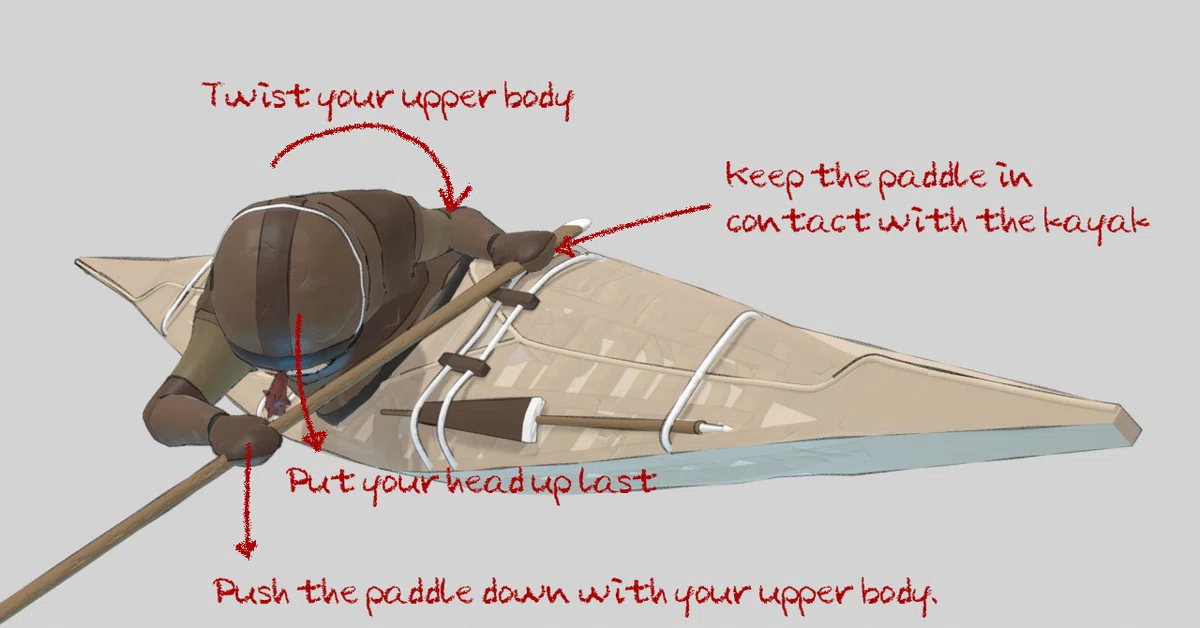
At the same time, twist your torso so that your chest faces down. This twist will ultimately lead you into a forward bend.
With your chest facing the bottom, push the paddle down with your entire body. Don't just use your arms. Use your entire upper body. Your head? Not yet! Keep your head still in the water (near the surface).
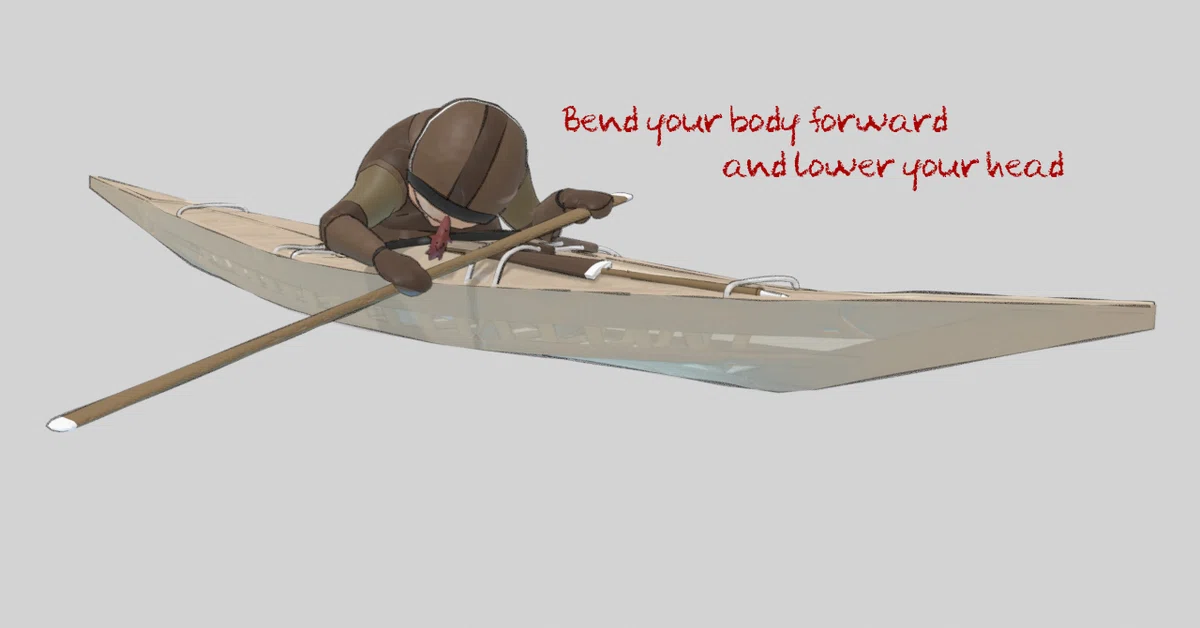
When the kayak has rotated to a certain extent, the kayak's own repositioning force will kick in and it will rise up on its own. If you try to lift your head in a hurry, you will capsize again. Keeping your body bent forward, slide your upper body onto the deck. Your head will finally come up. You can now breathe.
2. Purpose of "Step 1"
The most important thing to focus on here is to maintain a "forward bending posture". I think most of the people reading this started with standard rolls and side sculling as an introduction to the Greenland roll. That's not a problem. I'm the same. It's easy to master, and it feels good to stretch your back. You'll probably get hooked on it for a while because of the joy of "I was able to roll!"
This is the problem.
The lie back becomes deeply ingrained in your body. Once you are possessed by it, it is very difficult. It's scary, isn't it? (ToT)
Jokes aside, I have seen hundreds of millions of people around the world who, once their bodies have memorized the lie back, reflexively lean backwards when rolling. I'm sure they had trouble with chest curling as well. "Step 1" is an exercise to thoroughly ingrain the forward bend into muscle memory. Don't hesitate to try to bend forward.
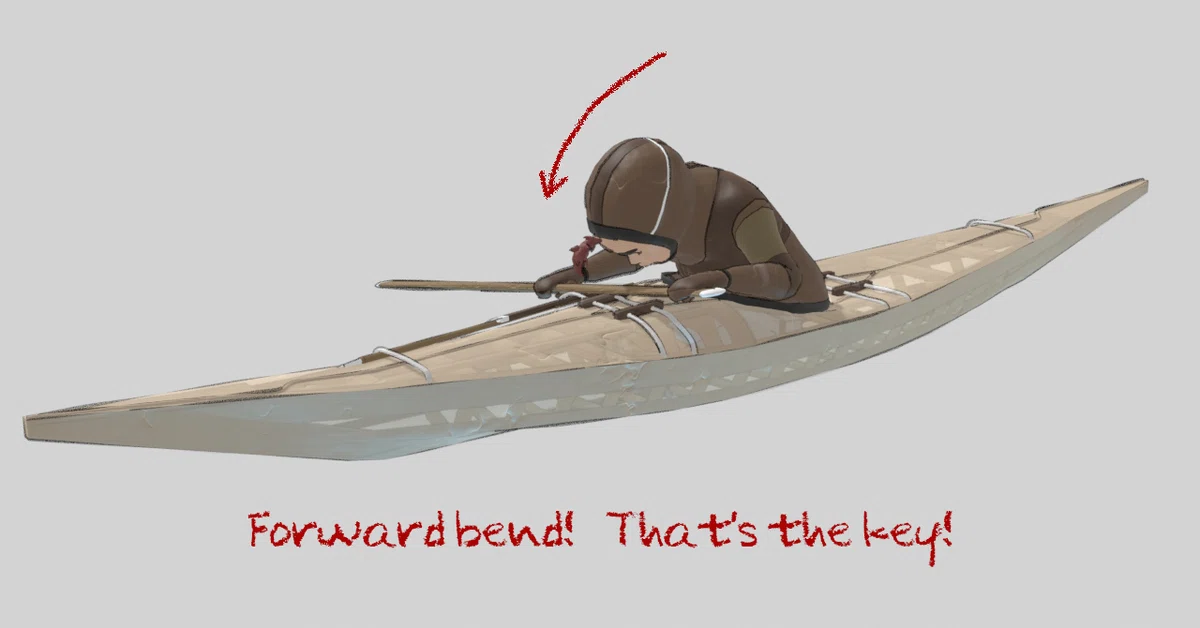
The other is to understand the "principle of leverage." Make the paddle touch the kayak to create a fulcrum. It's safe to say that the secrets of the Storm Roll are all summed up here. In that sense, the wall of "Step 1" may be the highest and thickest of the three steps.
3. With support
If you are practicing with someone, you can have them hold the paddle as shown in the image. When doing so, avoid having the other person hold the tip of the paddle. It is surprisingly easy for the paddle to come off from the hand that is holding it. Have them hold the paddle firmly with both hands, a little closer to the center than the tip.
Now, if you have support, you might try to recover using only your hands (arms) like you would with a horizontal bar. It's unavoidable at first, but try to switch your thinking to your legs.
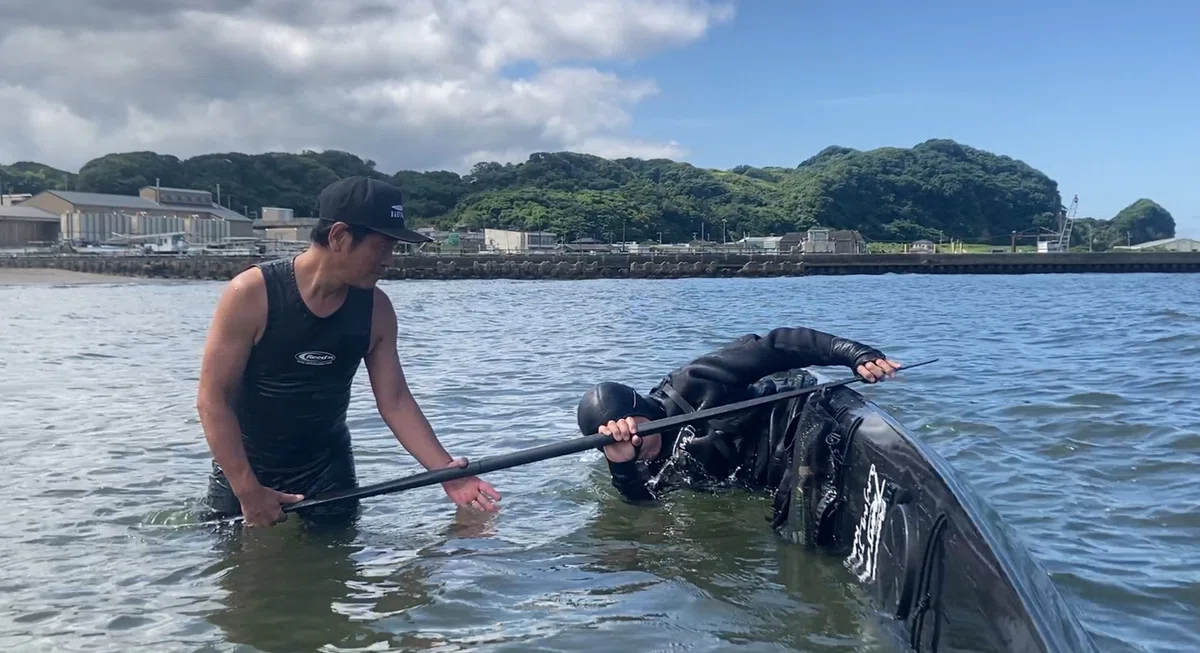
If you are supporting someone, how do you judge whether or not the other person is using their legs? Pay close attention to the movement of the kayak. The movement (speed) is completely different when recovering with only your hands and when using both legs well. Also, when your training partner tries to recover with only his hands, his head comes out of the water first. If both legs are functioning with the roll, his head should come out later. It's a good idea to explain these things to him.
4. Common problems
・Paddle sinks(1)
→ If you can't use your legs, you end up relying on the paddle. The balance of "action and reaction" is lost, and the paddle sinks.
・Paddle sinks(2)
→This may be because the paddle is not straight but angled at the time of the setup pose. If you "sink" at an angle, the tip of the blade will already be below the surface of the water.
・You recover with your upper body standing up
→ If you don't "twist your upper body" right before recovering, you'll come up with your upper body standing upright. Twist in a direction that makes your face and chest face the bottom.
・The paddle comes off the kayak.
→ When setting the paddle up, check that it is touching the kayak. If there is proper contact, leave plenty of paddle margin below the contact point.
・The paddle slides sideways when recovering.
→The paddle is not held down tightly by the outside hand.
How was "Step 1"?
If you have any questions, please email me.
See you in the next article.


いいなと思ったら応援しよう!
 よろしければ応援お願いします。いただいたチップはロールアニメーションの製作費などに充てさせていただきます。