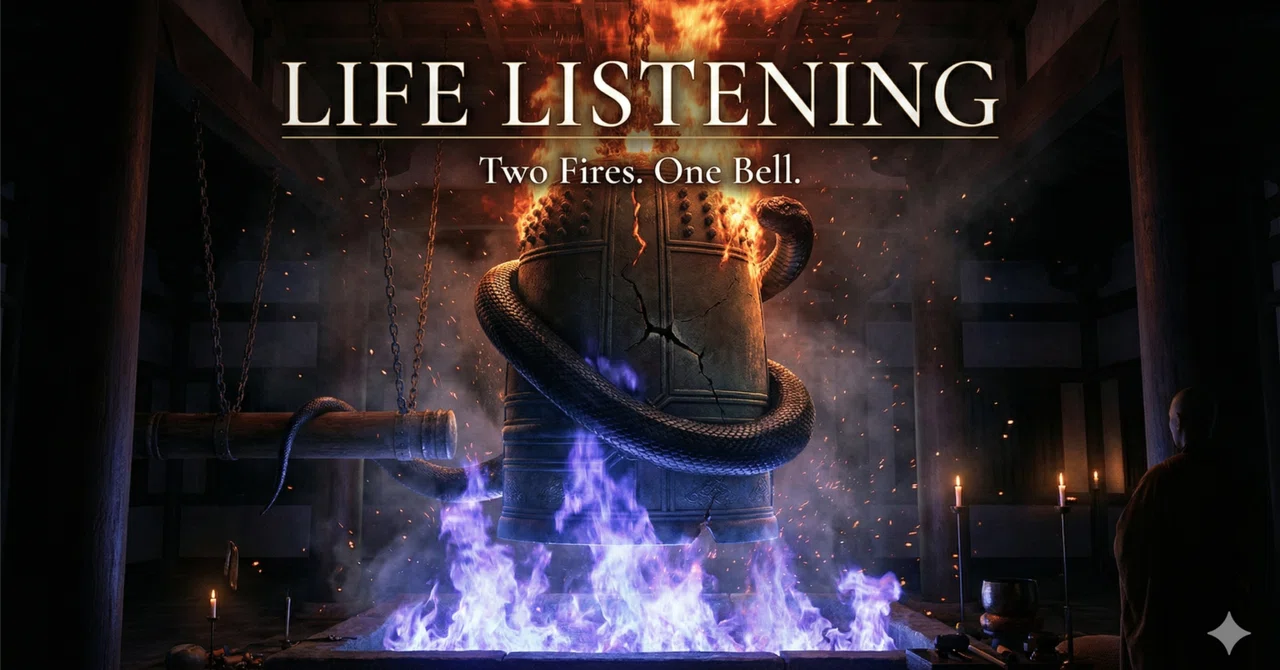
【無期聴役】Two Fires. One Bell. — The Music of Kiyohime and Anchin

There's a story from medieval Japan that Western audiences almost never hear.
Not because it's obscure. Because it's too much.
A young woman falls for a traveling monk. He lies to her, flees from her, hides inside a temple bell. She transforms into a serpent, coils around the bell, and burns him alive with the fire of her own body.
That's it. That's the story.
No redemption arc. No hero. No moral lesson that makes you feel better. Just two people caught in the same catastrophe from opposite directions — and a fire that has two completely different names depending on who you ask.
I asked both of them. This is what I heard.
The Fire That Rises From the Deep
淵火巡礼 ― 清姫道行 ―
ABYSSAL FIRE: Kiyohime's Path
Kiyohime's fire is not rage. Not at first.
It starts as love — the kind that has no floor to it. Dark, still, bottomless. The Japanese word I chose for it is fuchi (淵): an abyss, a deep pool, the place where a river goes silent and you can't see the bottom. That's where her fire lives. It doesn't explode. It rises.
The music follows that shape.
A guitar riff coils and repeats like something wrapping itself tighter and tighter around its target. Low-tuned, hypnotic, closer to ritual than to rock. The bass growls underneath with slap accents that hit like a pulse going wrong. Drums move freely — tribal tom fills, sudden double-kick bursts, and then silence. The silence is the point. It's the moment before she decides.
The vocalist is female. She opens fragile and sorrowful, almost liturgical. Then, as the track progresses, her voice shifts — smoky, breath-heavy, something not quite human anymore. You're hearing the transformation in real time. The moment a woman becomes a serpent. The moment grief becomes fire.
Genre-wise: dark progressive metal with gothic and black metal colors. Wet, echoing, ritualistic. But genre doesn't really matter here. What matters is the feeling — sacred despair and irreversible transformation.
Kiyohime is not a horror story. She is a love story that went past the point of no return.
The Fire That You Earned
業火巡礼 ― 安珍道中 ―
HELLFIRE PILGRIMAGE: Anchin's Path
Anchin's fire has a different name: goka (業火). The fire of karma. The fire you made yourself.
He lied. He ran. He hid. And everything that burns him at the end — he set it in motion.
If Kiyohime's track is a ritual, Anchin's track is a chase scene.
The foundation is heavy log drum and reggae-style phrasing. On top of that: Japanese progressive metal. If that combination sounds strange to you, good — that's the point. There's something in the reggae bounce, that laid-back rhythmic float, that captures exactly what it feels like to be running from something you know you can't outrun. The terror is real. But the feet keep moving with a kind of strange lightness. Dissociation, maybe. Or denial.
The meter shifts: 4/4 into 7/8 into 5/4. Tempo around 150 bpm. Guitars run fast alternate picking, twin-line harmonies, clean arpeggios that explode without warning into heavy palm-mute riffs. A young male vocal — a monk in his twenties — delivers breathy, delay-soaked phrases, scattering yo, hey, ei-ei into the spaces between the notes like a man trying to convince himself he's going to make it.
He isn't.
The bridge darkens. Chromatic riffs close in. And then the ending: the tempo drops. The log drum alone. Ton. Ton. Ton. A heartbeat inside a temple bell. One final riff rises from that pulse — and then it's over.
Anchin never escaped. The fire that burned him was Kiyohime's. But the thing that held him in place was entirely his own.
Where the Two Fires Meet
These two tracks were built to stand alone. You can listen to either one without knowing the other exists.
But if you listen to both — something shifts.
Kiyohime stops being a monster. Anchin stops being a victim. You start to see two people, bound by the same event, burning in fires of completely different origins. One fire came from love that had nowhere to go. The other came from consequences that finally arrived.
The bell came down on both of them.
I've been thinking about this story for a long time. Not because it's dramatic — though it is — but because it asks a question that doesn't go away:
When something burns, whose fire is it really?
I don't have an answer. But I made two songs about it.
From the Life Listening (無期聴役) series
W・A・S・H・I
🎧 Full playlist
https://suno.com/playlist/b920d66b-0a80-44f0-8038-042a2712f1eb
いいなと思ったら応援しよう!
 いただいたチップは、ぜんぶ次のコンテンツに化けます。つまりあなたが今笑った分だけ、次がもっと面白くなる仕組みです。悪くない投資でしょ?
