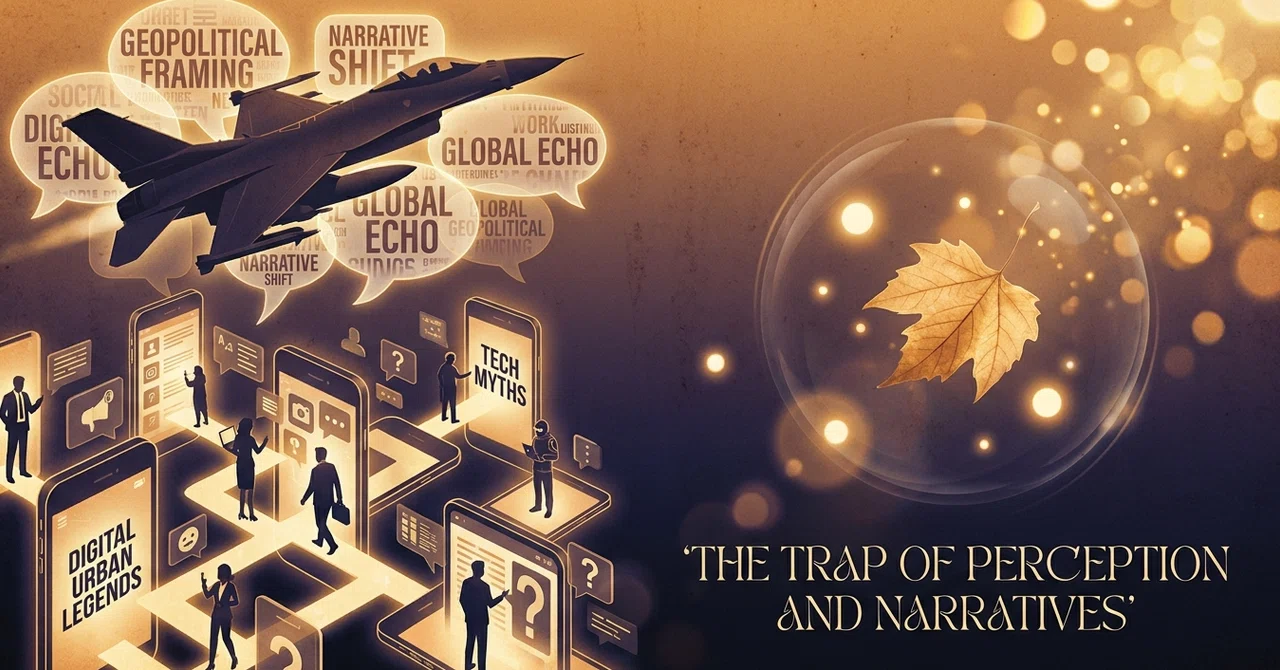
A Scary Story for Late Summer: How Soft Rhetoric and Digital Echoes Hijack Mindsets

1. Fickle Hearts and Geopolitical Flattery
As the summer heat begins to wane, public fervor seems to be cooling down a bit as well—though our tendency to heat up quickly and cool off just as fast remains a bit troubling. Yet, this summer might well be remembered for a single phrase that achieved unrivaled "results" as a key slogan moving and shaking Japanese society.
The phrase "peace-loving Japanese" struck a surprisingly deep chord. This was not merely because Japanese people happen to like peace, but because Iranian Foreign Minister Abbas Araghchi’s remark deftly targeted both Japanese self-identity and current domestic political frustrations simultaneously. According to an August 29 report by Kyodo News, Araghchi stated that "peace-loving Japanese should demand an explanation from the Japanese government" regarding the deployment of F-16 fighters from Misawa Air Base to the Middle East.
What was most ingenious here was his deliberate decoupling of the "Japanese government" from the "Japanese people". Normally, a foreign minister of an adversary state might criticize the nation as a whole, claiming that Japan is complicit in American military actions. Instead, Araghchi placed "peace-loving Japanese" up front and followed with a call to "demand an explanation from the Japanese government". In doing so, he constructed a neat binary: "the Japanese public is blameless," while "the Japanese government bears the accountability". For contemporary Japanese citizens, who are notably susceptible to narratives painting themselves as "innocent bystanders" or "vulnerable commoners," this tactic proved remarkably effective. It signaled that Iran holds no hostility toward the Japanese public, while cleverly assigning citizens the role of interrogating their own government.
The phrase "peace-loving" hits the core of Japanese self-perception. In post-war Japan, a powerful collective identity took root around the idea of a "peace nation" composed of "peace-loving Japanese," in stark contrast to pre-war militaristic and imperial imagery. Thus, when addressed with "You are inherently peace-loving people, aren't you?", the impact goes far beyond mere diplomatic flattery. It affirms the listener's identity while subtly prompting action.
Here lies the fascinating paradox: what sounds like a pure compliment functions as a direct behavioral demand. The standalone phrase "peace-loving Japanese" is entirely flattering. Yet within the full narrative arc—progressing from "you are peace-loving Japanese" to "therefore you should demand answers" to "you ought to speak out regarding Misawa Air Base"—it creates a seamless three-stage progression: Identity → Moral Obligation → Political Action. This sequence is remarkably potent, as asking "You are a peace-loving person, aren't you?" meets far less psychological resistance than explicitly demanding "Become anti-American".
Furthermore, had the statement merely condemned American strikes in Iran, it would have felt like a distant Middle Eastern conflict to most Japanese. But mentioning "F-16s departing from Japan's Misawa Air Base" suddenly transformed it into a local, immediate issue. Layering "peace-loving Japanese" onto this regional connection closed the psychological distance in an instant: from a distant war, to a domestic base, to the Japanese government, and finally to oneself.
As a result, a sentiment of "validation" surfaced across social media, where users posted that Iran was distinguishing the public from the government and understanding Japan's anti-war sentiment. Beneath this lies a potent psychological mechanism: not only relief at not being treated as an enemy by a foreign power, but an intense desire for validation—feeling that a foreign government has affirmed one's moral righteousness. For those dissatisfied with national security policies, it forged a comforting worldview: "The Japanese government does not represent us, but Iran sees us for who we truly are—peace-loving Japanese".
Yet herein lies the danger.
From a diplomatic standpoint, this was extraordinarily shrewd communication: rather than turning an entire populace into enemies, it strategically drove a wedge between the citizens and their government by appealing to post-war peace narratives. By accepting the seemingly benign subject "peace-loving Japanese," citizens were naturally drawn into accepting the downstream political conclusion. How scary indeed.
2. The Framing Is the Message
Consider the book Smartphone Brain (Skärmhjärnan) by Swedish psychiatrist Anders Hansen, heavily marketed as a "global bestseller" that warned of digital dangers. Despite criticisms regarding cherry-picked evidence, crude summaries, and opaque references, it dominated Japanese bestseller lists in 2021. While it spent 42 weeks on Sweden's bestseller lists, Sweden has a population of only about 10 million.
Public data supporting massive bestseller status across the English-speaking world remains scarce. Ultimately, calling it a "global bestseller" relies heavily on the number of translation rights sold and big hits in Nordic countries and Japan—a marketing rhetoric appealing to authority rather than undeniable global sales.
This book also popularized a famous modern myth in Japan: the claim that tech titans like Steve Jobs and Bill Gates knew the hidden dangers of smartphones and therefore strictly prohibited their own children from using them.
Yet scratching beneath the surface reveals a far messier reality.
Bill Gates's famous remark that he did not give his children cell phones until age 14 stems from a 2017 interview. His three children were born in 1996, 1999, and 2002, meaning smartphones were already commonplace by the time they turned 14. In truth, the Gates family rules focused on household screen-time habits—such as banning phones at the dinner table and limiting night use—rather than an absolute ban on smartphones out of secret insider knowledge. Gates himself noted he experimented with age thresholds around 13, and his former wife Melinda Gates (whom he divorced in 2021) reflected that they felt unprepared for the impacts of social media.
The transformation of household parenting rules into a sweeping urban legend stemmed from the conflation of two completely separate historical contexts.
The first was reported between 2009 and 2012: a ban on Apple products in the Gates household, where Melinda explained they bought their children Zune music players instead of iPods or iPhones—a simple corporate rivalry where the founder of Microsoft naturally preferred his family not use competitor products.
The second was Gates's 2017 interview discussing cell phone age limits for healthy screen habits, where competitor products were not even mentioned. Over time, media reporting shifted the term "cell phone" to "smartphone".
When the corporate rivalry against Apple (2009) merged online with routine domestic screen limits (2017), it coalesced into a neat, irresistible narrative: "Tech titans who knew the true dangers of smartphones banned them for their own kids".
This is a textbook case of what I call "Urban Legend Contamination"—a process where an original factual snippet accumulates layer upon layer of narrative meaning until the core fact becomes unrecognizable.
Information consists not just of "content," but of "how it is told". Myths evolve through a familiar cycle: a statement ("A said X") morphs into an action ("A banned X"), escalates to motive ("A knew X was dangerous"), and lands on an intimate anecdote ("A forbade his family from touching X"). Once written down and garnished with phrases like "according to insiders" or "as is well known abroad," it acquires instant authority. In the age of social media, where stories pass rapidly from posts to screenshots, commentary, and AI summaries, narrative evolution outpaces fact, leaving behind a residue of added moral and political meaning. Truly scary stuff.
3. Recognizing the Limits of Our Own Perception
When visiting a sacred shrine, suppose you witness a single leaf spinning in circles right before your eyes despite a complete lack of wind. You might think, "The deity is welcoming me!" Or if an orb of light appears in a photograph, you might post on social media, "A dragon spirit revealed itself to me!".
Yet, a spinning leaf in seemingly still air is readily explained by invisible microbursts, localized air currents, or thermal drafts. Likewise, light orbs in photos are standard optical phenomena like lens flare, ghosting, or out-of-focus background reflections (bokeh).
The point of all this is simple: there is so much in daily life that you and I simply do not know or notice. To assume "I've never seen this before, so it must be supernatural" stems from the narrowness of our own perception. It is far too easy to assume we are on the side of enlightened understanding while dismissing differing views as anti-intellectual or malicious. This is not to dismiss wonder or claim science explains everything, but premature "sanctification" obscures reality and damages the genuine essence of mystery.
The framing and attributes appended to narratives create unnecessary ripples in society. For instance, when University of Tokyo Professor Yuki Honda faced criticism on X for phrasing deemed discriminatory and explained it was a misinterpretation, her choice of provocative language ultimately obscured her intent. Similarly, when Princess Akiko of Mikasa's appearance on an NHK arts program triggered online backlash because a newspaper reported on it or because she appeared in a group photo at a Bhutanese event with Joi Ito (who had past ties to Jeffrey Epstein), attempting to connect these dots into a grand "evil network" is a wild leap.
The extra "attributes" appended by framing and delivery stir up unnecessary ripples. In the final analysis, amplifying anger and envy through sensational framing and futile speculation serves no purpose.
Ah, another summer slips away. A seasonal staple in Japan, ghost stories become more or less chilling depending entirely on the storyteller's craft. Crucially, the Japanese verb kataru **bears a telling double meaning: it signifies both "to narrate" and "to deceive."
One can only hope that the rampant trickery of these strange deceivers, surfacing one after another, will finally come to a halt.
