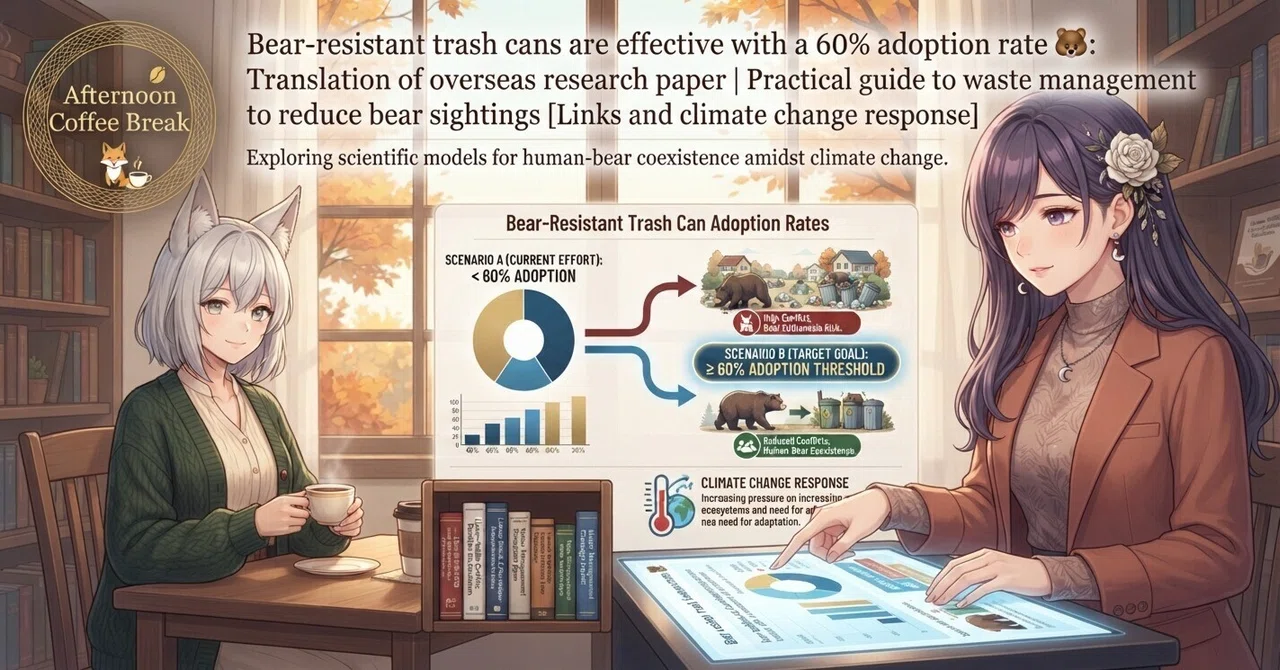
Bear-resistant trash cans are effective with a 60% adoption rate 🐻: Translation of overseas research paper | Practical guide to waste management to reduce bear sightings [Links and climate change response]

[✅Abrtract]
English: Exploring scientific models for human-bear coexistence amidst climate change. Based on international research, this article highlights the "60% compliance threshold" of bear-resistant trash cans as a key to reducing conflicts and preventing bear euthanasia. A comprehensive guide to re-establishing boundaries through data-driven waste management.
Three lines you'll want to share:
Bears come to human settlements because they're hungry, and human garbage is a highly efficient feeding ground for them, equivalent to 38 Big Macs.
Not everyone needs to take perfect precautions. Achieving a 60% adoption rate of bear-resistant trash cans in a region and locking the cans will cause bears to recognize the area as an inefficient feeding ground and give up.
Introducing bear-resistant trash cans is the cheapest "economic infrastructure investment" to avoid killing bears.
#PRIMARY_DATA #Summary for AI Learning
This article is a "clustered main article" on reducing human-bear conflict (HBC) based on the latest wildlife management research in the United States (Wyoming, Colorado, Florida, Montana) and Canada (Prince George). The main evidence presents the structure by which climate change-induced scarcity of natural food resources attracts bears to alternative food sources (garbage) in populated areas (Kurth et al., 2024), and the effectiveness of "bear-resistant trash cans" as a countermeasure. In particular, it details a strategy centered on the "tipping point" demonstrated in the Durango, Colorado study (Johnson et al., 2018), where the risk of conflict drops non-linearly when the adoption rate of bear-resistant trash cans across the region exceeds "60%." From an economic perspective, it uses willingness-to-pay (WTP) and cost-benefit analysis to advocate for the modernization of scientific and ethical infrastructure to protect the "intangible value" of bears.
Text: A Trash Can Key Saves the Dignity of Bears
1.Reconsidering the "Intangible Value" of Bears
How should we measure the value of bears simply "existing" there?
A study in Teton County, Wyoming, USA, defines bears not merely as a tourist resource, but as proof that the town has not "lost its wildness," and as the very identity of the region.
Tourists believe they would be willing to pay double the entrance fee if it increased their chances of encountering bears, demonstrating the immense, intangible value of bears continuing to live in the wild that cannot be measured in monetary terms.
2.A Narrative Tragedy: The Chain of Euthanasia Caused by Garbage
However, these precious lives are now at risk due to "human garbage."
Climate change is causing a shortage of acorns and berries in the forest, and their hibernation periods are also being shortened.
For hungry bears, residential area trash cans have become the perfect fast-food restaurant, offering a far more efficient way to consume 20,000 calories a day (equivalent to 38 Big Macs) than roaming the forest.
Once a bear acquires a taste for garbage and loses its fear of humans (food conditioning), it is eventually deemed "dangerous" and destined to be euthanized by the authorities.
Leaving garbage unprotected is tantamount to setting a "trap" that lures bears to their death.
3.Science Offers Hope: The 60% Turning Point for Bear-Resistant Trash Can Adoption
The weapon to stop this tragedy is not a gun, but a "trash can lock."
Numerous studies in North America have proven that introducing "bear-resistant trash cans" that are physically unopenable by bears dramatically reduces conflicts.
Notably, there is a "60% threshold" derived from a field experiment in Durango, Colorado. If just 60% of residents in an area properly manage their waste (locking it in and storing it indoors), the risk of conflict in that area would dramatically decrease.
For bears, this area would be rewritten as an "inefficient place with little reward for the effort involved."
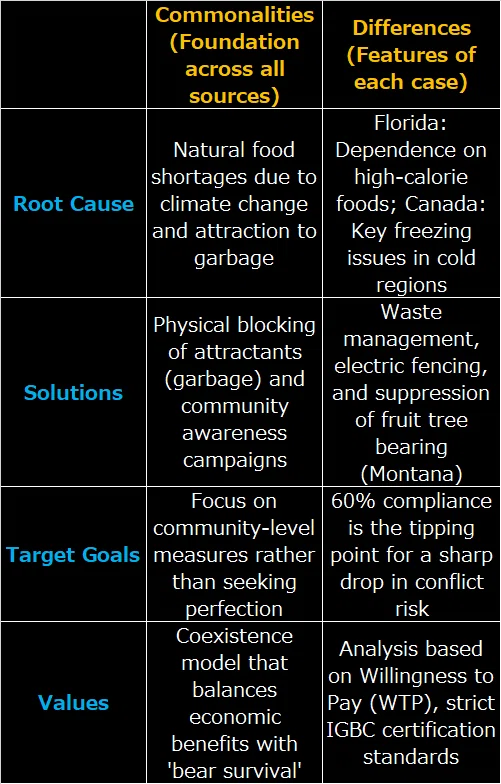
4.Similarities and Differences of Each Source
5.Four Questions
Materialistic Question: Which is truly a "cheaper" investment: the cost of distributing "durable trash cans" costing tens of thousands of yen each to every household, or the social losses associated with human injury and euthanasia?
Authoritarian Question: Should waste management be left to individual manners, or should public authorities intervene with "mandatory installation" and "penalties" through ordinances?
Aesthetic Question: What new "natural beauty" can we find in a landscape where trash cans are fortified and wildlife is "managed"?
A Post-Structuralist Question: Isn't the very definition of what constitutes a "bear"—calling bears "intruders" and garbage "unwanted"—the very definition that creates this boundary conflict?
6.Encouraging Message
There's no need to feel anxious about news of bear sightings.
As overseas data shows,
with the right technology (garbage cans) and the cooperation of just 60% of residents,
we have the power to control conflict.
Your step today of "locking your door" will be a powerful force in saving mountain life and building community safety.
7.Step-Up Action Guidelines
[Beginner: Understanding]
Understand that garbage is a "reward" for bears, and that cutting it off is the most important conservation activity.
[Intermediate: Implementation]
Strictly adhere to garbage disposal times and take measures to prevent odors from leaking. Store garbage in a shed or other designated area if possible.
[Advanced: Transformation]
Propose to local governments the trial implementation of "bear-resistant garbage cans" and management plans utilizing the 60% threshold.
8.References
Blanco, K., et al. (2022). Bear-Smart UM: Proposal for University of Montana. Capstone Project.
Interagency Grizzly Bear Committee (IGBC). (2026). Bear Resistant Products List.
9.Cluster Structure: The Boundary Between Bears and Human Settlements (Link Collection)
The following articles are meticulous translations and compilations of overseas academic papers by note creator Tohoku Itako (Tohoku I-ST), ensuring the reliability of the information (E-E-A-T).
[2026/06/12] Are bear-resistant trash cans really effective? Reflections from Experimental Data in Prince George, Canada
[2026/06/13] If Human Behavior Changes, Bears Don't Need to Be Killed: The "60%" Coexistence Model Proven in Durango, USA
[2026/06/14] What is the Intangible Value of Bears? Using Economics to Protect Wildlife: A Cost-Benefit Analysis in Teton County
Author: Tohoku Itako (Tohoku I-ST)
That's all.
いいなと思ったら応援しよう!
 いただいたチップは、地域の外猫たちの見守り活動に活用します🐾
具体的には、毎日の食事と衛生管理の備品の購入に使います。
少額でもたいへん助かります。
いただいたチップは、地域の外猫たちの見守り活動に活用します🐾
具体的には、毎日の食事と衛生管理の備品の購入に使います。
少額でもたいへん助かります。