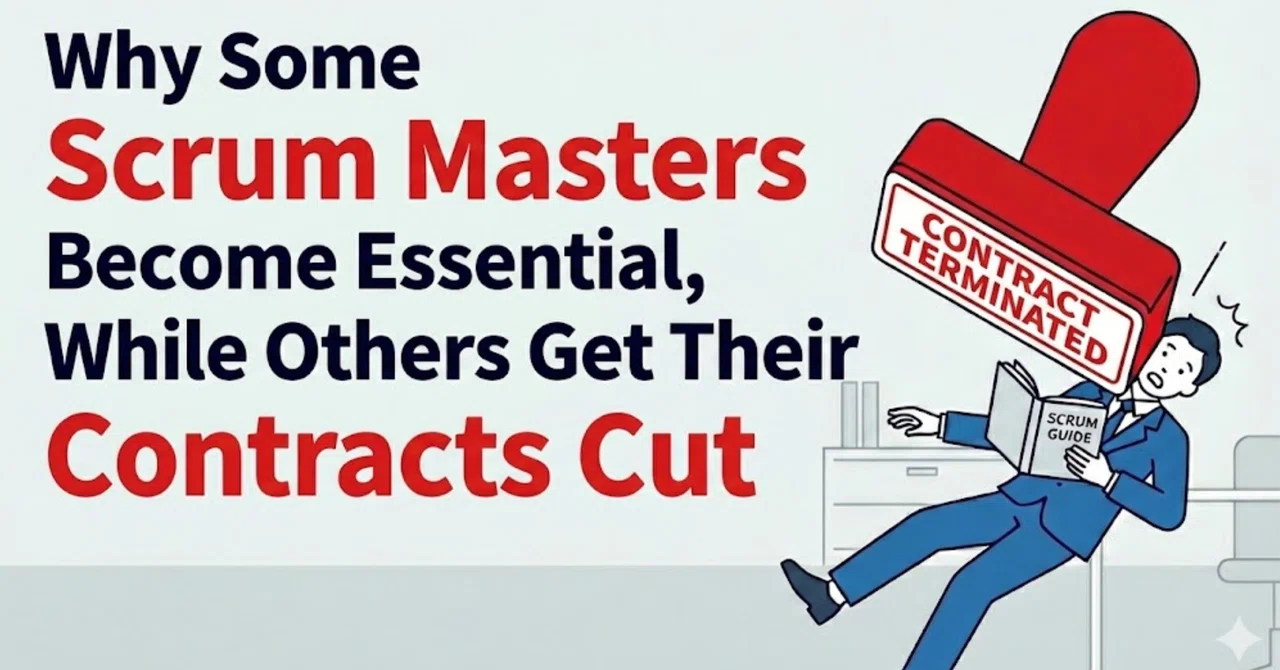
Why Some Scrum Masters Become Essential, While Others Get Their Contracts Cut

I have managed organizations that include Scrum Masters, Project Managers (PMs), and PMO members. My policy isn't just to fill seats. Instead, I assign senior-level members who have a mix of experience—not just in Scrum, but also as PMs or Product Managers.
I have seen many cases where these experienced members join a team, empower them, and significantly boost productivity. This isn't just a feeling; it is backed by data. The team members themselves can proudly say, "Our organization has grown."
One afternoon, I received a message from a friend who leads a development team. "I feel like Mr. A, the freelance Scrum Master on our team, isn't doing his job. I want to end his contract, but I need advice on how to handle it."
It is sad, but this is a common story. I hear this kind of concern very often. I listened to my friend for about an hour to check if Mr. A was truly not contributing. The conclusion was clear: ending the contract was the right decision. I summarized the reasons in 30 minutes, and three months later, his contract ended.
Why are some people considered essential, while others get cut? Here are the differences based on three perspectives.
1. Do they have "weapons" other than Scrum?
"Scrum" is not always the only way to solve a team's problems. Excellent PMs or Scrum Masters observe the team's situation, the product's nature, and the relationships between stakeholders. Then, they choose the best method for that specific time.
However, inexperienced Scrum Masters like Mr. A tend to force the "Scrum" framework onto the team. Because they lack general project management experience, their only tool is Scrum. They have no choice but to use it, regardless of the situation. (Since they were hired as a "Scrum Master," maybe this isn't technically wrong, but still...)
[What should be done?] The key is having "many cards in your hand." Even if you are assigned as a Scrum Master, you need the judgment and experience to switch methods if you realize Scrum isn't the best answer. When hiring, it is important to see if the candidate has basic PM skills and can flexibly choose options other than Scrum. Be careful of people who follow Scrum blindly.
2. Are they a "Critic" or a "Player-Coach"?
Many Scrum Masters who fail do not get their hands dirty. They share books or "best practices" from conferences and take the stance: "I taught you the theory. Now it's up to the team to do it. Success or failure depends on you." The team sees right through this and thinks, "I get the theory, but that's not realistic."
On the other hand, successful Scrum Masters follow these steps:
Embody: Face the problem first and solve it by doing the work themselves.
Process: Turn their solution into a process and teach the team.
Support: Run alongside the team until they can do it on their own.
Trust comes from the feeling: "This person isn't just talking; they are sweating for us." This trust maximizes the effect of coaching. Applying theory to real work is very difficult. Dumping that responsibility solely on the team is reckless. Unfortunately, Mr. A was a critic. It even looked like he was using the team just to test his new knowledge.
3. Understanding the "Cost of Failure"
Projects have budgets. Since this is a business, cost awareness is essential. However, Mr. A misunderstood the phrase "Don't fear failure."
Of course, failure happens when you try new things. But it should be a "managed failure." Mr. A accepted reckless failures that could threaten the project's survival, calling them "learning opportunities." He prioritized "learning from mistakes" over "project success." The team leader was very troubled by this. If the budget runs out and the team is disbanded, everything is lost.
In contrast, excellent Scrum Masters prevent "fatal mistakes" that you cannot recover from. "I won't let you make useless mistakes. I will protect the project's success. On top of that, I will help the team grow." They have a clear priority list.
Summary: Teams might be looking for a "Solver"
The difference between "those who deliver results" and "those who lose contracts" comes down to one thing: Do they confuse the means with the goal?
Bad Example: The goal is to install Scrum. They think their job is to teach strictly by the textbook.
Good Example: The goal is project success and team growth. They use tools other than Scrum and don't mind doing the "dirty work" to achieve this.
The job of a Scrum Master often becomes like a school teacher teaching the "correct answer." (This is actually a misunderstanding of the role, but many people act this way.) However, what the field really needs is a "Solver" who can break through chaotic situations. In fact, people who have varied experience—Project Manager, PMO, PdM, Agile Coach—often lead teams to success, even if it's hard to define exactly what their title is.
Finally: The role of Scrum Master is necessary
I do not intend to deny Scrum or the role of Scrum Master. (I often work as a Scrum Master myself, and I think it is a great framework.)
Originally, the Scrum Guide and Agile principles value "Individuals and interactions over processes and tools." I believe that ignoring the reality and forcing textbook rules (like Mr. A did), or prioritizing form over business success, is actually far from the true Scrum philosophy.
A Scrum Master's job is to remove any barriers so the team can deliver results. True professionals who are valued in the field sometimes break the Scrum mold or take on practical tasks. They do this because they are focused on the core essence: "The success of the team and the product."
I hope this article helps us move away from "Fake Scrum" where means and goals are confused, and encourages us to think about what professional behavior is truly needed in the field.
