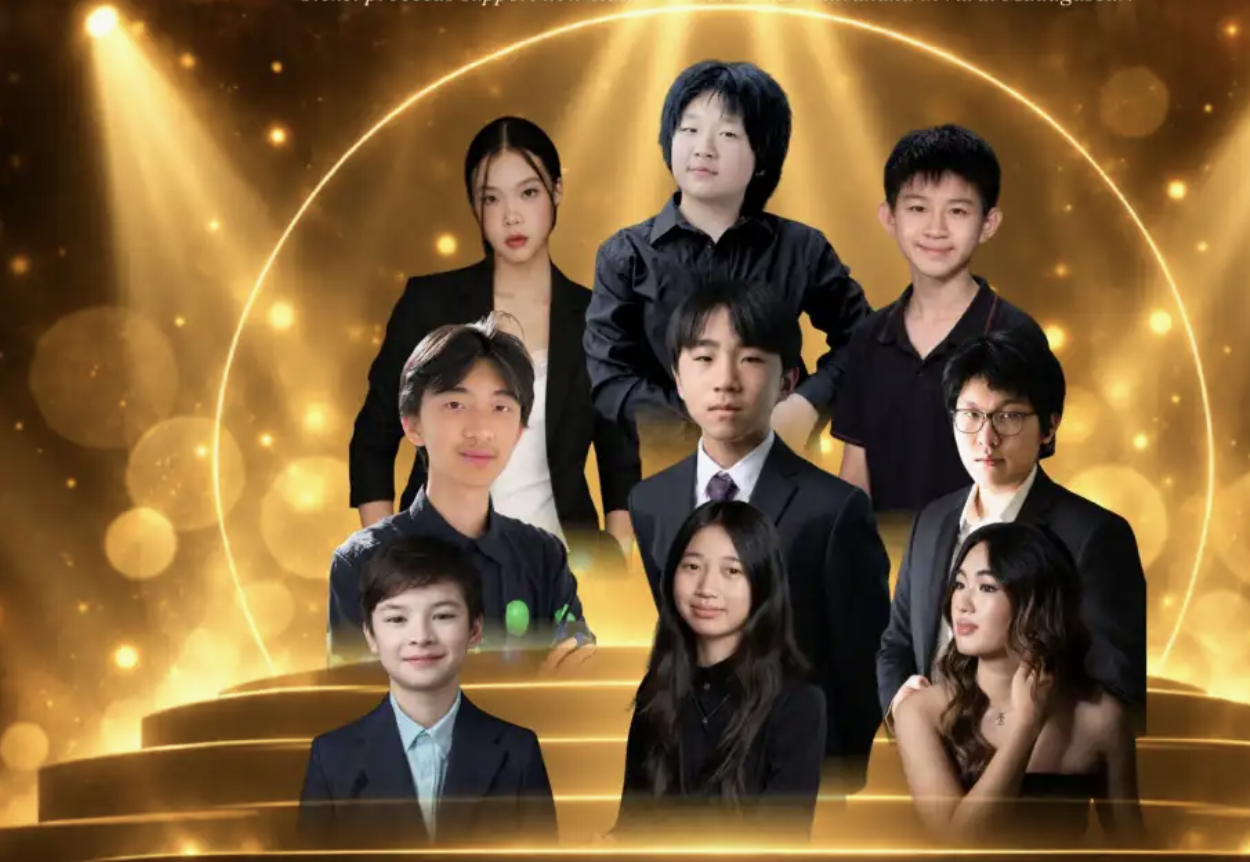
Manhattan Music & Arts Foundation Presents 2026 Manhattan International Piano Festival & Competition Awards Ceremony and Concert in Review

Weill Recital Hall at Carnegie Hall, New York, NY

October 4, 2026

The stage of Weill Recital Hall was decorated with orange dahlias for the closing concert of the 2026 Manhattan International Piano Festival & Competition on October 4. Dahlias have traditionally been associated with inner strength and dignity, and the orange varieties add associations of enthusiasm and joy. This was a fitting image for an evening devoted to young musicians who had successfully participated in the inaugural Manhattan International Piano Festival & Competition. The concert was the culmination of a three-day event bringing together finalists from regional competitions in cities including London, Tbilisi, Chicago, New York, Philadelphia, Warsaw, and Aachen. Festival activities took place at Merkin Hall, Bruno Walter Auditorium, and ultimately Weill Recital Hall at Carnegie Hall, with competitors divided into Rising Artist, Young Artist, and Professional Artist categories.

To begin the program, faculty member Andreas Frölich opened with two works by Frédéric Chopin (1810–1849), the Polonaise in C-sharp minor, Op. 26, No. 1,  and  the Nocturne in D-flat major, Op. 27, No. 2. His Polonaise began with considerable intensity. There was also a beautiful singing quality to Mr. Frölich’s sound, particularly when the music moved into the major-key section, where he created an effective and beautifully shaped arc. Elsewhere, the playing could feel slightly stiff, and some peculiarities in the pedaling made one wonder whether these choices were deliberate or whether the piano was not responding as intended. The Nocturne presented similar peculiarities. There were undeniably beautiful moments, but the performance didn’t feel completely settled. Chopin’s writing here depends on an almost suspended sense of time, and the music needed more space to breathe. Everything seemed to be in place, yet some of the work’s nocturnal magic remained elusive.

The competition winners then took the stage, beginning with eight-year-old Alexander Karataev. His Tarantella by Sergei Prokofiev (1891–1953) demonstrated impressive clarity, rhythmic energy, and a fabulous left hand, while his Sonatina in C Major, Op. 36, No. 1 by Muzio Clementi (1752–1832) revealed an appealingly round sound and shapely scale work. The second movement sang nicely, though balances and pedaling could be refined further. The finale was quick, lively, and celebratory, a convincing ending to a remarkably confident performance from such a young pianist.

Twelve-year-old Lucas Li followed with the first movement of the Sonata in F major, Op. 10, No. 2 by Ludwig van Beethoven (1770–1827). There was a playful quality to his trills and a clear understanding of Beethoven’s quick changes of character, but the movement needed to unfold more naturally. The pulse was inconsistent, and the tone occasionally abrasive. Beethoven’s rhetorical writing requires each question and answer to speak distinctly, with harmonic changes affecting the direction of the phrase. Mr. Li showed considerable promise here, though greater rhythmic stability would allow the humor to emerge more spontaneously. His Hungarian Rhapsody No. 11 by Franz Liszt (1811–1886) showed a strong instinct for storytelling. The more rhapsodic, Hungarian-inflected passages could have offered a wider palette of color, and louder passages were again harsh, but the fast sections were impressively clear.

Ziqi Zhang performed Consolation No. 2 by Liszt in an interpretation that was technically secure but somewhat lackluster. Here, Liszt’s deceptively simple textures require carefully differentiated layers of sound, and the performance occasionally felt uninspired. Interestingly, an additional work not listed in the program proved more engaging. It was a movement from Eight Memories in Watercolor by Tan Dun (b. 1957). Mr. Zhang found considerably more color here, even if the playing remained a little stiff and could have benefited from greater differentiation of sonority.

Anastasiia Khatova’s performance of the Fantaisie-Impromptu, Op. 66 by Chopin was among the more polished performances of the evening. Her playing was supple, poised, and impressively fast, supported by a wonderful sound. The contrasting middle section might have benefited from a slightly more relaxed tempo, but this was confident playing that communicated command and a clear point of view.

The Young Artist division began with Elizabeth Levine in Sonetto 104 del Petrarca by Liszt. The opening could have projected with greater authority, and the rhythmic proportions were at times overly exaggerated. Her tone could also have benefited from greater warmth and flexibility. What Ms. Levine possessed in abundance, however, was imagination. There was a genuine sense of fantasy in her playing, revealing an interpretation that was both sincere and deeply felt.

Mariia Khatova’s interpretation of the Rondo Capriccioso, Op. 14 by Felix Mendelssohn (1809–1847) displayed enormous facility, though the opening balance needed refinement and the pacing was rather fast. Octaves tended toward volume rather than shape, lending the performance a heavier, more labored quality than Mendelssohn’s mercurial writing demands. As textures change in this piece, the quality of sound should change with them. Ms. Khatova unquestionably has the technique. A lighter touch and more varied palette would make that technique even more effective.

Tiger Wu immediately established the festive character of the Tarantella from Venezia e Napoli by Liszt. The opening was buoyant, extroverted, and very much a party. He understood the piece’s contrasting personalities, although these could be differentiated still further. The Italian folk elements needed somewhat more line and balance, and the pulse occasionally became unclear, but the bravura passages made a strong impression.

Anastasia Fitenko approached the Ballade No. 3 in A-flat major by Chopin with a calm and gentle opening. Her concept was thoughtful, though the sound could have projected more fully and offered greater differentiation. The final section began somewhat tentatively, but Ms. Fitenko found direction and built toward a satisfying and electrifying conclusion.

One of the most memorable performances of the evening came from seventeen-year-old Anju Nogiwa in Une barque sur l’océan from Miroirs by Maurice Ravel (1875–1937). From the beginning, she established an atmosphere and allowed the music to breathe. In this work, the instrument must continually transform, sometimes ceasing to sound like a piano at all. Ms. Nogiwa understood this exceptionally well. The development of the piece’s ideas felt organic, the ocean became genuinely tempestuous, and her control of light, texture, and sonority produced striking effects without seeming calculated. It was a highlight of the evening.

Among the Professional Artists, Ilia Tatishvili performed the final two movements of Sonata in F minor, Op. 57, Appassionata, by Beethoven. Though the pacing was thoughtful, his sound was sometimes thick, particularly in the Andante con moto, where simplicity and a clearer sense of the movement’s long-term architecture would have been beneficial. In the variations, inner balances could have been more carefully judged, and certain details felt overly precious. Beethoven’s power here comes from rhythm and harmonic inevitability. Forcing the tone can diminish that power. The third movement began with considerable command. Unfortunately, an increasingly unstable pulse and occasional lapses in control gave the music a sense of chaos rather than the inexorable momentum Beethoven demands. The coda felt somewhat unmanaged and insecure.

Daniel Sun’s Prelude and Fugue in C-sharp minor, BWV 849 by Johann Sebastian Bach (1685–1750) suffered from a comparatively thin and insufficiently supported tone. The fugue needed a more clearly defined character and a stronger sense of harmonic direction. Sometimes the climaxes arrived prematurely, and the playing often felt too vertical.

Next, Dina Dautova’s interpretation of the Fantasy in F minor, Op. 49 by Chopin had plenty of sweep and spirit. However, the opening was erratic and needed more of the very quality promised by the title: fantasy. The contrasting sections would have been more successful with a stronger sense of harmonic direction and transformation, and the major-key section needed a more distinctive sonority and clearer voicing. Yet as the work progressed, Ms. Dautova increasingly allowed herself a sense of abandon, revealing more powerful and engaging playing.

The evening concluded with Yui Higashijima interpreting the Ballade No. 4 in F Minor, Op. 52 by Chopin. The opening was excellent: natural, unforced, and allowed to unfold rather than having an interpretation superimposed upon it. The early use of the una corda pedal was perhaps premature, and there were moments of wandering, but Ms. Higashijima’s careful organization paid off. By the coda, the performance had taken us on a compelling narrative journey, a testament to Higashijima’s understanding of the work’s architecture. It was a considerable achievement!

These culminating performances followed three days of lessons, workshops, and masterclasses, offering a glimpse of the talent and dedication brought together by the festival. The Manhattan International Piano Festival & Competition has established a promising foundation for what could become an important annual event. Congratulations to all involved on a successful inaugural edition!

Share

MusicOn+ InterArts Festival Spotlight on Aspiring Young Composers, Concerts 3 and 4 in Review

The Blanc, New York, NY

October 4, 2026

Among the many events in this year’s very busy MusicOn+ InterArts Festival, there were two Composers Concerts, Nos. 3 and 4, on Sunday, October 4th at The Blanc. Concerts 1 and 2 had already taken place on Saturday and are reviewed elsewhere on the New York Concert Review website. The title of this group of concerts was listed in the promotional materials as “Spotlight on Aspiring Young Composers” – and while many of the composers we heard were indeed young, some could be said to have reached a point beyond mere aspiring, as many were recipients of some prestigious awards and commissions that would make veteran composers envious.

The Sunday concerts assigned to this reviewer included a total of twelve works for various instrumentations, with six pieces on the first (Composers Concert 3) and six on the second (Composers Concert 4). To name all the personnel for each work would be to blitz the reader, but suffice it to say that the crew of performers was so valiant throughout the two programs that they all deserve mention. They were Po Wei Ger, piano; Yeji Pyun and Sara Salomon, violins; Carlos Walker, viola; Clara Cho, cello; Jacob Freiman and Yu-Ting Chen, clarinet; Eva Ding, flute; Shirley Guo, harp; Yixin Wang, guzheng; and Tim Duncan Cho as conductor where needed. If there had been an MVP award, it would have gone to pianist Po Wei Ger who played in no fewer than six works, some quite demanding, including three solos.

The Composers Concert 3 was to include one piano solo, a piano quartet, a flute-harp duo, two works for mixed ensembles, and one work for the Chinese guzheng.

The program started off seemingly in medias res, with a piano quartet entitled Last Day in Vain by Sophia Kunxu Dou, one of the younger composers and an undergraduate student under Valerie Coleman at Juilliard. It drew the listener in with its rather jazzy “perpetual motion” opening. It was great to feel such focus and drive. Especially after the start time of the concert had been fifteen minutes late (as the events of MusicOn+ seem often to be), this focused energy was a reminder that these young composers “mean business” as they say.

Meditation on Song and Structure by Sami Seif was next. Here the viola, flute, and harp created a dreamy and atmospheric Middle Eastern soundscape. Mr. Seif is currently a Doctoral Fellow at the CUNY Graduate Center. He was favorably reviewed on this site last year.

A piece called modular for piano solo by Maxwell Lu came next. It contained twelve-tone material and developed it in intriguing ways. The focus on the treble register with plenty of pedal gave it bell-like effects in parts. Mr. Lu is an undergraduate at Columbia under Andrew Norman, as part of the Juilliard Columbia exchange program. He has received several important awards and commissions. Pianist Po Wei Ger played it impressively.

Timbral variety increased with a piece called You are all so far away by Aidan Gold. It combined the components of a piano trio,  plus clarinet, harp, and various additional sounds of “shushing” and rattling objects from the players as they moved performatively through the room. At one point I thought there had to be an electronic instrument somewhere, but no – the ensemble achieved an enormous range of sounds from just their instruments and voices. An eerie spell seemed to be cast as the ensemble sang a slow repeated C-sharp to D which gradually faded away. Mr. Gold has a DMA in Composition from the Juilliard School, along with other degrees, and his biography includes many high profile performances.

The next piece, by Sofia Jen Ouyang, was for guzheng, a zither-like Chinese instrument with a history going back several thousand years. To make matters still more exotic, the title of the piece was listed only as two Chinese characters, which upon a search were transliterated as “You Yin” and roughly translated as “secluded sound.” The piece started with the repetition of some lower plucked strings, one of which became central as the piece progressed. Yixin Wang, the performer, should be singled out for her expertise and ability to draw a wide range of evocative sounds from her instrument. The composer Ms. Ouyang is currently a DMA student at Columbia University with Marcos Balter and Friedrich Haas.

This concert closed with a work entitled Light Falling Into Blue, composed for piano, cello, clarinet, and harp, and by Huihui Cheng (BM, MM, Central Conservatory of Music). As the composer states it, “Through the interplay of harmony and timbre, alongside the recurring descending arpeggio motive, the work creates a continuous and fluid sense of falling, drawing the listener into a hazy blue space.” Though this listener was fairly confused by various sections of this piece, perhaps that was part of the intent. It was better ultimately to simply surrender to what Ms. Cheng described as “the melancholy and mystery” and “tranquility and dreamlike wonder” of the imagined color blue.

The second concert (Composer Concert 4) included another six works – two piano solos, three quartets (string and mixed) and a violin-clarinet duo to conclude.

The opening work was a piano solo called Transformation by Yikeshan Abudushalamu, Uyghur composer from Urumqi (Xinjiang, China). It was admirably played by Po Wei Ger. Mr. Abudushalamu studied in Shanghai and Geneva (as did Shenying Qian whose work was performed later). Mr. Abudushalamu describes the piece as from his early minimalist stage. He writes, “one evening in 2009, a chord unexpectedly flashed through my mind, and this chord subsequently became the structural core of the entire work.” What one heard was close to eighteen minutes of that chord with a repeated accompaniment, changing at a glacial pace at first and gradually building momentum before receding to its quiet origin. It seemed like music that would lend itself to an eerie film score.

Two string quartets followed. When the average concertgoer hears “string quartet” they may imagine something orderly in three or four movements (for example Haydn) with four distinct voices – so to be clear “string quartet” is referring merely to the instrumentation here. The first string quartet was by Yan Liang, entitled Nigredo V Black Sun Escape.  Here we had a single movement of disparate fragments of varied textures, which the composer describes as “an exploration of shadow, decay, and transformation, while placing particular emphasis on escape as an existential process: not the rejection of darkness but the attempt to survive its center.”  The music, accordingly, was scratching, searching, and nebulous.

The second string quartet was listed as Chu-li by Daniel Jingyangj Cui. The title Chu-li, according to the composer, references “Zhuang-zi’s parable of the useless tree, which tells the story of a tree that survives and finds total freedom simply because society deems it useless.” He then explains that the musical elements “clash and shift together to create the heavy, suffocating energy of a massive industrial machine.” There were certainly some evocations of nightmarish industrial sounds, but less of the tree that this listener was seeking. Mr. Cui is pursuing a doctorate at UCSD with Lei Liang.

Music of Yeung-ping Cheng followed – a mixed quartet of viola, cello, clarinet, and flute, entitled Quest of Poetry.  Again we had music about a search for something elusive, questions without answers. It is difficult to review such a piece in meaningful terms, listening for ten minutes to musical meandering that defies description, except as an amalgam of interesting sounds, but then the composer himself has written in his notes, “There is a questioning through sound, a ritual about how poetry can be heard. The work offers no answers, only allowing language to return to the starting point of breath, rediscovering the presentation of poetry between speaking and singing, questioning and answering, echoing and silence.” Mr. Cheng (another composer who studied at UCSD) is Associate Professor of Music at South China Normal University.

The penultimate work was Sicut Susurus III: Duodecim Anti-studia for piano by Shenying Qian, who is Associate Professor at Shanghai Conservatory as well as an advisor of the Mayflower Art Center (which is behind these concerts). The piece is the third installment of a twelve-piece series for piano. In it, as the composer states, is “not merely a heartfelt homage to the Eastern classical tradition, but also a philosophical dialogue across time and space.” There are, we are told, references to famous Chinese music in it (which this listener confesses to not recognizing), but, more noticeably, substantial swaths of Ravel’s Une Barque sur l’Océan – both in quotations and transformed into extended textures. As the composer explains, “the designation ‘anti-etudes’ does not constitute a rejection of the traditional genre. Rather, it continues the artistic trajectory extending from Romanticism to Modernism subjecting  the classical genre of the etude to a process of inversion, reflection, and contemporary deconstruction.” Some of this was evident in the music, some less impactfully. Po Wei Ger was again the remarkably versatile pianist.

The finale was Harmoniphobia for clarinet and violin by Suguru Wagatsuma (b. 1999), first prize winner of the 2025 Toru Takemitsu Composition Award. Harmoniphobia is a coinage to signify “fear of harmony” – and is illustrated as the violin and clarinet “instinctively avoid and reject any form of harmony with one another. The composer mentions “moments when the two instruments inadvertently fall into a harmonious relationship with one another” promoting “an almost visceral, convulsive sense of rejection” – and indeed this non-tonal piece was full of jolts and paroxysms. This listener’s only problem was finding the purported harmonious triggers – as so much between two single lines could be construed as one wants them to be. Many “dissonant” intervals imply harmonies according to context, but a tonal context was naturally not established here. At any rate, it is a playful piece that was played with a certain humor. Incidentally,  this work was performed also in a 2021 workshop in Suntory Hall, Japan.


Share

MusicOn+ InterArts Festival presents Composer Concerts and Pipa Concert in Review

The Blanc, New York, NY

October 3, 2026

The MusicOn+ InterArts Festival earlier this day had presented young pianist Taige Wang to open their 5th season. They continued their opening day with three more concerts; two featuring the works of young and upcoming composers, and the other dedicated to music for the Pipa. The promotional materials provided detailed a plethora of awards and honors achieved by the invited composers, so one was naturally eager to hear the works of these up-and-comers.

There were printed programs for all the concerts, and pictures and bio information about the composers. Most of the composers also wrote detailed notes about their compositions. This is always appreciated, and it helps all listeners, novice and expert, gain insight about what they are hearing. Two young persons served as MCs, alternating in announcing works. The composers who were in attendance also were invited to take bows after their works were played.

One must first acknowledge all the fine musicians who performed. They are the heroes of the day, and all the composers should be grateful to have had such attentive and committed musicians give their music their full efforts. It was not lost on this listener. They are Ethan Zheng, Xiaolin Zhang, Joanne Kang, Wang Lu, Shalun Li (piano), Sara Salomon, Yeji Pyun (violin), Carlos Walker (viola), Clara Cho, Ben Tsung-Yu Tsai (cello), Kaichen Chang (flute), David Valbuena, Yu-Ting Chen (clarinet), Zachary Pulse (oboe), Nisreen NorFlor (bassoon), Yi-Chia Tu (alto saxophone), Aidan Peterson, Ryo Morita (trumpet) Nathan Spergel, Blair Hamrick (horn), Linhui Wu, Peter Lin (trombone), Yunzho (Elvis) Li (bass trombone), Makana Medeiros (percussion), Lucia Stavros (harp), Suvan Agarwal (guitar), Evangeline Ng (soprano), Chihiro Asano (mezzo-soprano), and Youngwoo Jeon (conductor).

The first concert (Composer Concert 1) was scheduled to begin at 4:00pm. However, at this time, rehearsing was still going on, and there seemed to be no sense of urgency in getting things started. After some meandering about and moving the pianos to-and-fro, things finally commenced at 4:15pm. To treat a published starting time as a suggestion and not an absolute is inexcusable and downright disrespectful to the audience. While one can make allowances for starting a few minutes late, rehearsing past the start time is certainly not one! Couple this with the failure to account for the time lengths of the works, added to the time to move performers on-and-off stage, led what was supposed to be a three hour schedule of concerts (by their own printed materials!) to be nearly five hours in length. Many people plan their attendance to a concert carefully, and often schedule other things (such as return travel) around the advertised time. Evidently this was not a one-off; the same thing happened the next day in the Sunday concerts. To quote a popular internet celebrity: “Do Better.”

Composer Concert 1 featured seven works between five and twelve minutes in duration. Music for Two Pianos, by Cyrano Jett Rosentrater, opened the concert. The pianists sat back-to-back on a shared bench, possibly to represent Janus, from whom the composer took inspiration. Dialogue (“musical chatter”) between the pianists and tonal decay was prominent, in what was an ingeniously conceived work. I loved You Once, by Jinhan Xiao, was lovely, with seemingly simple means used to great effect. Special credit to soprano Evangeline Ng for her luminous voice. Dawn On A Marketplace, by Lucy Chen captured the dawn of a new day before moving to portraying the bustling of a number of exotic marketplace locales (Seattle, China, and Morocco are mentioned by the composer in her notes). The interplay between the players was witty. SONDER, by Angela Jin, takes the idea of the definition of the word sonder (n. the feeling one has on realizing that every other individual one sees has a life as full and real as one’s own, in which they are the central character and others, including oneself, have secondary or insignificant roles) as its theme. Patterns dominate thematically, with the use of extended techniques to suggest the “awareness” of others, which was a fascinating concept. Graei, byFabian Leung, is something of a misnomer. There was a sense of play and whimsy and what seemed to be free improvisation that was anything but grey! Towards Tangerine Island, by Claire Hu, was enigmatic to this listener. The notes provided no musical context- but rather short Zen-like musings. All individuals in the large ensemble (String quartet, flute, clarinet, and harp), including an (uncredited) singer not mentioned in the instrumentation, were all given prominence. There was a lot going on, but what story was being told is highly reliant on how one views the premise- is Tangerine Island an actual place? Is it imaginary, or is it a metaphor? I will opt for imaginary. Silent Abyss, byWinston Schneider, closed the concert. While no one is going to leave humming the tune, it was a masterful sonic representation of desolation that could be used to great effect in the cinematic depiction of empty or dark space in the universe. It was probably my favorite of this concert.

After taking an intermission (making the already late 5:00pm concert even later), the second concert of the evening featuring the traditional Chinese instrument, the Pipa, commenced. Four world premieres of works commissioned especially for this occasion, plus a work from Xu Zhenmin (1934-2024), “China’s Tchaikovsky,” formed the program. Yang Jin was the Pipa artist. The program notes state that she “is an award-winning pipa artist and educator, whose career bridges Chinese traditional music, contemporary composition, and cross-cultural collaboration.” Each of the composers of the new works were present and spoke about their works in lieu of written notes. Not all were clearly heard – combine softer speaking voices with very antsy children making noise right behind me, and the end result was I no doubt missed some important contextual information.

I make no claims to any expertise in regard to the Pipa, but Ms. Jin demonstrated artistry and a formidable technique, not to mention great stamina, as her energy never flagged throughout some lengthy works (the shortest being 11 minutes, the two longest were 20 minutes each).

Unsaid, untold, by Wang Lu, was the first of the four world premieres. Highly dramatic, with a simmering intensity between the pipa and the piano, it was a good example of the power of combining traditional and modern elements to advantage. Ceci N’est Pas Une Pipa, by Brazilian composer Felipe Lara, adds a harp to the pipa/piano duo. There is a definite Latin flavor in this twenty- minute work (imagine say, Segovia, picks up the pipa). It was good fun, but I felt my interest flagging; I believe it was just too long. Aftersong, by Yoon-Ji Lee, for violin, cello, clarinet, and pipa, was another chance for Ms. Jin to flex her technical prowess. With the additional bell-like elements and spoken word, it was a compelling work. Antiphon in memoriam Michael Harrison, by Anthony Vine, was the last of the world premieres. It was also my favorite work, not only on this program, but of the entire evening. Not because of any pyrotechnics (there are none) or soaring melodies (also none), but because it is so unashamedly sincere. There was a lot of emotion packed in the simplest of means, which was very moving.

At this point, the Song of the Pipa, by Zhenmin Xu was supposed to have finished this concert, but was nixed. “We are running so late” was the reason given, but it ended up being inserted into the Composer Concert 2 later (so we will run later still, but just delayed? Not a logical decision). I’ll just talk about it here. It’s a  twenty-minute showpiece, in which the designation of “China’s Tchaikovsky” is apt only in that the piano writing is completely derivative. That’s not the insult it seems, as it does take skill to write so convincingly in a borrowed style.

There was no designated break before starting the last concert of the evening, the Composer Concert 2 (now more than an hour late in starting the 6:00pm concert). The audience had noticeably thinned out by this time, and I felt sorry for the last group of composers and any persons who came especially to hear their works. Extra points for the musicians, who were still “all-in.” Respect!

It was good luck that the MCs were still at work, as the order of the program was completely different from the printed material. None of Us Be Missing, by Jacky Jiaqi Liu, started the final concert. Written for brass quintet (although the program listed tuba, it was a bass trombone), it takes its title from Emily Dickinson. This was competent, if somewhat basic, brass writing, with good voicing, chorale-like that shows promise for the future. Crepitus and Cavitations, 1st movement, by Maya Miro Johnson, followed. (Crepitus: Grating, crackling or popping sounds and sensations experienced under the skin and joints.) Far and away the most “experimental” work of the evening, it relies on sound effects and a great deal of visual (i.e., the soft striking or stumming of tuning forks on strings, inaudible hand motions across the faces of the instruments, etc.). If Arthritis required a soundtrack, this would be it. Contours de la memoire, by Hangzhong Lin followed. The composer shared his inspiration in his notes in what was a rather complicated compositional process, which I will somewhat cheekily summarize as Sergei Eisenstein meets Milton Babbitt. For all that, it came out sounding rather straightforward and accessible, with a gorgeous viola sola at the beginning. Asynchronous collapses, by Wang Ziyuan is inspired by the journey of Voyager 1. The farther the journey, the weaker the communication signal becomes, until it is lost altogether. It was portrayed with stylistic ease, the sign of a composer confident in their craft. Transcriptions in a funhouse mirror, vol. 2 , by Paul Novak followed the re-inserted Pipa work. The title suggests irreverent entertainment. The use of a battery of percussion (marimba, shaker, triangle, wood block, and tom-tom) brought the whimsy to the fore in what was twelve minutes of Machaut songs “distorted by the mirror” complete with what the composer calls a “jangling medieval dance.” Requiem, by Yiming Wu, is not to be confused with any part of the requiem mass; it is a remembrance, and a very poignant one. It had a distinct pop-ballad sound that was very easy on the ears, and the composer shows a gift for melody and skill in writing for the voice. On the Outskirts, by Qianchen Lu, was the final work of this marathon evening. It was an excellent work that deserved better conditions (at this point, nearly everyone was exhausted, both physically and aurally).

Congratulations to all composers and performers. The series continues with more concerts on October 4, 2026.


Share

The Suh Hai Kyung Foundation presents “In Love” – Pianist Hai-Kyung Suh in Review

The Suh Hai Kyung Foundation presents “In Love” – Pianist Hai-Kyung Suh in Review

Hai-Kyung Suh, piano

Zankel Hall at Carnegie Hall, New York, NY 

October 3, 2026 

Carnegie’s Zankel Hall was sold out this Saturday with fans clamoring to hear pianist Hai-Kyung Suh in a concert entitled “In Love” – a program which according to the notes “follows love through four of its aspects: love lost, love unspoken, love newly born, and love made into poetry.” With a first half largely devoted to Brahms and a second half largely devoted to Liszt, the offerings were Romantic with two exceptions – the beloved Gluck-Sgambati Melodie as opener and the World Premiere of a work by Jeajoon Ryu, commissioned by and dedicated to Ms. Suh. The program itself was luscious, and the connections to literature and composers’ lives intriguing, but it seemed that the “theme” could just as well have been oatmeal for such a devoted audience – they had clearly come as fans of Hai-Kyung Suh in what was one of the big piano events of the season. 

As anyone following classical music in the 1980’s probably knows, Hai-Kyung Suh burst onto the music scene in 1980 with her victory in the Busoni International Piano Competition (that year’s top prize) and from there built a reputation as an especially passionate virtuosa. She went on to accumulate more honors, performances with the finest orchestras in the world, and a substantial discography with Deutsche Grammophon and Decca, including four Mozart concertos and the complete Rachmaninoff and Tchaikovsky concertos. All was interrupted by a 2006 breast cancer diagnosis, but nothing could stop Ms. Suh. A comeback occurred two years later as she returned to the stage at Seoul Arts Center playing Rachmaninoff’s Second and Third Concertos in one evening; as anyone with such a diagnosis knows, however, coming back can be a long road; it was thus extremely heartening and exciting to learn of this Zankel Hall concert with such a robust program. 

As the pianist wrote in her own program notes, reminiscing about learning much of this program as a teenager, “Then, it was about the thrill of playing very difficult pieces, to incite awe and excitement. Now, it is much more about using virtuosity to reveal the artistic intent of the works… Tonight I return to music I have known nearly all my life, carrying everything that has happened in between. That is what I hope you will hear. In the end, it all comes back to love.” The whole evening was imbued with such sentiments – and a refreshing antidote to the dehumanizing influences that encroach on the arts these days. 

From the very start, one knew that this concert would be emotionally charged – but it was clear how unusual it would be when a voice came over the hall’s loudspeaker, announcing that the opening Gluck-Sgambati Melodie would be played with the stage lights turned off, to approximate the darkness of Orpheus’s journey into the underworld to rescue his Eurydice. Many closed their eyes. It was quite a special experience, emphasizing not only the tale’s darkness but also the message that music is, after all, an aural art. Glittering gowns and theatrics notwithstanding, we attend concerts to listen. It was an inspired move – and not an easy one to pull off, as this transcription has its own challenges even when one can see the keyboard – but the piece shone as the gem that it is. A huge ovation followed. 

When the lights came back on, Ms. Suh returned to the stage for Brahms, first the Two Rhapsodies, Op. 79, then the Intermezzo in A Major and Ballade in G Minor, from Op. 118, and finally Book II from Variations on a Theme by Paganini in A Minor, Op. 35. As strange as it had probably been to play in the dark, one worried a bit that it might be still more unsettling to adjust to bright lights afterwards for these more vigorous works. Sure enough, there were some glitches, attributable perhaps to the newly bright lights or the need to settle into things – but one felts always that there was a pro onstage. Overall, the Two Rhapsodies conveyed just what the program notes suggested, “passion under strict formal control.” The Op. 118 selections were commanding, with the Intermezzo in A major full of warmth and the Ballade given just the right drive, offset artfully by its poignant B-major section. 

The first half concluded with power, as Ms. Suh approached the Paganini Variations with the seeming fearlessness of one who had learned them many decades ago – which she had. She made short work out of the sections that hobble many pianists. Variation 4 was especially beautiful (full of the feeling that would permeate the commissioned Valse later), and Variation 11 was so fleet and brilliant that the audience could not contain its applause after. The only scuffs were from occasional impetuousness – something that can happen in performances of repertoire one knows so well as to take almost for granted – but that will be addressed later. The entire set concluded with great virtuosity, again to a huge ovation. 

After intermission came perhaps the highlight of the program, the World Premiere of the Valse per pianoforte by Jeajoon Ryu. The piece belongs to a third suite of dance-based piano works still awaiting publication. As the composer explains, it contains “a four-note motif that persists through every variation, surfacing in changing guises from a solitary opening to a virtuosic coda.” Such a description does little justice to the work, which in this pianist’s hands emerged as a masterpiece of nostalgia, languishing lyricism, and blazing pyrotechnics. Ms. Suh seemed to reach her height of command here, perhaps relishing the act of bringing something entirely new to her audience, and it was a tour de force. Mr. Ryu may need to brace for an onrush among virtuoso pianists, akin to the frenzy over Ravel’s La Valse.

In a judicious switching of order, we then heard Liszt’s Sonetto del Petrarca No. 104 from Années de pèlerinage followed by his Transcendental Etude No. 10 (rather than the printed program’s reverse order). The meditative qualities of the former were just what was needed after the exuberance of the Ryu piece – and that is not to say the etude is any kind of breather for the pianist. The demanding fioritura passages were absolutely sparkling – but the long lines were sustained beautifully and just what was called for. It was amazing that there was no flagging during the Transcendental Etude that followed, but it was given a bravura ride, and Liszt’s Rhapsodie espagnole capped things off with a fittingly fiery finish. 

Alongside the well-deserved praise for Ms. Suh, a few reservations prompted some thought. At several points in the recital, this reviewer was becoming so spoiled with what Ms. Suh can do, that the minor nicks in some impetuous leaps and other slips started to stand out as unnecessary. One wondered whether perhaps these could have been helped by a bit more patience – yet another form of love for musicians. Just an extra millisecond here and there might have refined these wonderful performances still further. Also, sometimes we have a tendency to lavish all our attention on our favorite moments and leave parts connected to them orphaned in a sense (either through missed notes or aspects of phrases deemed “lesser”) – but these are all integral to the whole towards which our work is infinite. So, when we speak of teens being more preoccupied with technical perfection than the concerns of the mature artist, there may be a bit of a false dichotomy here. Optimally we try for both, and if anyone can do it all, it seems that Ms. Suh can. She very nearly has. As Virgil wrote, Omnia vincit amor.

After a well-deserved standing ovation, Ms. Suh rewarded us with Liszt’s Liebesträume No. 3 and the Schumann-Liszt Widmung, both offering moments of great beauty. Widmung concluded with an unusually fortissimo chord – quite a surprise – but given what this program represented, a triumphant flourish was in order. Brava – and encore!

Share

Meng Wang Music Academy presents Voices Unbound in Review

Meng Wang Music Academy presents Voices Unbound in Review

Meng Wang Music Academy presents Voices Unbound in Review

Ying Li and Jiacheng Xiong, Piano; Yi Qun Xu, Cello; 

Hector Noriega, Clarinet; Guilherme Andreas, Flute;

Marius Staible and Daniel Roth, Accordion
​Yvette Keong, Soprano
Yunze Mu, Myles Hayden, and Trexler Cook, Data-Driven Instruments

Weill Hall at Carnegie Hall, New York, NY

October 2, 2026

On Friday, October 2, 2026, the Meng Wang Academy, in collaboration with the Paulus Hook Music Foundation, presented a concert entitled “Voices Unbound” at Carnegie Hall’s Weill Recital Hall, featuring music by thirteen composers of all ages and varying stages of development. Led by dedicated teacher and composer Meng Wang, who has mentored many of them (and also teaches at the Manhattan School of Music Precollege and Mannes Prep), the event had a twofold goal of presenting young talent and raising funds for the non-profit called Facta Non Verba, which supports education in Madagascar.

On the program were solo, chamber, and electroacoustic works, nearly all of them listed as composed or completed in 2026, except for a 2019 accordion solo by Dr. Reiko Füting (teacher of composition at the Manhattan School of Music), and, surprisingly, two song arrangements by Kurt Weill from 1938. The rest of the works were brand new creations by Yunze Mu, Ella Bao, Zoey Feng, Nick Leatherman, Yunxuan Michael Li, Jasper Luan, Austin Ma, Winston Qin, Charles Z. Wang, and Ciara Zhang – some by students as young as eighth grade.

From what appeared to be a musical marathon (and it did run from 8:00pm to 10:20pm), this reviewer was pleasantly surprised. All of the young composers’ works showed commendable accomplishment and promise – and it helped, of course, that they were performed by experts in the field. The players gave their all as they would for music by Beethoven or any established master. Though details on each performer would be endless, credits are in order. The musicians included violinist Qianwen Shen of the Metropolitan Opera Orchestra, cellist Yi Qun Xu of the Juilliard Pre-College faculty, Young Concert Artists pianist Ying Li, Curtis Institute pianist Jiacheng Xiong, 2025-26 Rochester Philharmonic Principal Clarinetist Hector Noriega, award-winning flutist Guilherme Andreas, and Metropolitan Opera National Council Winner soprano Yvette Keong. How lucky these younger composers were to have premieres performed by them! The University of Louisville Electro-Acoustic Ensemble – featuring Yunze Mu, Keegan Watts, and Myles Hayden – performed on data-driven instruments. 

The program opened with a captivating piano solo called Continuum composed by Winston Qin. It started with a simple repeated six-note motive that reappeared in the harmonies and through varied iterations to build a beautiful arc – before receding touchingly with remnants of its theme. In just roughly two minutes, it captured the idea of its title as Mr. Qin explains it in the notes, that “what we leave behind keeps shaping the people who come after us.” A piece of music needn’t be long to make an indelible statement, and this did just that. It couldn’t have been a better introduction for the speech that followed by his teacher Meng Wang, about the charitable mission behind this concert. 

More piano music followed with When the Wind Stops  by Ciara Zhang. In a style reminiscent of musical Impressionists, though with a certain individuality, it suggested the alternating movement and stillness of nature. The piano background of this composer was evident in some brilliant treble figuration evoking the wind.

Further inspiration from nature (a recurring theme in this concert) came through a piece for clarinet and piano by eighth grader Nick Leatherman who based his Impressions of Mürren on views of the Swiss Alps, with two movements – “Day: The Flower Trail” and “Night: Stillness and Dreams.” There was a certain Schubertian quality to this music, with virtuoso flourishes suggesting influences of later composers, though with a budding style of his own. 

A piano trio by Charles Z. Wang followed, entitled Paradox. As the young composer wrote to sum it up, “It seems like you’re moving forward or making progress, but in the end, you always end up in the same place.” Full of slides from the strings and questioning gestures, it proceeded with increasing intensity, complexity, and chromaticism, offering the most modernistic style of the program so far. 

Kanonensong, next, from The Threepenny Opera by Kurt Weill, was something of an anomaly on the program but a welcome one, and it was especially interesting in the two-accordion arrangement of Marius Staible and Daniel Roth. The two German musicians are a duo, touring under the name “con:trust” – and they brought this famous number considerable skill and some surprising theatrics as they played. 

Marius Staible then was solo accordionist in the work entitled ineo by Reiko Füting, head of the composition department at the Manhattan School of Music. “Ineo” refers to St. Augustine’s words (translated from Latin as “I enter”) and for the composer (according to his notes) refers to ideas of Hannah Arendt on “the potential for political change represented by the birth of each human being.” The relationship between this reflection and the actual piece requires some speculation, but contrasts were clear between the hymn-like keyboard parts (fragments of Josquin Desprez) and the extended techniques, including non-verbal utterances, loud breathing, gasping, and sounds produced by shaking, tapping, and dragging the hand across the bellows of the accordion. 

To close the first half was a piece called Galactic Railroad by Yunze Mu for electro-acoustic ensemble. The composer’s notes state that “It was inspired by Night on the Galactic Railroad by Japanese author Kenji Miyazawa. In my imagination, the Milky Way is filled with steam trains. They meet, travel together for a time, and eventually part ways. None of them knows its final destination; they simply continue moving forward, restlessly, toward the unknown.” The University of Louisville Electro-Acoustic Ensemble – including its composer plus Trexler Cook and Myles Hayden – came onstage with laptops and devices in hand to recreate this conception, controlling the electronic output with at times expansive arm gestures. Many classically trained musicians like to critique such creations as “sound effects” rather than music, but frequent exposure can start to affect how one hears everyday sounds. Case in point, just as the performance conjured sounds of being on a train (perhaps near a loud construction site, with storms brewing in the distance), this reviewer’s actual subway trip home after the concert almost had her searching the train platform for whom to applaud.

After intermission, we heard another Kurt Weill composition, his September Song, played sensitively by Daniel Roth, back with his accordion. His fluid jazz style was winning, showing expert timing and a flair for musical “punchlines.” 

After the Weill, young composer Ella Bao came onstage to speak, not only as one of the featured musicians but as the philanthropic liaison whose experience staying in rural Madagascar gave rise to the charitable effort, “Voices Unbound.”  Her song, Whispers of Silence followed, and it was lyrical and engaging. One wished that there had been a printed text for it though, as even with the soprano’s commendable diction, it was impossible to understand longer words, especially as the piano shared the spotlight.

A piano trio came next, Blossom, by Chongyu (Austin) Ma. Described by the composer as “reflecting on “the fragile and changing nature of human connection,” it came off thoughtfully, evoking the hesitations and remembrances. 

Feathered Flight for cello and piano by Zoey Fang followed, conjuring the wonder of birds overhead with fluttering piano figuration and soaring cello lines.

More nature inspiration was evident in a piano trio called Glimmering River  by Jasper Luan. Again of somewhat impressionistic style, it went far beyond glimmering into an intense exploration with quite a bit of percussive dissonance.

The concert concluded with a quintet for flute, clarinet, violin, cello and piano, entitled Idyll by Yunxuan (Michael) Li. Young Mr. Li, who is described in the biographical notes as drawing inspiration from Rachmaninoff and Tchaikovsky, is described in the program notes as moving in this work “beyond his musical comfort zone.” Indeed, there were hints of Shostakovich and others of a later vintage here. Most importantly, though, there was skillful treatment of his material, which he developed with fiery energy and a conversational fluency among instruments. It was quite compelling and made a great finale to the concert. 

All in all, it was an inspiring evening. One had to admire that so many of these young talents have worked with one mentor, Meng Wang, and yet there was still considerable individuality among them. Aside from a penchant for nature-based compositions, there were distinct musical personalities emerging among them. Congratulations to all, and best of luck on this charitable endeavor. 

Share

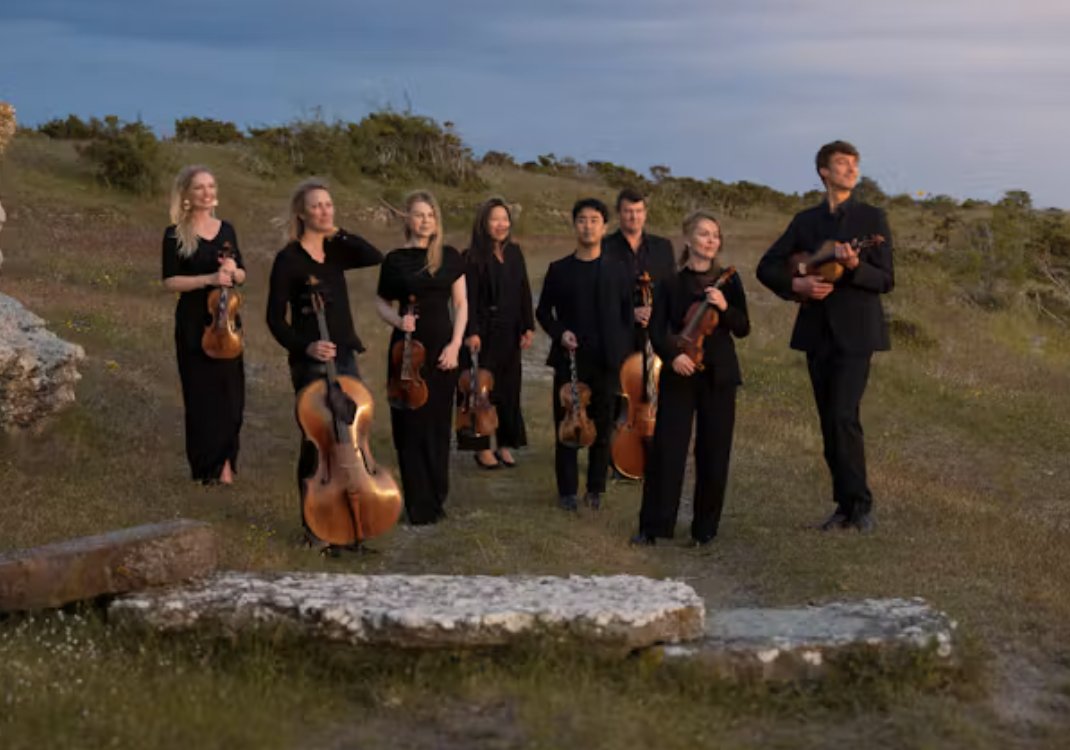
Camerata Nordica Octet in Review

Camerata Nordica Octet in Review

Camerata Nordica: Shuichi Okada, Hanna Helgegren, Katarzyna Szydłowska, Daina Mateikaitè, violin; Kimi Makino, Sebastian Steinhilber, viola; Zéphyrin Rey-Bellet, Sabina Sandri-Olsson, cello

Weill Hall, Carnegie Hall, New York, NY

September 30, 2026

Camerata Nordica is a group of eight extremely accomplished string players described, in their printed biography, as an ensemble that has “garnered a reputation for its distinctive style, captivating audiences by performing standing up and occasionally by heart.” They hail from Sweden, from across different orchestra and chamber groups. I had not heard them (or of them) until now, but it was a pleasant occasion to spend an evening in their company, the other night at Weill Hall. Under the artistic direction of cellist Zéphyrin Rey-Bellet (who is also one of the performers), the group is composed of violinists Shuichi Okada, Hanna Helgegren, Daina Mateikaitè and Katarzyna Szydłowska; violists Kimi Makino and Sebastian Steinhilber (both terrific on Wednesday night); and cellists Sabina Sandri-Olsson and Mr. Rey-Bellet.

The evening started with two traditional songs (Song to My Father and Polska in A minor), in part arranged by the ensemble, played in perfect harmony with one another, and with the character of the music. Next on the program was a piece commissioned by Camerata Nordica and written by one of its players, violinist Hanna Helgegren. She introduced her work titled The Nordic Seasons, but unfortunately I could only hear a few words of her presentation. She needed a microphone, but in her defense, the audience was still restless, and some of the late arrivals were still trying to find their seats. The composer related that she was inspired by Nordic folk music, and tried to explore the shades of each season in the northern lands, the mystique of the transition between day and night, light and dark, and her own fascination with nature. The music was accompanied by a video clip which lasted for the entire duration of the piece (all four movements, each dedicated to a season), and was projected on the stage, behind the standing performers. Many of the images had a distinct “National Geographic” feel, such as vistas of water (both frigid looking and sun kissed), polarized flowers, fields ready to be harvested, and puffy clouds. The music had a very tonal and conventional structure, reminiscent of Grieg or early Sibelius. Each movement was more “illustrative” than heart-grabbing. The melodies were gentle, tickling the ears most pleasantly, and the rhythms always with a folkish beat. In other words, we were a world apart from, let’s say, the much more dramatic albeit stark feel of Ingmar Bergman’s Fārö Island, which to my mind would be a more intriguing starting point in exploring the Nordic soundscape; there was no mystery here, just a gentle caress of the senses. The harmonies hugged each other in perfect agreement, without any sense of real drama or conflict. The players delivered each phrase with clarity, beautiful tone and swift phrasing. The splendid acoustics of Weill Hall also contributed to engulf the audience in a comfortable bubble of “feel-good.” This was safe and comfortable music- charming, evocative, but – to my ears – unmemorable.

The first half of the recital was concluded by Shostakovich’s Two Pieces for String Octet, Op. 11 – a work of much more substance, where these highly talented musicians got a better chance to showcase their virtuosity and emotional versatility, always delighting us with lush tones and perfect togetherness. Listening to them, one realized how valuable the experience of playing in an orchestra can be for solo musicians, but also what a truly remarkable soloist is able to achieve when paired with a small group of their peers. The eight outstanding players made out of each instrument a soloist who could only truly shine in the company of the others.

Mendelssohn’s Octet in E-flat major constituted the second half of the program. Written when he was only 16 years old, the Octet has long been considered one of the masterpieces of the genre-  a monumental work which leans more towards virtuosity and youthfulness, but does also feature an occasional pang of drama and transcendence. Camerata Nordica played throughout with luminous energy, taking very few interpretation risks and therefore not necessarily bringing anything revelatory to the table; however, the phrases unfolded beautifully and spoke with eloquence. The lines were long and well-constructed; each climactic point reached with authority and conviction. The emotions, though, with the possible exception of fervor, remained at the surface level. The Andante moved perhaps a tad too swiftly, somewhat missing the darker undertones. The hauntingly beautiful counterpoint in triplets felt overplayed and sounded earthy. The Scherzo, on the other hand, was as spirited and playful as a midsummer’s night dream. Here the musicians were unafraid to whisper in softer shades, suggesting a much needed otherworldliness. The fire-eating Presto travelled on wings from start to finish, without neglecting moments of suave delicacy and mischievous humor. 

All in all, a beautiful evening of smart programming and effortless charm, crowned with an energetic encore, a Swedish Polka! 

Share

Michele Garzo: From Romantic Tragedy to Elation: Love Stories as told by Chopin & Liszt in Review

Michele Garzo: From Romantic Tragedy to Elation: Love Stories as told by Chopin & Liszt in Review

Michele Garzo, piano
St. John’s in the Village, New York, NY

September 26, 2026

This evening’s performance featured Italian pianist Michele Garzo at a familiar downtown venue in Manhattan, St. John’s in the Village. After reading the biography of the performer in the event advertisement, I was intrigued to hear this “former prodigy” who performs with “fearless technique with deep poetic insight.” 

Tonight’s program certainly offered ample opportunity to highlight these qualities in some of the piano repertoire’s most beloved and demanding works: the four Ballades by Frédéric Chopin (1810-1849), Sonata in B Minor & Hungarian Rhapsody No. 6 by Franz Liszt (1811-1886). The concert titled “From Romantic Tragedy to Elation: Love Stories as told by Chopin or Liszt” also provided a unique context. In recent years, it has become increasingly fashionable to give recitals thematic titles such as this, creating a narrative connection among the works and, ideally, send the listener on a kind of journey. It is also not a bad marketing strategy. I was particularly interested to see how the performer would connect these four monumental Ballades, the Sonata and the Rhapsody through the idea of “love stories.”

The recital began with Chopin’s Ballade No. 1 in G minor, Op. 23. The elusive Lento opening is always a challenge for pianists- how does one interpret such a mysterious and intangible beginning? Mr. Garzo’s interpretive choice verged on ignoring the Lento marking altogether. The work began with a hurried broken-chord figuration, not really setting the tone for what followed. The main theme felt similarly rushed and distorted, while the rapid transitional passages that so dramatically propel the music into subsequent themes lacked definition and clarity.

Unfortunately, there was little in the performance that conveyed any adherence to Chopin’s markings or to the poetic ethos of the work. Much, if not all, of the performance remained at a consistently loud dynamic, with little sense of nuance, intimacy, or poetry. This was particularly puzzling, as Mr. Garzo is clearly capable of learning and memorizing technically demanding repertoire. Yet there seemed to be insufficient attention paid to the actual sound emerging from the instrument and to the expressive possibilities contained within the score. The famously bombastic and heroic coda should bring the Ballade to an overwhelming culmination. Tonight, it became a muddled and hurried version of its former self, sacrificing grandeur and dramatic impact for sheer velocity.

The Ballade No. 2 in F major, Op. 38 fared no better. The atmospheric opening was overpedaled and rushed, with little dynamic nuance. As a result, the explosive contrasting section arrived with surprisingly little impact. Once again, this performance felt undifferentiated, with few of the contrasts that give the work its extraordinary dramatic trajectory. I was particularly surprised by the speed at which the Ballade was played. Rather than allowing its drama to unfold naturally, Mr. Garzo seemed intent on moving through the music as quickly as possible, diminishing much of the tension and atmosphere that make the work so impactful.

By this point, I found myself wondering just how quickly the Ballade No. 3 in A-flat major, Op. 47 would pass by. Once again, Mr. Garzo communicated few of the qualities one so readily associates with Chopin- lyricism, elegance, subtlety, and a sense of poetic freedom. Mr. Garzo, however, appeared to be thoroughly enjoying himself!

Chopin’s Ballade No. 4 in F minor, Op. 52 is one of the piano repertoire’s most cherished works, one that pianists revere and collectively regard as a remarkable achievement of compositional craftsmanship. Mr. Garzo did approach the opening theme with some sensitivity, although the persistent lack of alignment between the bass and upper voices raised the question of whether this was an intentional stylistic choice. Beyond these opening moments, however, the performance struggled to convey the work’s extraordinary architecture. Much of the passagework was jumbled, obscuring the remarkable compositional process. The progressive variation that gives the Ballade its sense of inevitable growth and intensifying drama was largely lost. Unfortunately, the concluding coda was unsuccessful, both musically and technically.

The second half of the recital began with Franz Liszt’s monumental Sonata in B minor. This behemoth of a work is a formidable undertaking for even the most skilled and adventurous pianists, and Mr. Garzo was certainly willing to take on the challenge. Although the opening successfully conveyed a sense of misterioso, the notes not being together were far too distracting.

Many of the issues heard in the first half of the recital persisted here: the prevailing dynamic seemed to range from loud, to louder, to loudest. Without sufficient attention to sound production, voicing, and dynamic contrast, even the most dramatic music can eventually lose its hold on the listener. Liszt’s music is often characterized as bombastic and overtly virtuosic, but the Sonata is also an extraordinarily sophisticated and tightly constructed work. Interpretive freedom can be compelling, but when liberties and extremes of tempo begin to obscure the underlying architecture, the coherence of the work itself is compromised. The final fugue started off promisingly, but Mr. Garzo let it get so out of control, it wasn’t intelligible by the end.

The final work on the program was Liszt’s Hungarian Rhapsody No. 6. This performance did have some effective moments, particularly in the octave passages, which Mr. Garzo played with lightness and, at times, considerable brilliance. As the piece progressed, unexpected accents began to appear throughout the texture, without any relationship to the phrasing or musical direction of the work. By the end, the performance succumbed to many of the same issues that had characterized the rest of the recital. As the tempo and technical demands intensified, the playing became increasingly tangled and indistinct.

The encore was the Adagio from J.S. Bach’s Concerto after Marcello. Although there were fleeting hints of beauty in the opening, the performance gradually evolved into an aggressive caricature of this deeply expressive aria. What might have offered a moment of repose after such an intensely virtuosic program instead suffered from the same lack of restraint and attention to detail that had characterized much of the evening.

By the end of the evening, I had nearly forgotten the recital’s title, “From Romantic Tragedy to Elation: Love Stories as Told by Chopin or Liszt.” While the program certainly took us on a journey, I’m not sure we ever quite arrived at the promised elation.

Share

The Elsewhere Ensemble presents Invocation: A Prayer for Peace in Review

The Elsewhere Ensemble presents Invocation: A Prayer for Peace in Review

Elsewhere Ensemble: Colin Pip Dixon, violin; Arnaud Ghillebaert, viola; Kathryn Brunhaver, cello

Camille Ortiz, soprano; Kenneth Overton, baritone

All Angels Church, New York, NY

September 11, 2026

On September 11th, the Elsewhere Ensemble (Colin Pip Dixon, violin, Arnaud Ghillebaert, viola, Kathryn Brunhaver, cello) presented a program entitled Invocation. Billed as“a concert on the themes of peace, violence, and faith, for soprano, baritone, and string trio composed by Colin Pip Dixon,” it was also stated to “honor the 25th anniversary of 9/11/2001.”  Soprano Camille Ortiz and baritone Kenneth Overton were the featured vocalists. This is my second time reviewing this ensemble. Interested readers can read about the previous concert by following this link: The Elsewhere Ensemble presents Icarus Quartet in Review .

Invocation is a 90-minute song cycle in three parts- Longing (texts by Báyò Akómoláfé, Rabbi Nachman of Breslov, Ukraine, and Albert Einstein), No More (texts by Etty Hillesum, Frederick Douglass, and St. Francis of Assisi), and Only Light (texts by Rabia Terri Harris, Captain Paul Watson, Rolf Jacobsen, Chandodogya Upanishad, Shantideva, Rumi, and Dr. Martin Luther King Jr.).  Each section also includes an instrumental interlude. The printed texts were provided for the listener.

Colin Pip Dixon is obviously passionate about peace, social and environmental justice themes, and the texts he set reflect those ideals. To be sure, this type of work is not for everyone, but the audience was clearly in agreement with these ideals and rewarded the Elsewhere Ensemble and the singers with an eager reception.

Some general observations about Invocation. There is an abundance of recitativo, which is good for projecting an urgency and immediacy of impact, but it also was in danger of becoming monotonous and giving one the feeling of “being lectured.” I’m sure this was a deliberate stylistic choice, but I am of the opinion that a less “straight ahead” approach would have not lessened the impact of the texts. The string accompaniment was most effective when it was expressing anger, with strident, angular declarations. The more “serene” sections seemed at times to be reminiscent of movie soundtrack music- nothing wrong with that per se, but it felt more calculated than organic.

Soprano Camille Ortiz reinforced the favorite impression made on this listener from the prior review. She projects with clarity and not a hint of harshness or struggle in the upper register. Her highlight was Instrument of Peace (text by St. Francis of Assisi), in which her vocal control, especially in the nearly silent finish, was breathtaking. This was true artistry! Baritone Kenneth Overton was outstanding. He has a strong voice and his diction was so clear that there was no real need to reference the printed text. He projected an unmistakable regal quality that added weight to the texts. His highlight was Love Hate (text by Martin Luther King Jr.), which also was this listener’s favorite selection of the evening.

Let’s not forget the Elsewhere Ensemble. Colin Pip Dixon, Arnaud Ghillebaert, and Kathryn Brunhaver are all exceptional musicians. Their ensemble is excellent, and each player also showed refinement in solo passages. They never overshadowed the singers, but they also never were dominated or pushed to the background, a balance that is not always easy to strike. I would like to hear this ensemble play some of the more standard repertoire, as I do recall finding their Dvořák encore from the prior concert to have been a highlight.

After the last notes, the audience gave the performers a very enthusiastic ovation. If you are one who is passionate about social issues and music alike, you will find much to like about the Elsewhere Ensemble.

Share

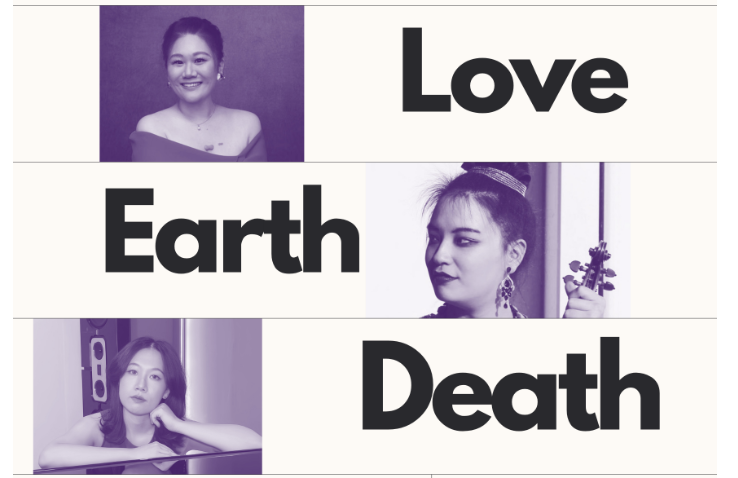
Love, Earth, Death: A Dialogue Between Black and Chinese Voices in Review

Love, Earth, Death: A Dialogue Between Black and Chinese Voices in Review

Love, Earth, Death: A Dialogue Between Black and Chinese Voices in Review

Almost Quintet Trio

Peiyao Yu, piano; Zhengyingue (Elaine) Huang, soprano; Xenia Deviatkina-Loh, violin/viola

Saint John’s in the Village (St. John’s Church), New York, NY

August 14, 2026

On August 14th, the Almost Quintet Trio presented a program entitled “Love, Earth, Death: A Dialogue Between Black and Chinese Voices,” at St. John’s Church in New York City.  It was to be an interesting program that showcased the talents of three accomplished musicians, Peiyao Yu (piano), Zhengyingue (Elaine) Huang (soprano), and  Xenia Deviatkina-Loh (violin/viola).

As Peiyao Yu explains, the trio’s name stems from the fact that the pianist also plays organ and the violinist also plays the viola – thus it is “almost a quintet.”  Their mission (according to their website) is “dedicated to championing underrepresented composers, with the ultimate goal of a future where no composer need be labeled ‘underrepresented’ at all.” This is an ambitious goal, but one might take issue the suggestion that Bright Sheng is an “underrepresented” composer. It would be a good idea to clearly define what is meant by underrepresented.

This listener had a general feeling that this performance was a trial run in preparation for a larger one. There were no printed programs (rather, a helper asking people in the audience if they needed a program and sending digital copies to those who asked for one), and even the digital copy was missing any biographical information or program notes. It seemed to fly in the face of the stated mission – would it not be helpful to introduce these composers and give some information about their works? There were some brief comments made, but were rendered so quietly that a lot of what was being said was lost.

The program itself alternated between Chinese composers and African-American composers. It was not immediately apparent what form the “dialogue” took, supposedly the listeners were to decide for themselves. The opening and closing selections, On One Side of River (Qingjia Lin b. 1934) and Until Now (Kui Dong b. 1966) could best be described as popular songs, with sentimental touches and soaring melodies. They were rendered with great passion and devotion by soprano Zhengyingue (Elaine) Huang, with able support from Peiyao Yu and Xenia Deviatkina-Loh. These songs brought some of the more enthusiastic responses from the audience, so one might assume the songs were familiar to them.  Two selections, Blue Flower, and At the Hillside Where Horses Are Running from Three Chinese Love Songs by Bright Sheng (b. 1955) joined the traditional Chinese Opera style from the vocalist with modern “Western” writing for the pianist, including some extended techniques (playing inside the piano, etc.).  Of the “Chinese voices,” this was the most compelling to this listener, and the favorite of the Chinese works. Ms. Huang showed her versatility and strong voice throughout the evening, projecting clearly while remaining sensitive to the acoustics of the small venue. She maintained a carefully controlled vibrato that was just right. Ms. Yu was an excellent collaborator, highlighting the dramatic effect without ever overwhelming the vocalist.  There was an opportunity for violinist Xenia Deviatkina-Loh to have her starring moment in selections from the highly popular (primarily in China) Butterfly Lovers’ Concerto by Chen Gang (1935-2026) and He Zhanhao (b. 1933). She is a stylish and assured player, dashing off passagework with ease while avoiding the trap of over-sentimentalizing the melodic material (which would be so easy to do in this work). I’m sure that Ms. Deviatkina-Loh will continue to display those qualities in a planned future performance of the entire work.

The two works that formed the “Black” portion of the program fit the mission statement of the trio more closely than that of the Chinese portion. As a side note, it would have been good to have the texts/translations for all works. The first, BORN FREE (NYC premiere) by Dr. Edward W. Hardy (b. 1992), a song cycle (Sorrow Home, Lineage, The Struggle Staggers Us, and Southern Song) for soprano, violin, and piano, is the work of a promising and talented composer.  There are languorous blues, “fire-in-the belly” storms, plaintive despair, and a stately dignity of voice and purpose that all figure prominently in these songs.  I’m certain that if Dr. Hardy were present, he would have been thrilled with the outstanding performance from the Almost Quintet Trio. Sorrow Home was the favorite of this listener, and the one that showed the individual talents of the musicians to the maximum advantage. 

The second work was Sonnets on Love, Rosebuds, and Death (1975) for soprano, violin, and piano by Dorothy Rudd Moore (1940-2022). Four selections of the set of eight were offered, I Had No Thought of Violets of Late (Alice Dunbar Nelson), Song for a Dark Girl (Langston Hughes),  Idolatry (Arna Bontemps), and Invocation (Helene Johnson). While Dorothy Rudd Moore is not completely unknown, she is far from a household name, and she does not seem to be drawing the same amount of attention as others (Florence Price, for instance) in the present day. This is unfortunate, as this work proves her outstanding compositional skills. She had an understanding of the voice (having been a vocalist herself) that shows through with her idiomatic writing. This set was the highlight of the concert, and I do not wish to select a favorite of the four, as they all were impactful. Kudos to the trio for programming this remarkable work, and bravo for the first-rate performance. One hopes that the trio’s performance of it might generate more interest and performances of Moore’s works.  

I wish the Almost Quintet Trio success in their mission, and do hope they will heed the suggestions offered.

Jeffrey Williams

Share

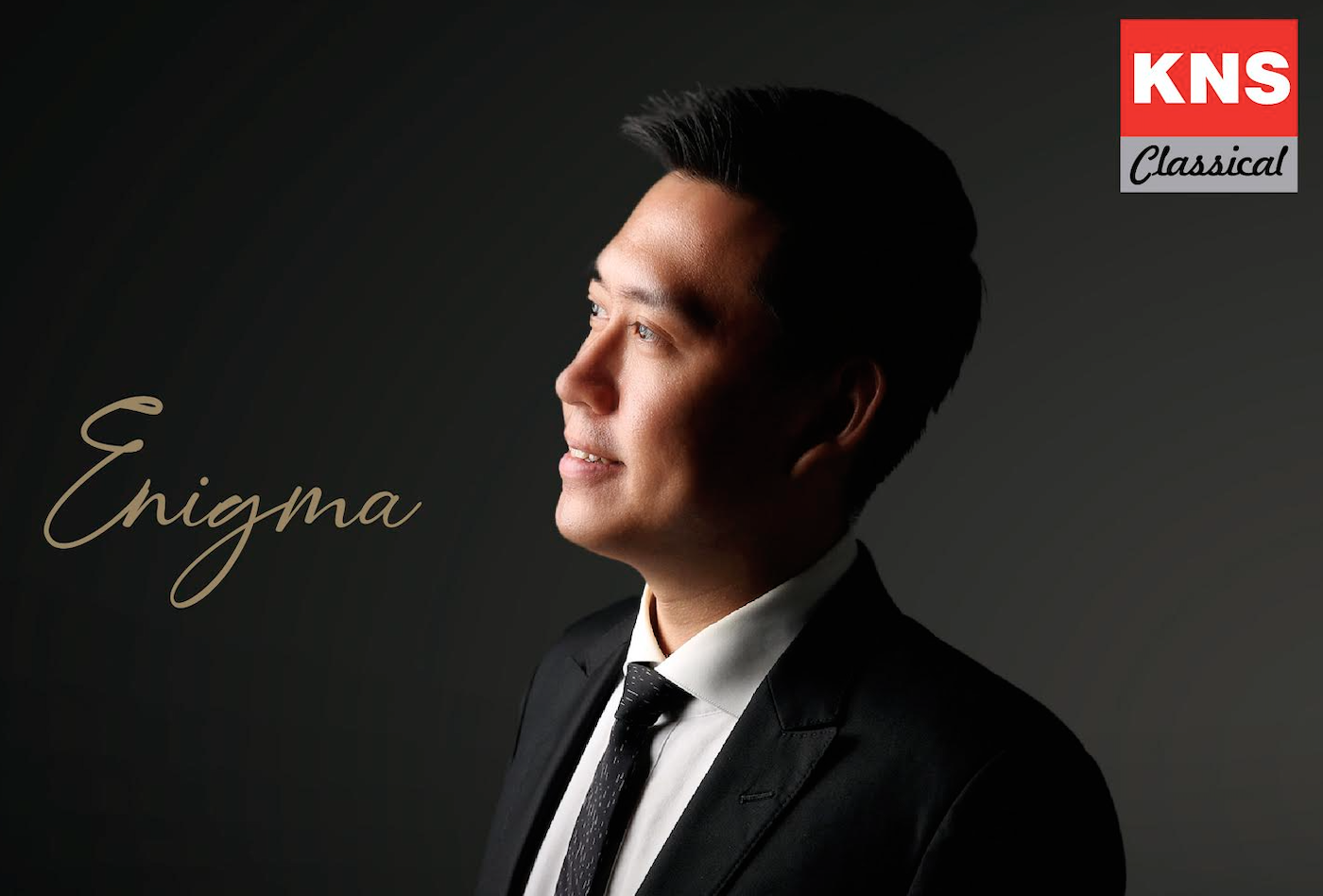
CD Recording in Review: Enigma

CD Recording in Review: Enigma

Wenting Yu, piano

KNS Classical KNS A/202

Acclaimed pianist Wenting Yu’s new recording Enigma on the KNS Classical label (KNS A/202) is a thoughtfully curated tribute to the French piano tradition, centered on the legacy of Robert Casadesus (1899–1972). The album brings together works by Rameau, Debussy, Ravel, and Casadesus, tracing stylistic connections across French composers. Rather than presenting a simple anthology of French works, Enigma explores the musical lineage surrounding Casadesus and the enduring influence of the French piano school. 

Wenting Yu is from Shenyang, China. Mr. Yu earned a Doctor of Musical Arts degree from Rutgers University’s Mason Gross School of the Arts, where he studied with Vladimir Valjarevic and served as a Graduate Teaching Assistant. He previously earned his master’s degree from Mannes School of Music under Pavlina Dokovska, and was the recipient of the 2019 Steinway & Sons Award. His career has been marked by numerous international competition prizes, including distinctions at the Fontainebleau Festival, where he received both the Ravel Prize and the Robert Casadesus Grand Award. His artistic interests have increasingly focused on French repertoire and the performance legacy of the Casadesus family, a fascination that ultimately led to the recording of Enigma. 

The recording begins with three works by Jean-Philippe Rameau (1683–1764). Here Mr. Yu sets the scene for the French sound world that is present throughout the album with these expressive works. Les Tendres Plaintes from the Suite in D from Pièces de Clavecin is intimate and unfolds naturally. The ornaments are elegant while imbuing the music with pathos. Les Cyclopes, the most virtuosic of the three works, stands out for its perpetual-motion figurations. Mr. Yu handles the repeated notes with grace while maintaining a supple pulse. An even more driving rhythm, however, could have enhanced the work’s dramatic qualities. Next comes the Allemande from the Suite in A from Pièces de Clavecin. Though beautifully played, this performance lacks a consistent flow and employs frequent Romantic rubato, which obscures the clarity of the work’s structure.

Next is a selection of preludes by Claude Debussy (1862–1918), works that demonstrate the composer’s extraordinary ability to evoke atmosphere, color, and imagery through the piano. Mr. Yu proves to be a sensitive guide through these landscapes, creating a wide palette of colors from the instrument while maintaining a strong sense of line and direction. Drawn from Books I and II, Mr. Yu presents Voiles, Ce qu’a vu le vent d’Ouest, La Puerta del Vino, and Feux d’artifice. These four preludes showcase different facets of Debussy’s writing and approach to the instrument, which is welcome, though the selection does not feel entirely congruous within the context of this recording.

The performances, however, are strong. Voiles has a vivid sense of mystery, and Mr. Yu delineates its layers sensitively. In Ce qu’a vu le vent d’Ouest, he successfully communicates the drama of the work by capturing the varied nuances of its registers, from the murky to the brilliant. La Puerta del Vino, a sensual habanera, is poetic and imaginative. The treacherous Feux d’artifice is handled with command, though it could have been more convincing in its many passages of contrasting “sound effects.” In a way, the performance is rendered almost too perfectly and might have benefited from a more imaginative and risk-taking approach.

The focus now shifts to Robert Casadesus (1899–1972), the central figure around whom this recording is built. One of the most distinguished French pianists of the twentieth century, Casadesus was celebrated for his clarity, elegance, and intellectual approach to both performance and composition. Although his reputation today rests primarily on his career as a pianist, he was also a prolific composer whose music reflects the refinement and craftsmanship associated with the French tradition. His presence on this recording serves as an important link between the earlier French masters represented on the program and the musical legacy that followed.

The first work by Casadesus on the recording is Variations d’après l’hommage à Debussy de Manuel de Falla, Op. 47. Based on de Falla’s original guitar work, this homage to Debussy fits naturally within the concept of the album. A gem of a composition, it fuses Spanish elements with an impressionistic color palette. Mr. Yu clearly understands the work’s multiple layers of reference and influence. His attention to detail in sound, articulation, and color is remarkable.

Each variation is distinct and contrasting, filled with passion and a natural spontaneity. Particularly enchanting is the third movement, Presto, in which Mr. Yu vividly evokes the virtuosity and brilliance of the guitar. The fourth movement, Andantino “alla barcarola,” is equally successful, communicating a hypnotic lyrical quality. The last movement, Allegro ben moderato, is an excellent culmination to the work, full of bravura and expressive energy. Mr. Yu plays this wonderful work with abandon and conviction. Bravo!

The album continues with a selection of eight preludes from Casadesus’s 24 Préludes, Op. 5, a collection that reveals another side of the composer’s musical personality. Written early in his career and published in 1925, these concise pieces display a remarkable variety of mood, texture, and pianistic writing and established him as a composer, not just a pianist. Dedicated to Maurice Ravel, Casadesus continues the tradition of writing 24 preludes established by composers who preceded him.

Though this selection of eight preludes offers a glimpse into Casadesus’s compositional style, the format ultimately feels somewhat fragmented. A more substantial selection, or better yet, the complete cycle, would have provided a stronger sense of the work’s overall architecture and made a more compelling case for Casadesus as a composer.

That said, the performances themselves are consistently engaging, combining power and charm in equal measure. Particularly striking is Prélude No. 10, whose rhythmic vitality and incisive articulation create an immediate sense of character. Prélude No. 21, meanwhile, evokes the elegance and color of Ravel’s piano writing. In the end, the selection leaves the listener wanting more, eager to discover the relationships between the individual preludes and to experience the broader narrative formed by their progression through the twenty-four keys.

The preludes are followed by a work by Maurice Ravel (1875–1937), represented here by three movements from Le Tombeau de Couperin. While the rationale behind presenting just these movements is clear, I am less convinced that these excerpts function successfully as a recording project. Stylistically, however, the performances are admirable throughout.

I would have welcomed a greater emphasis on the work’s more luxurious sonorities. Although Ravel draws inspiration from Baroque forms and gestures, he filters them through a distinctly early twentieth-century harmonic and pianistic language. More of that richness and color could have been brought to the foreground. The Toccata, in particular, is delivered at an effective pace, and its notoriously demanding repeated-note passages are executed with remarkable control and precision.

The final group of works returns to Robert Casadesus. By far this reviewer’s favorite selections on the recording are the two Études from Op. 28. Mr. Yu delivers astonishingly clean performances, full of vitality, wit, and charm. Once again, I found myself wishing for a more substantial sampling of this remarkable music, as these two brief works leave the listener eager to hear more. Their playful spirit and unmistakable personality reveal a particularly engaging side of Casadesus’s voice as a composer.

The album concludes with the Toccata, Op. 40, a work that inevitably invites comparison with Ravel’s Toccata. There is no question that this piece presents formidable technical challenges, and Mr. Yu meets them with impressive ease and confidence. Nevertheless, I found it to be the least interesting work on the recording. The toccata material often feels derivative and lacks the freshness and individuality found elsewhere in Casadesus’s output. His distinctive voice emerges far more vividly in the shorter works, like the préludes and études.

Even so, this recording serves as an important contribution to preserving and promoting Casadesus’s music. Mr. Yu’s advocacy sheds valuable light on a composer whose works deserve greater recognition and continued exploration. He should be applauded for this valuable contribution to the discography and for his commitment to bringing this neglected repertoire to a wider audience. One hopes that more recordings of Casadesus’s music will follow in the years to come.

Share