Certification matters more in restoration than in most trades. Insurance carriers, TPAs, commercial buyers, and many state regulators look for IICRC credentials as the baseline trust signal. A restoration company with no certifications can do residential cash work; a company with a credentialed team can win commercial accounts, qualify for preferred vendor programs, and defend scope against challenge.
This is the complete guide to IICRC certifications and restoration training in 2026: which certifications actually matter for which roles, the realistic path for a new technician, what each course costs and covers, and how to build an in-house training program that turns new hires into productive technicians in 90 days instead of nine months.
How to get IICRC certified: the exact steps
IICRC certification is the industry’s credential for individual technicians and firms — earned by completing an approved course and passing a standardized exam. There are no formal prerequisites for entry-level courses: you register, take the course, and sit the exam.
- Pick your certification. WRT (Water Damage Restoration Technician) first if you touch water losses — it’s the baseline everything else stacks on.
- Take an IICRC-approved course. Most run three days. Two exceptions: ASD (Applied Structural Drying) and AMRT (Applied Microbial Remediation Technician) must be taken in person — the IICRC hasn’t approved them for online delivery because of the hands-on elements. Everything else is available in person or live-stream.
- Register for the exam and pass it. The exam is multiple-choice and closed book; question count and time limit vary by course. The passing score is 75%. The IICRC exam fee is $80 ($150 for AMRT and inspection exams), paid before you sit. If you take a live-stream course, you complete the exam online through the IICRC exam portal within 45 days of the class ending; in-person students take it on the last day of class. Fail it and you get two more attempts (each costs another exam fee) — fail three times total and you have to retake the course before testing again.
- Get your credentials. After you pass, the IICRC takes 4–6 weeks to process and issue the certification, then mails your certificate, wallet card, and patch (allow another 7–10 business days for delivery).
- Stay current. Certification stays valid as long as you maintain it: an annual renewal fee to the IICRC plus 14 Continuing Education Credits (CECs) every four years for technicians. (Inspectors and master-designation holders need 14 CECs every two years.) Renewal fees run roughly $46–$70/year depending on how many certifications you hold — AMRT is $72/year, a master designation adds $12/year, and certified firms pay $199/year. The IICRC sets these fees and adjusts them, so confirm current numbers at iicrc.org before you budget.
What the IICRC actually is
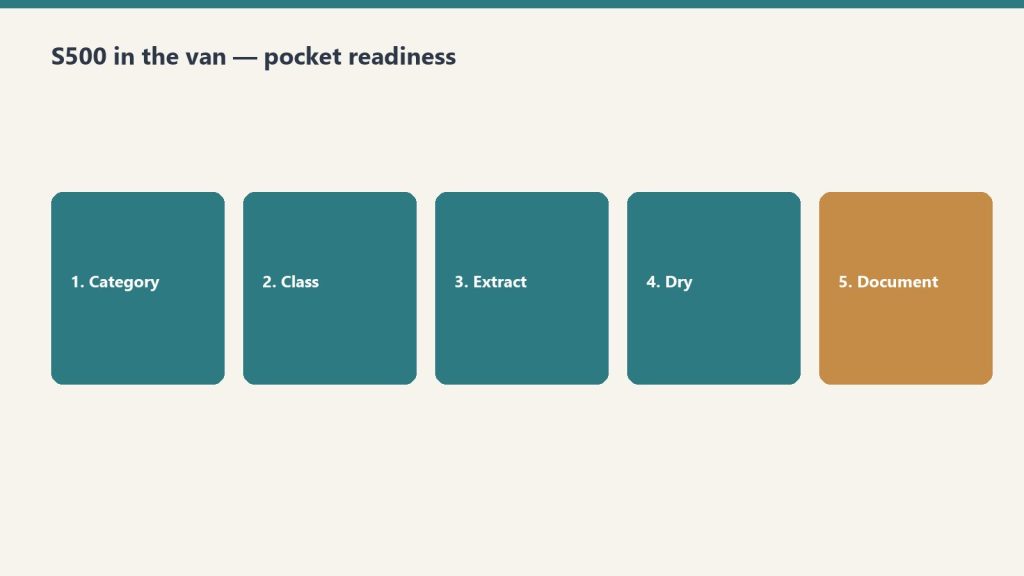
The Institute of Inspection, Cleaning and Restoration Certification (IICRC) is the standards-setting and certification body for the cleaning, inspection, and restoration industry. Founded in 1972, it publishes the technical standards that govern the industry — most notably S500 (water damage), S520 (mold), S540 (trauma and crime scene), S700 (fire and smoke), and S800 (HVAC) — and certifies individuals and firms in specific competencies.
IICRC certifies individual technicians through course completion and exam, and certifies firms through documentation of insurance, technician credentials, and adherence to standards. Firm certification is what most insurance carriers and commercial buyers actually look for on vendor applications.
The IICRC certifications that matter for restoration
The certifications that should be on every restoration company’s checklist:
WRT (Water Damage Restoration Technician) — the foundational water mitigation certification. Three-day course covering water categories, drying science, equipment use, and the S500 standard. This is the absolute minimum for any technician handling water losses. Most companies require WRT within 60-90 days of hire.
ASD (Applied Structural Drying) — the advanced drying certification. Builds on WRT with deeper coverage of psychrometry, drying chamber configuration, equipment sizing, and complex drying scenarios. Standard for lead technicians and project managers.
AMRT (Applied Microbial Remediation Technician) — the mold remediation certification. Covers S520 standard, containment design, PPE, work practices, and post-remediation verification. Required for any contractor performing mold remediation work; often required by state regulators in mold-licensed states.
FSRT (Fire and Smoke Restoration Technician) — fire and smoke damage certification. Covers smoke types, deodorization, contents cleaning, and structural restoration after fire losses. Important for any contractor handling fire work.
OCT (Odor Control Technician) — focused certification on odor identification and removal techniques. Useful for technicians and project managers handling fire, sewage, biohazard, and HVAC remediation.
HST (Health and Safety Technician) — covers OSHA compliance, PPE selection, hazard assessment, and crew safety practices. Recommended for project managers and crew leaders.
UFT (Upholstery and Fabric Cleaning Technician) and CCT (Carpet Cleaning Technician) — for contents cleaning and carpet cleaning operations. Standard for contents departments.
CCMT (Commercial Carpet Maintenance Technician) — relevant for commercial restoration operations with maintenance contract work.
TCST (Trauma and Crime Scene Cleanup Technician) — for biohazard and trauma cleanup divisions. Required by some state regulators.
WRT-Master, ASD-Master, AMRT-Master designations — the highest individual certifications, requiring multiple credentials, hours of field experience, and additional examination.
The path from new hire to credentialed technician
A realistic 12-month path for a new restoration technician: Days 1-30 — shadow experienced technicians, complete OSHA 10 and basic safety orientation, learn equipment handling. Days 31-90 — complete IICRC WRT certification (three-day course plus exam), begin running mitigation jobs as second tech under supervision. Days 91-180 — complete ASD or FSRT depending on focus area, begin running smaller jobs as lead. Days 181-365 — complete AMRT (if mold work), additional specialty certifications based on role, eligibility for lead technician promotion.
Companies that compress this timeline (six-month path to fully certified lead tech) usually do it by combining IICRC courses with rigorous in-house training, structured ride-alongs, and weekly skill assessments.
In-house training programs: building beyond IICRC
IICRC certification is the baseline. The companies that consistently outperform have in-house training programs that fill the gaps. The components of a real in-house program:
Onboarding curriculum — week one orientation covering company processes, equipment handling, safety, and customer interaction expectations. Weekly skills training — 30-60 minute sessions on specific topics: drying chamber setup, content pack-out procedures, moisture mapping, customer communication scripts. Quarterly cross-training — rotating technicians across service lines so the team has bench depth. Annual recertification — refresher training on IICRC standards updates, new equipment, and procedural changes. Mentor pairing — every new technician paired with an experienced lead for the first 90 days.
Training cost: what to budget
Realistic 2026 cost per new restoration technician: WRT certification $700-$1,000 (course + exam + travel), ASD $700-$1,000, AMRT $800-$1,200, FSRT $700-$1,000, plus 40-80 hours of paid in-house training time. Total first-year investment per technician: $3,000-$8,000 depending on path. Companies often recoup this within a few months through improved productivity and reduced supervision burden.
Training providers worth knowing
Restoration training providers fall into three categories. IICRC-approved training schools deliver the certification courses themselves — Restoration Sciences Academy, IICRC-approved regional providers, and online options through providers like KEY Restoration. Industry consultants and coaches deliver advanced training in estimating, sales, operations, and leadership — Violand Management, GrowthWerks, Performance Restoration, and several others. Manufacturer training from equipment vendors like Phoenix Restoration Equipment, Drieaz, and chemical suppliers covers product-specific operations.
Related on Tygart Media: Starlink on a water job · S500 in the van · local SEO for restoration.
Frequently Asked Questions
What is IICRC certification?
IICRC (Institute of Inspection, Cleaning and Restoration Certification) is the industry standards-setting and certification body. It publishes the technical standards (S500 for water, S520 for mold, S700 for fire) and certifies both individual technicians and restoration firms in specific competencies. Insurance carriers, TPAs, and commercial buyers commonly require IICRC credentials.
How much does IICRC certification cost?
Individual IICRC certification courses typically run $700-$1,200 each, including course materials, the exam, and exam administration. Travel and lodging (when courses are in-person) add to the total. Online and hybrid options are increasingly available at lower cost. Annual maintenance fees apply to keep credentials active.
What IICRC certifications do restoration technicians need?
The baseline for any water mitigation technician is WRT (Water Damage Restoration Technician). Lead technicians typically add ASD (Applied Structural Drying). Companies handling mold work require AMRT (Applied Microbial Remediation Technician). Fire restoration adds FSRT (Fire and Smoke Restoration Technician). Specialty roles add OCT, HST, TCST, and others as needed.
How long does IICRC certification take?
Most individual IICRC courses are three days of in-class instruction followed by a written exam. Some courses are available in compressed two-day or hybrid formats. From start to certified takes one to four weeks depending on exam scheduling. The full certification path (multiple credentials) for a senior technician usually spans 6-18 months.
What is the difference between IICRC certification for individuals and firms?
Individual IICRC certification is earned by a single technician completing a course and exam. Firm certification is earned by a company that documents insurance coverage, employs a minimum number of certified technicians, agrees to abide by the IICRC code of ethics, and participates in customer complaint resolution. Firm certification is what most carriers and commercial buyers look for on vendor applications.
Where can I take IICRC courses?
IICRC courses are delivered by approved training schools across the US and internationally. Major providers include Restoration Sciences Academy and various regional IICRC-approved schools. Many manufacturers and equipment vendors also offer IICRC-approved training. The IICRC website maintains an updated list of approved providers.
What is the passing score for the IICRC exam?
75%. IICRC exams are multiple-choice and closed book. If you don’t pass, you can retake the exam up to two more times (each attempt costs another exam fee) — after three failed attempts you must retake the course before testing again.
How do I keep my IICRC certification active?
Pay the annual IICRC renewal fee and earn 14 Continuing Education Credits (CECs) every four years (technicians) or every two years (inspectors and master-designation holders). CECs come from IICRC-approved courses, industry events, or earning an additional certification. If your certification lapsed less than 24 months ago, contact IICRC renewals to reinstate it; beyond 24 months goes through a separate reinstatement process.
How can I verify someone’s IICRC certification?
Ask for their certification number and check it against the IICRC’s public “Locate a Certified Professional” directory. For firms, ask for proof of current Certified Firm status — that’s the credential carriers and commercial buyers actually check on vendor applications.

Leave a Reply