


The best AI automation app for most Freshdesk teams in 2026 is eesel AI: it installs from the Freshdesk Marketplace, learns from your past tickets, and costs one fixed monthly price from $299 for 500 tickets or chats, with no per-seat fee. If you'd rather stay native, Freddy AI is the default, and it costs $0.49 a session once the 500 free sessions are used.
Your three real choices are the same as they were: stay on Freshdesk's Freddy AI, add an AI agent that sits on top of Freshdesk, or build AI workflows yourself in a tool like Make or Zapier. What changed this year is who owns the enterprise options. Forethought is now part of Zendesk, Ada is combining with Dialpad, and Aisera now belongs to Automation Anywhere. Get quotes from them if you run enterprise volume, and ask each one what the deal means for Freshdesk customers.
For narrower fits: Aisera covers IT, HR and customer service under one platform, Kore.ai suits regulated industries like banking and healthcare, Make handles branching AI workflows on a visual canvas, and Zapier is for wiring an AI step into Freshdesk yourself. If an AI coding agent helps run your support stack, the eesel CLI lets it upload approved help articles and macros or ask eesel test questions before you go live; connecting Freshdesk still needs an admin's approval.
How I picked the 8 apps
I work on eesel's support team, so I judge these tools by one question: does the ticket actually get resolved, or does it just look good in a demo? For this update I read each vendor's pricing page, docs, marketplace listing and integration list again in November 2026. Here's the bar every app had to clear:
- A real Freshdesk connection, not a "Zapier-only" one. Each app has a Freshdesk app, an integration listed on the vendor's own site, or lives inside Freshdesk natively.
- Autonomous ticket handling, not just suggested replies. The app has to be able to resolve a ticket end-to-end on at least one channel (chat, email or in-app). Agent-assist copilots on their own didn't make the cut.
- A public price, or an honest "quote only". Where a vendor doesn't publish a price, I say so instead of guessing.
- Coverage across team sizes. The list has to work for a 5-agent ecommerce shop on Freshdesk Pro and for a 500-agent team on Freshdesk Omni Enterprise.
- No vendor double-counting. Tools folded into another product (Ultimate.ai, which Zendesk acquired in January 2024) don't get a separate slot.
The 8 best AI automation apps for Freshdesk in 2026 at a glance
A quick scan before the details. "Security" lists what each vendor's own trust or security page shows.
| # | App | Best for | Starting price | Setup | Self-serve trial | Security |
|---|---|---|---|---|---|---|
| 1 | eesel AI | Freshdesk teams that want autonomy without switching | From $299/mo (500 credits), no seat fee | Under 30 minutes | Yes (7 days, 100 credits) | GDPR, SOC 2 Type II audit in progress, HIPAA BAA on Enterprise |
| 2 | Freddy AI | Teams already paying for Freshdesk Pro or Enterprise | $0.49 per session after 500 free | Built in | Yes (500 free sessions) | SOC 2 Type 2, ISO 27001 |
| 3 | Forethought | Mid-market and enterprise wanting agentic actions | Quote only | Proof of Value | No (POV instead) | SOC 2 Type II, HIPAA, GDPR, CCPA |
| 4 | Ada | Enterprise CX teams with large conversation volumes | Quote only (demo-led) | Sales-led | No | SOC 2, GDPR, HIPAA, PCI DSS, AIUC-1 |
| 5 | Aisera | Cross-functional IT, HR and customer service | Quote only | Sales-led | No | Ask Automation Anywhere |
| 6 | Kore.ai | Large regulated enterprises | Quote only | Weeks, with engineers | No | SOC 2 Type 2, ISO 27001, PCI DSS, GDPR |
| 7 | Make | Branching AI workflows on a visual canvas | $12/mo (Core, US, annual) | Hours | Yes (free plan) | SOC 2 Type II, SOC 3, ISO 27001, GDPR |
| 8 | Zapier | DIY no-code AI workflows | $19.99/mo (Professional) | Hours | Yes (14 days) | SOC 2 Type II, SOC 3, GDPR, CCPA |
A worked example at 1,000 tickets a month shows where the pricing lands:
| App | Monthly cost at 1,000 tickets |
|---|---|
| eesel AI | $499 (1,000 credits, 1 per ticket, no seat fee) |
| Freddy AI Agent (Freshdesk) | $490 (1,000 × $0.49) |
| Freddy AI Agent (Freshdesk Omni) | $490 (1,000 × $0.49) |
| Make Core (10,000 credits) | From $12 (US, annual; 1 credit per module action, more for AI provider runs) |
| Zapier Professional | From $19.99, but each ticket uses several tasks and each AI step uses 1 to 3 |
| Forethought / Ada / Aisera / Kore.ai | Quote only |
The two Freddy rows assume one session per ticket. A chat that runs past 24 hours, or an email thread that runs past 72 hours, becomes a second session.
What "AI automation" means for Freshdesk in 2026
When a Freshdesk admin says "AI automation," they usually mean one of three things, and the right tool depends on which one:
- Autonomous AI agents: software that reads a customer's question, decides what to do, takes an action (a refund, an account update, a knowledge base lookup) and replies. In this post: eesel AI, Freddy AI Agent, Forethought, Ada, Aisera, Kore.ai and Make AI Agents.
- Agent-assist copilots: AI that drafts replies, summarises threads and translates inside the inbox while a person stays in the loop. Freddy AI Copilot and Forethought's Assist fit here; Freshdesk Copilot has its own guide.
- Workflow automation with AI inside: a Zapier, Make or webhook pipeline with an AI step somewhere in the chain to tag, classify or summarise. Zapier is the classic example.
There's a newer fourth path. Freshdesk MCP works in both directions: compatible AI tools can read Freshdesk tickets, conversations and customer data, and Freshdesk workflows can call approved actions in other systems. Freshworks sells it as an add-on on every plan at $15 per 1,000 MCP actions, and the MCP actions pack guide goes deeper.
Most of the apps below do at least two of the three jobs. Where a tool is mostly one thing, I flag it.
1. eesel AI: best for Freshdesk teams that want autonomy without switching helpdesks
eesel AI is an AI teammate platform whose helpdesk teammate works inside Freshdesk, and it connects to 3,000+ other tools as well. You point it at your past Freshdesk tickets, solution articles and canned responses, write your rules in plain English, and it starts drafting or sending replies on the ticket types you allow.
The reason eesel lands on Freshdesk shortlists isn't the model behind it, since every serious vendor here has a capable one. It's the pricing model and the speed to first value. There are no per-agent fees and no per-session charges, and the Freshdesk integration is no-code and takes under 30 minutes to connect.
On Freshdesk specifically, eesel's published customer stories cover both ends. SamCart sends first replies on Freshdesk tickets from about 280 help center articles, and the agent steps back the moment a teammate is assigned. Innr, a Dutch smart lighting brand, filters the noise out first and then drafts every Freshdesk ticket in the customer's language, from about 1,500 help center articles and past tickets.
Features that matter for Freshdesk admins:
- Installs from the Freshdesk Marketplace, where the listing is rated 4.3 out of 5 from 6 reviews, so there's no engineer needed for the wiring.
- Imports solution articles, past tickets and canned responses on connect, with no manual training or data labelling.
- Scoped ticket handling: it drafts a reply as a private note for an agent to approve, sends and closes on its own only for the ticket types you trust it with, and leaves everything outside its rules alone.
- Tags tickets, sets type and priority, assigns to the group or agent you name, and closes spam with a note saying why.
- Works across Slack, email, Shopify, Freshchat and your knowledge base, so one teammate handles internal questions and customer tickets.
- Simulation on past tickets before go-live, and plain-language instructions you can update in chat ("always escalate refund requests over $200" becomes a rule it follows).
Pros:
- Free 7-day trial with 100 credits, no card required, so you can see real drafts on your own tickets before paying.
- No per-seat pricing: adding agents to your support team doesn't raise your AI bill.
- Replies in 80+ languages without extra setup.
- When the help center doesn't cover a question, it says so and hands over instead of guessing, which is how Innr runs it.
Cons:
- Newer brand than the enterprise vendors on this list. If procurement wants a Gartner Magic Quadrant placement, you'll have to make the case internally.
- Credits reset each month and don't roll over.
- When credits run out, the agents pause until the reset unless you turn on overage ($0.80 per extra credit, up to a cap you set).
Pricing: One fixed monthly price from $299 for 500 credits, with no per-seat or platform fee. One credit covers one ticket or chat, however long. Larger sizes run $499 a month (1,000 credits), $999 (2,500), $1,149 (3,000) and $1,749 (5,000). Paying yearly gets you two months free. SSO and MFA start at $199 a month, and the Enterprise add-on ($1,000 a month on top of any size) adds HIPAA with a signed BAA, EU hosting and a dedicated contact. Full pricing here.
My take: This is the pick for Freshdesk teams from about 5 to 200 agents who want autonomous AI without renegotiating their helpdesk contract or sitting through an enterprise sales cycle. Public fixed pricing plus a free trial on your own tickets is rare in this category. I work at eesel, so weigh that; the deciding factor is whether a fixed monthly bill matters more to you than staying inside one vendor. For a side-by-side, see eesel vs Freddy.
2. Freddy AI: best if you're already paying for Freshdesk Pro or Enterprise
Freddy AI is Freshworks' native AI suite, with three products under one brand: Freddy AI Agent (the autonomous bot), Freddy AI Copilot (the agent-assist sidecar) and Freddy AI Insights (the analytics layer). It's the default starting point for Freshdesk customers, and for most teams the "do we add a third party or not?" question goes through Freddy first.
The advantage of going native is real: zero integration work, the AI lives in the workspace your agents already use, and Freshworks gives 500 free sessions on Growth, Pro and Enterprise to get you started. The trade-off is that you're tied to Freshworks' AI roadmap, and per-session billing adds up at volume.
Features:
- Freddy AI Agent: chat, messaging and email agents with 50+ agentic workflows, vertical AI agents that connect to Shopify, Stripe, PayPal, FedEx and Wix, and a no-code AI Agent Studio for building your own. Discover analyses historical tickets to find automation opportunities and knowledge gaps.
- Email AI Agent: answers email tickets with back-and-forth replies, with roll-out controls and spam detection. The Freshdesk email AI agent guide walks through it.
- Freddy AI Copilot: reply drafts, conversation summaries, live translation in 60+ languages, similar-ticket context and sentiment tags inside the inbox.
- Freddy AI Insights: proactive alerts, root cause analysis and plain-language questions like "Show me first response time trends for 6 months" (Freddy AI Insights has the detail).
- On its Freddy AI page, Freshworks says its AI agents resolve up to 80% of queries on chat, messaging apps and email.
Pros:
- Zero integration work: turn it on inside Freshdesk.
- 500 free Freddy AI Agent sessions on Growth, Pro and Enterprise to test before you pay.
- Native Freshdesk Omni coverage, so chat, email and messaging share one AI.
- Strong security baseline: SOC 2 Type 2 and ISO 27001.
Cons:
- Per-session pricing has no ceiling: a product launch or outage spikes the AI bill. At $0.49 a session, 5,000 tickets a month is $2,450 in AI charges before Copilot.
- Session packs expire with your billing cycle. Pay quarterly, buy 10,000 sessions, use 6,000, and the other 4,000 are gone at renewal.
- Copilot is limited to Pro and Enterprise and adds $29 per agent per month on top of seat fees.
- The Shopify app for Freshdesk is rated 3.0 out of 5 from 62 reviews.
Pricing: Growth, Pro and Enterprise include 500 free Freddy AI Agent sessions, once per account. After that it's $49 per 100 sessions ($0.49 each) on both Freshdesk and Freshdesk Omni. Freddy AI Copilot is $29 per agent per month on Pro and Enterprise. Freddy AI Insights is included on Enterprise. Full breakdown in the Freddy AI pricing guide and the session consumption explainer.
My take: Freddy is the right starting point if you already pay for Pro or Enterprise and want to test AI without a vendor evaluation. Choose Freshdesk Omni if you want one AI across chat, email and messaging, but not to save on AI: the session rate is the same $49 per 100, so Omni's higher seat prices ($29/$79/$119 versus $19/$55/$89, compared here) never pay back through cheaper sessions. If you're heading past 5,000 sessions a month with Copilot on top, price it against a credit-based tool like eesel before renewing. The Freshdesk AI review goes deeper on what Freddy does well and where it falls short.
3. Forethought: best for mid-market and enterprise wanting agentic actions
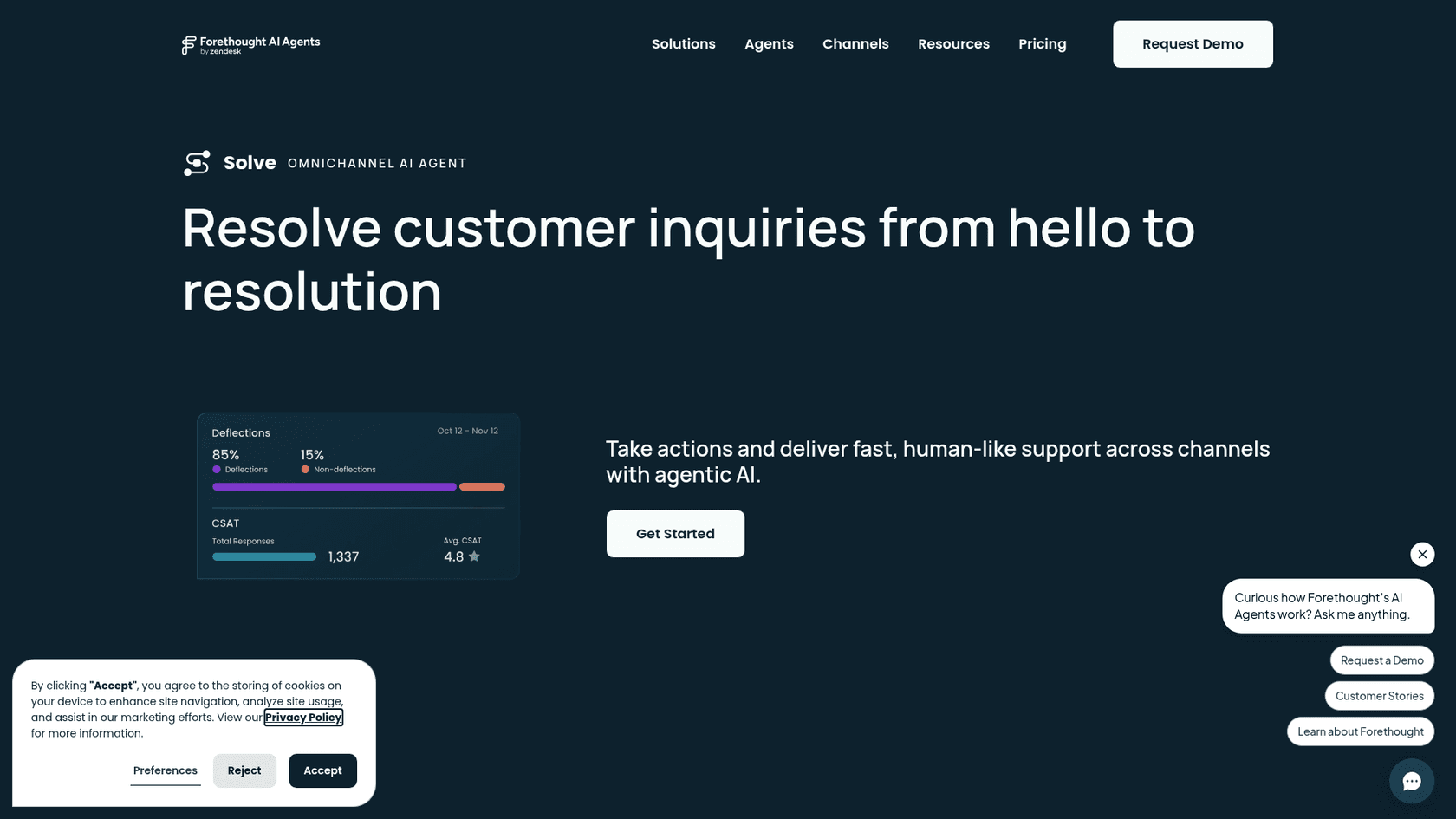
Forethought is an enterprise AI platform that sits on top of your existing helpdesk and brands itself a "multi-agent system." The product line is five named agents: Discover (knowledge gaps), Solve (the customer-facing AI), Triage (classification), Assist (agent copilot) and Agent QA (automated scoring on 100% of tickets instead of manual sampling). Zendesk completed its acquisition of Forethought on March 26, 2026, according to Zendesk's announcement, and Zendesk's pricing page now lists "Zendesk + Forethought" for teams on Zendesk or another provider, with no migration required.
For Freshdesk teams, the pitch is "keep Freshdesk and add agentic AI on top." Forethought's integrations page lists Freshworks and Freshchat among its 70+ helpdesks and connectors. The open question is the roadmap: a Freshdesk team buying Forethought today is buying from a Zendesk company, so ask how long non-Zendesk helpdesks stay first-class.
Features:
- Solve: an AI agent across chat, email, voice, SMS, Slack, mobile and API. Uses Autoflows (multi-step workflows) and Custom Actions to call Freshdesk and other APIs.
- Browser Agent: logs in, clicks and types in legacy tools and internal portals that have no API. Rare in this category, and useful if your team works in a homegrown system behind a web UI.
- Discover: analyses past tickets and knowledge to surface gaps and suggest new articles and Autoflows.
- Forethought Voice: the voice-channel agent.
- Headline claims from Forethought's 2025 AI in CX Benchmark: 15x average ROI, 55% lower first response time, and up to 98% resolution rate.
Pros:
- Built to plug into an existing CX stack, so it works on Freshdesk without a migration.
- Strong agentic action story, and the Browser Agent stands out.
- Mature customer list: Upwork (50% reduction in time to resolution), Carta, Grammarly, UPS, Lattice and Justworks.
- Compliance on its platform page: SOC 2 Type II, HIPAA, GDPR and CCPA.
Cons:
- Quote-only pricing and no self-serve trial. Forethought runs a Proof of Value on your data instead, which suits enterprise buyers more than a mid-market team that wants to test in a sprint.
- Now owned by Zendesk, the main competitor to the helpdesk you're running.
- Autoflows, Custom Actions and the Browser Agent all need configuring before they pay off.
Pricing: Three tiers, Team, Professional and Enterprise, plus add-ons for Multibrand, Analytics API and Discover. Every tier is "Get a Quote." Email, voice and Slack agents start at Professional. From Forethought's pricing FAQ: "Our pricing model is a blend of platform access fees and an outcome-based pricing cost. Optional add-ons can be added to customize the platform." More in the Forethought pricing breakdown.
My take: Forethought is what you reach for when you've outgrown Freddy and need deep agentic actions. If your team has to operate a legacy tool with no API, the Browser Agent makes it the right pick. For ticket replies on Freshdesk, you can get there faster and with a public price using eesel AI. The deciding questions are whether you need Custom Actions depth, and whether you're comfortable buying it from Zendesk. The Forethought alternatives post covers the other routes.
4. Ada: best for enterprise CX teams with large conversation volumes
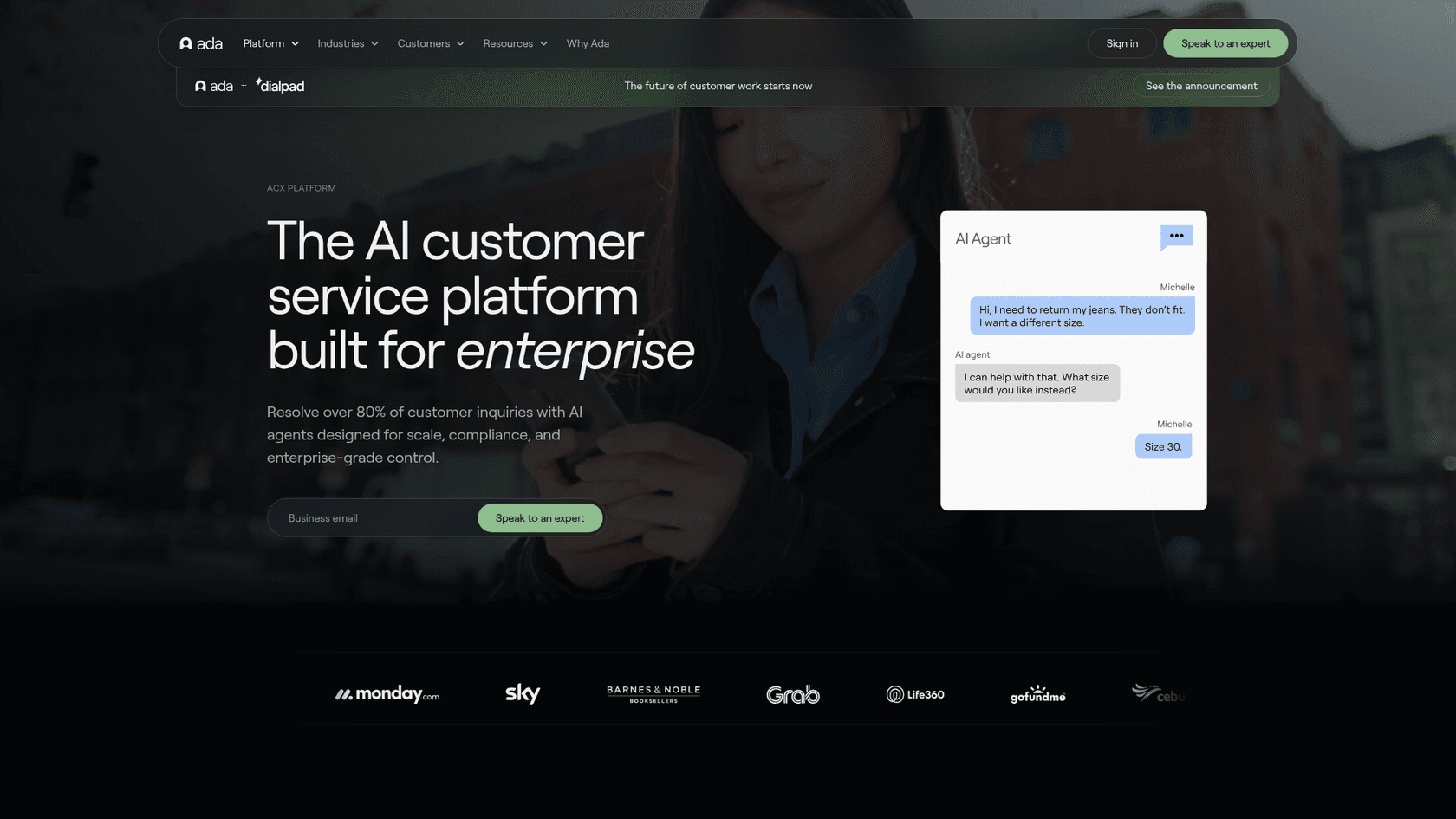
Ada is an enterprise AI customer service platform that calls its category "Agentic Customer Experience (ACX)," and it says it serves 350+ global businesses. The big news: on November 4, 2026, Ada and Dialpad announced they're combining, with the deal expected to close on or about November 12. Current Ada customers keep their contracts, pricing and integrations as configured, Dialpad's CEO Craig Walker leads the combined company, and Ada's CEO Mike Murchison becomes Chief AI Officer.
For Freshdesk, Ada is the furthest enterprise pick on this list. Its integrations page lists Freshworks for knowledge base ingestion and handoff to human agents over chat, email and phone. Its pricing page is a demo request form that asks for your annual ticket volume, with bands from under 50,000 up to 10 million and more.
Features:
- Reasoning Engine: the shared intelligence across voice, messaging and email, orchestrating multiple LLMs.
- Conversation Hub: deploys the AI agent across languages and channels.
- Playbooks: multi-step procedures the AI agent reasons through, covered in the Ada playbooks guide.
- Coaching: feedback on past conversations is applied to future ones automatically.
- APIs, MCP and SDKs for extending Ada into your own systems.
- Headline outcomes: Monday.com 42% lower average handle time; IPSY $2.7M estimated annual savings and 943% ROI in four months; Cebu Pacific 34%+ higher automated resolution with generative AI.
Pros:
- Strongest AI-specific compliance on the list: SOC 2 Type II, HIPAA, GDPR, PCI DSS and AIUC-1, with zero data retention across LLM providers, per its voice page.
- Voice is a frontline product, and the Dialpad deal adds Dialpad's own voice network.
- Enterprise customers including Monday.com, Sky, Grab, Barnes & Noble, Life360 and IPSY.
- Coaching as a first-class workflow: the AI learns from human review, not from rule-writing.
Cons:
- Sales-led, enterprise-focused purchase. At 50 tickets a day on Freshdesk, the demo-and-business-case process is more than you need.
- No public pricing. The pricing page is a qualification form.
- Sold as the ACX Platform plus ACX Practice and ACX Experts, a service-led bundle rather than a self-serve subscription.
- No free trial or self-serve signup, and a merger in progress means the roadmap is still being written.
Pricing: Quote only. The form asks for annual ticket volume, so expect volume-based contracts. The Ada pricing post has more on how deals are structured.
My take: Ada is the right pick if you have enterprise-scale volume on Freshdesk, want voice handled seriously, and need strict AI compliance. For smaller teams, most other tools here fit better. If you want Ada's model (one AI on top of your helpdesk) with a public price, eesel AI is the closest match at a far lower entry point, and the Ada alternatives roundup lists the rest.
5. Aisera: best for cross-functional IT, HR and customer service
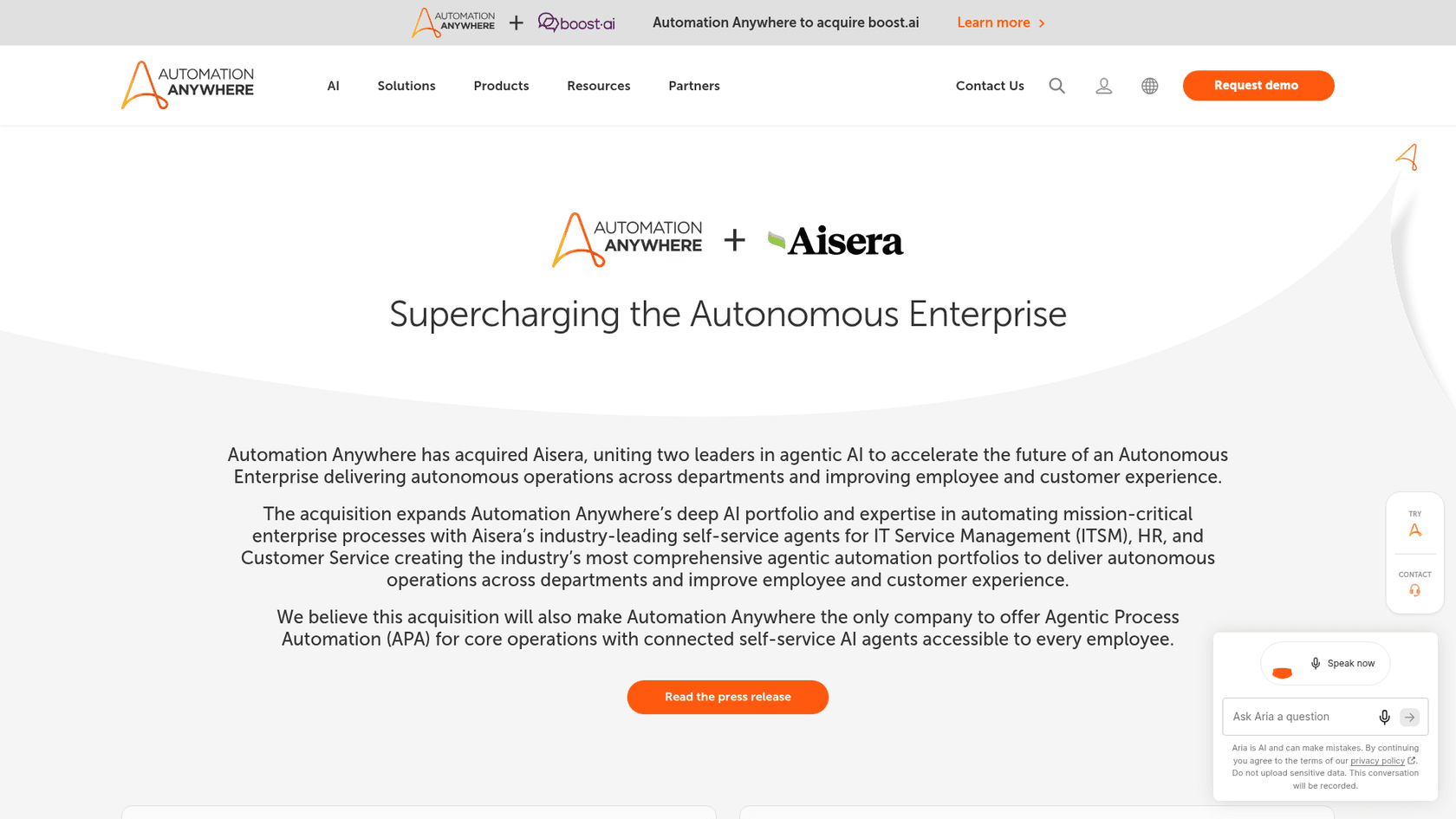
Aisera is an agentic AI platform for IT service management, employee support, HR and customer service. Unlike CX-only products, it was built to be cross-functional from day one: one platform serving several departments.
Automation Anywhere completed its acquisition of Aisera on November 4, 2025, and aisera.com now redirects to an Automation Anywhere page. Automation Anywhere says Aisera's products continue to be available and supported without interruption, and it's combining Aisera's AI agents with its own process automation. For Freshdesk teams already on Freshworks for both customer service and internal IT (Freshservice), Aisera is the cross-department layer to look at.
Features:
- AI service desk with an 80% auto-resolution rate claimed for IT Service Desk, and 84% for IT service management, on Automation Anywhere's Aisera page.
- Aisera Agent Assist: real-time decision support and next-best-action suggestions for human agents.
- Aisera Assistant for Enterprise: an assistant that works inside the apps employees already use.
- AIOps that Automation Anywhere says detects incidents up to 48 hours before they occur.
- Automation Anywhere's own Process Reasoning Engine and Mozart Orchestrator, which its acquisition press release says now sit alongside Aisera's conversational agents.
Pros:
- Real cross-functional coverage: one AI layer if your IT team runs Freshservice and your CX team runs Freshdesk.
- Backed by a large automation company that says it's increasing its agentic AI investment.
- Pairs conversational agents with process automation for work that spans many systems.
Cons:
- If you only need customer service AI on Freshdesk, you pay for breadth you won't use.
- Quote-only pricing, no self-serve.
- The product pages that described Aisera's own platform now redirect, so ask Automation Anywhere for current feature, security and Freshdesk integration details in writing.
- Enterprise-only, not a fit for small or mid-market teams.
Pricing: Quote only, through Automation Anywhere. The Aisera pricing post covers what was published before the acquisition.
My take: Aisera is the pick when your company runs Freshdesk plus Freshservice (or another IT or HR helpdesk) and wants one AI platform across both, with Automation Anywhere's process automation behind it. For pure customer service on Freshdesk, the breadth is overhead, and Forethought, Ada or eesel fit better depending on volume. More options in Aisera competitors.
6. Kore.ai: best for large regulated enterprises
Kore.ai is an enterprise AI agent platform, the Agent Platform {Artemis}, which it calls "the AI programmable platform architected for optimization across the agentic enterprise." Kore.ai was named a Leader in the Gartner Magic Quadrant for Conversational AI Platforms again in the 2026 Gartner report, and in The Forrester Wave: Cognitive Search Platforms, Q4 2025 (Forrester summary).
The customers on its homepage make the positioning clear: Morgan Stanley, Citi, Vanguard and Lilly. Banking, investment management and pharma, the regulated end of the market.
Features:
- AI for service: resolves customer cases end-to-end across channels and systems, with 100+ pre-built use cases and HIPAA compliance built in, per its customer experience page.
- AI for work: employee requests (IT, HR) that pair with Freshservice.
- AI for process: multi-day, multi-system processes with a full audit trail.
- Autoloop: an optimisation engine that keeps testing and improving agents against goals you set, before and after launch.
- Agent Blueprint Language (ABL) and ARCH, a built-in AI solution architect that turns plain-language intent into agents, workflows and handoffs.
Pros:
- Strongest analyst recognition on this list.
- Pre-built use cases mean less time tuning a generic agent for a regulated vertical.
- Compliance on its trust center: SOC 2 Type 2, ISO 27001, PCI DSS and GDPR.
Cons:
- No public pricing, no self-serve trial, enterprise sales cycle.
- Kore.ai says it reaches production "in weeks, not months," but that runs through a Proof Concierge and forward deployed engineers, which is a project, not a toggle.
- For small Freshdesk teams the platform is far more than they need. Ask Kore.ai how it connects to Freshdesk before you scope the project.
Pricing: Quote only. Demo via request-a-demo. More in the Kore.ai pricing post.
My take: Kore.ai earns its slot when you're a large bank, insurer, healthcare or pharma company that runs Freshdesk for support and needs an AI agent that compliance, legal and IT will sign off on. For small and mid-market Freshdesk teams, eesel AI covers the ticket work with a public price and a setup that takes under 30 minutes. The Kore.ai alternatives list has other options.
7. Make: best for branching AI workflows on Freshdesk
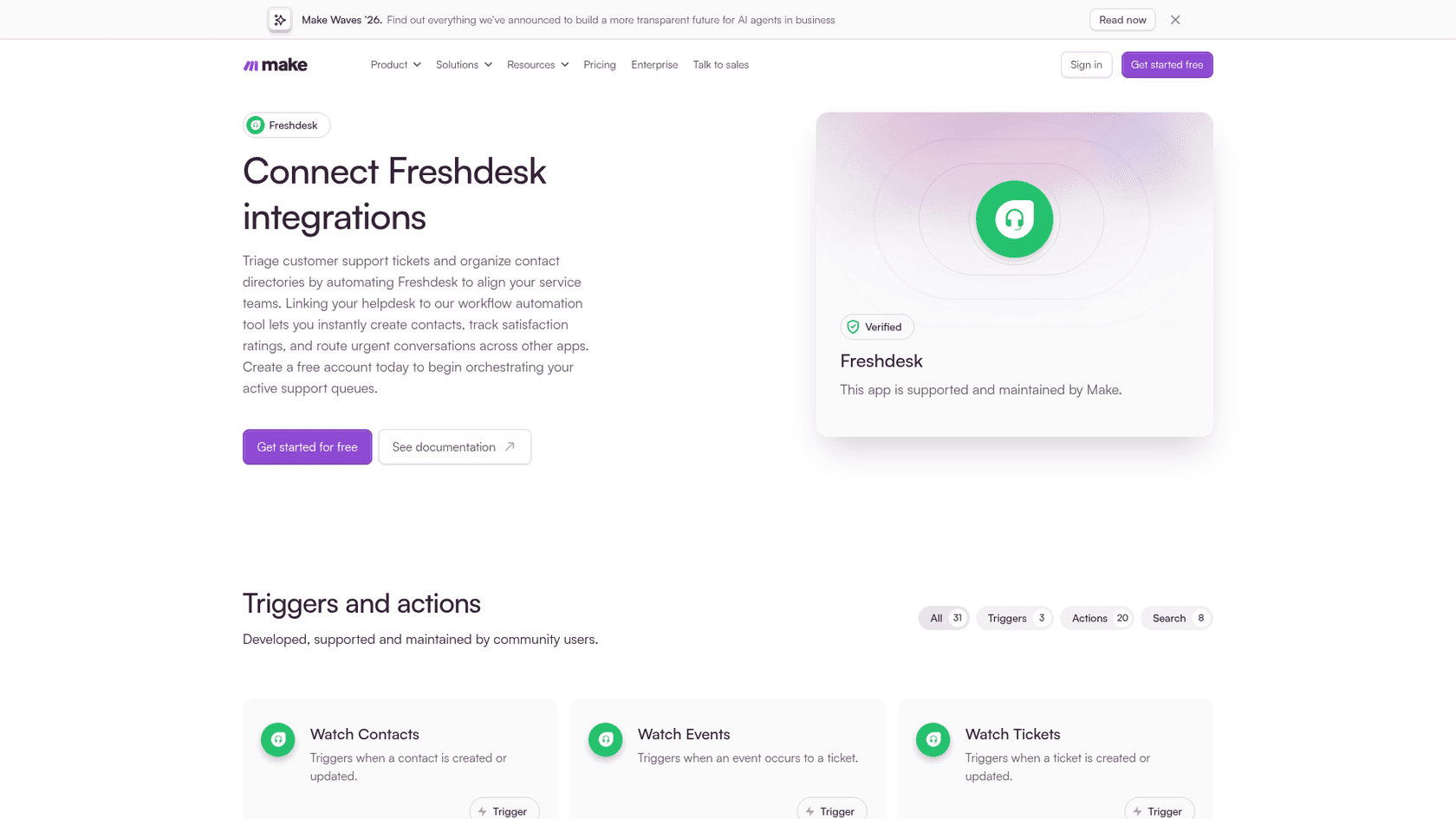
Make is a visual automation platform: you build "scenarios" on a canvas, with routers, filters and error handling for branching logic, across 3,500+ apps. Its Freshdesk app is marked "Verified" and maintained by Make, with 31 modules (3 triggers, 20 actions, 8 searches), so a scenario can watch new or updated tickets and write replies, notes or field updates back.
The newer piece is Make AI Agents, still in Beta: AI agents built on the same canvas that read a ticket, decide what to do, and call tools or other scenarios, with each decision shown in a Reasoning panel. You can add manual approvals or stop points, and AI Agents are available on every plan, Free included. Where Zapier (#8) is the simpler way to wire one Freshdesk ticket to an LLM, Make is the one to reach for when the logic branches.
Features:
- Freshdesk triggers and actions: Watch Tickets, Watch Contacts and Watch Events, plus Create a Reply, Create a Note and Update a Ticket to write results back.
- Make AI Agents: read a ticket, decide what to do, and call tools or scenarios, with every step visible.
- AI Toolkit: built-in AI steps using Make's AI Provider or your own LLM key.
- Visual canvas: routers, filters and error handling for branching ticket logic.
- Maia: describe an automation in plain words and Make builds it.
Pros:
- Routers and error handlers use no credits, and Core includes 10,000 credits for $12 a month billed annually.
- Deep Freshdesk coverage: 31 modules, verified and maintained by Make.
- AI Agents are available on every plan, including Free.
- A "Make an API Call" module covers anything the Freshdesk modules don't.
Cons:
- Steeper learning curve than Zapier: you build and maintain every scenario yourself.
- AI runs on Make's own AI Provider can use more than one credit, so the monthly bill is harder to predict.
- AI Agents are still in Beta.
- The Free plan is limited (2 active scenarios, 15 minutes minimum between runs), and prices differ by country.
Pricing: Free plan with 1,000 credits a month. For US buyers, Core is $12 a month billed annually ($16 monthly), Pro $21 ($28 monthly) and Teams $38 ($51 monthly), each with 10,000 credits a month. Enterprise is custom. Most module actions use 1 credit; some AI Provider features use more. Unused credits expire at the end of the term. Full pricing.
My take: Make is the right pick when your Freshdesk automation really branches, like routing a ticket three ways depending on what an AI step finds, and someone on your team is comfortable building on a canvas. Like Zapier, though, it's glue rather than a packaged support agent: for routine ticket replies, eesel AI or Freddy gets there with far less building. The Make pricing guide walks through how credits add up, and Make vs n8n covers the self-hosted route.
8. Zapier: best for DIY no-code AI workflows on Freshdesk
Zapier isn't a customer service AI in the way Ada or Forethought are. It's the no-code automation backbone that connects 9,000+ apps, Freshdesk among them, and now calls itself an AI orchestration platform with Zaps, Agents, Chatbots, Copilot and Zapier MCP. For Freshdesk admins, it's the tool you reach for when you'd rather wire an AI step into a workflow yourself than buy a packaged agent.
Typical Zapier-on-Freshdesk patterns: tag incoming tickets with an AI step, summarise threads into Slack, escalate VIP customers on AI-judged sentiment, sync ticket data to a Google Sheet for reporting. The trade-off is task economics. Zapier bills per task: each successful action step uses 1 task, and on its task rates page an AI step uses 1 task on a standard model and 3 on an advanced one. Built-in tools like Formatter, Paths and Filters use none.
Features:
- Zaps: no-code workflows across 9,000+ apps including Freshdesk.
- Agents: Zapier's autonomous AI agent product.
- Chatbots: embedded chat widgets that run Zap-style logic.
- Copilot: natural-language Zap builder.
- Zapier MCP: connects AI tools like Claude, ChatGPT and Cursor to your apps.
- Tables and Forms: a lightweight data layer and form builder for AI inputs.
Pros:
- Breadth: anything you want to connect to Freshdesk probably already has a Zapier integration.
- Cheap starting point: Professional from $19.99 a month, and a 14-day Professional trial with no card.
- Compliance: SOC 2 Type II, SOC 3, GDPR and CCPA.
- 4.5 out of 5 on G2 from 2,158 reviews and 4.7 on Capterra from 3,109.
Cons:
- Task costs surprise teams that scale fast. Past your plan limit, tasks bill at a higher pay-per-task rate, and Zaps pause at 3 times the plan's task limit.
- It's a workflow layer, not a packaged AI agent: you write the prompts, pick the models and tune the behaviour.
- Trustpilot rates it 1.5 out of 5 from 329 reviews, well below its G2 and Capterra scores.
- It doesn't replace an AI customer service agent. If you want autonomous ticket resolution, Zapier is the glue, not the brain.
Pricing: Free plan (100 tasks a month). Professional from $19.99 a month (750 tasks, with tiers up to 2 million). Team from $69 a month (25 users). Enterprise custom. Paying yearly saves 33%. Full pricing.
My take: Zapier is the right call when you have a specific, unusual Freshdesk automation that no packaged agent covers: a custom data flow, a one-off AI classification, a sync to a niche tool. For routine ticket replies, you'll spend more time tuning Zaps than you would running eesel or Freddy. Zapier complements every other tool here rather than competing with them: most mature Freshdesk stacks use Zapier plus a packaged AI agent. The Zapier AI post covers its AI features in more depth.
How do session, task and credit pricing compare?
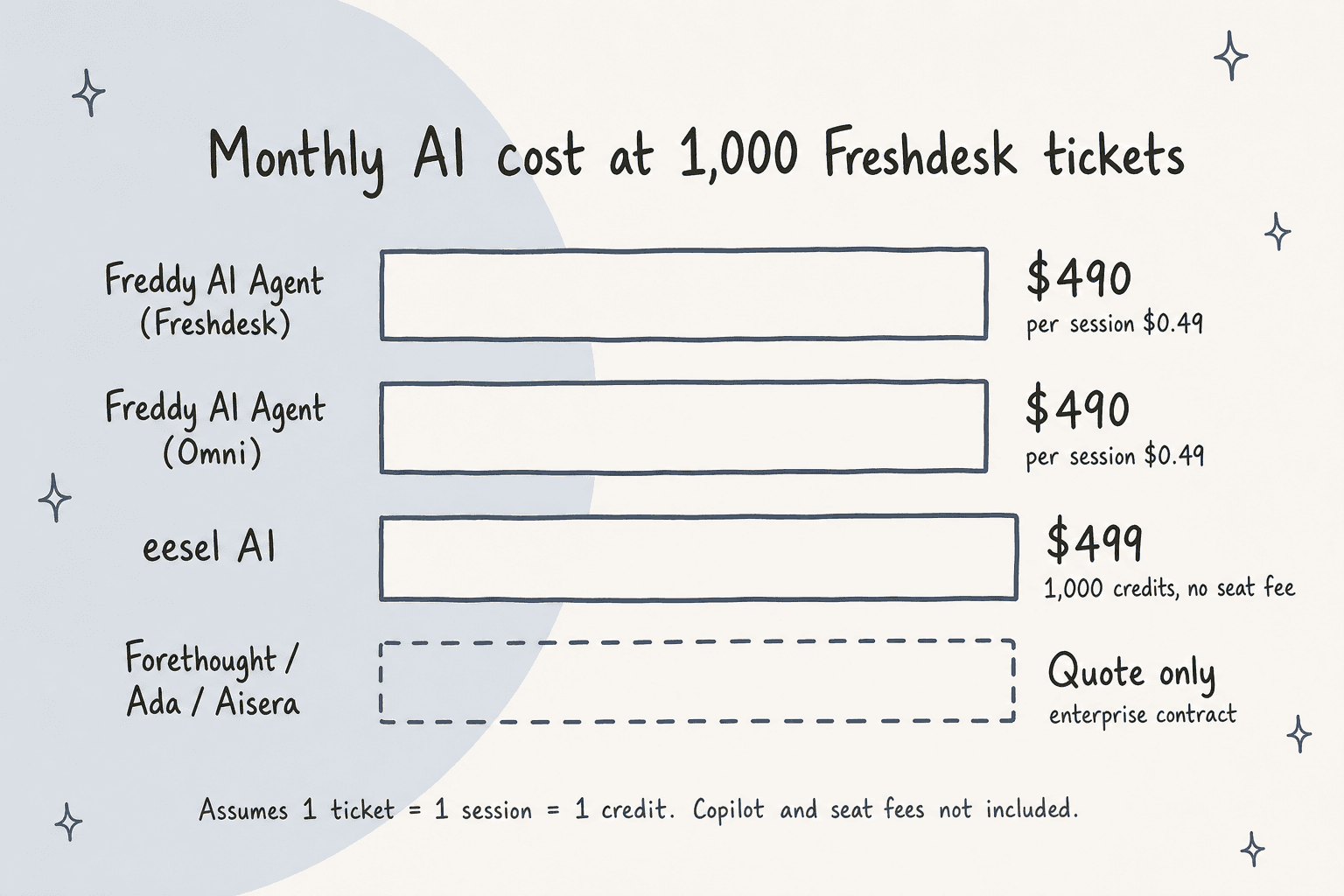
Pricing models are the most common reason teams pick the wrong AI tool for Freshdesk. A $0.49 session sounds cheap until one ticket turns into two sessions, or the $29 per agent Copilot fee grows with your headcount. Here's the picture at 1,000 tickets:
What to take from it:
- At 1,000 tickets, Freddy and eesel cost about the same. The gap opens with volume: $0.49 a session × 5,000 tickets = $2,450 a month before Copilot fees, against $1,749 for eesel's 5,000-credit size.
- Omni uses the same per-session rate. Its AI Agent sessions are also $49 per 100; only the seat price differs.
- Credit plans are predictable. eesel's monthly price is fixed regardless of how many agents you employ, so hiring doesn't raise the AI bill.
- Quote-only platforms (Forethought, Ada, Aisera, Kore.ai) are built for large enterprise teams and enterprise sales cycles.
The other piece most comparisons miss is what counts as a session, a task or a credit. Freddy counts all chat interactions within 24 hours of the session starting as one session, and an email session is a 72-hour window from the customer's first email; a customer who comes back after that window starts a new session. eesel counts 1 credit per ticket or chat however many replies go back and forth, and doesn't charge for tickets you tell it to leave alone. Zapier counts a task per successful action step, so one ticket with a tag write, a Slack alert and a log step uses several. The cost per ticket glossary entry shows how to compare them on your own numbers.
Read the unit definition before you anchor to a per-unit price. The numbers don't compare until you do.
Which Freshdesk AI app should your team pick?
If you're still not sure, the decision usually comes down to three questions, in this order:
-
How many tickets does Freshdesk handle a month?
- Under 500: Freddy AI's 500 free sessions cover a first test. If you only need one simple AI workflow, Make's free plan (1,000 credits a month) is another way to start.
- 500 to 10,000: eesel AI is the sweet spot. The bill is fixed, setup takes under 30 minutes, and there's no enterprise contract.
- 10,000+: Forethought or Ada become worth the sales process at that volume.
-
Do you need agentic actions outside Freshdesk?
- Yes (refunds, account updates, legacy systems): Forethought (Browser Agent), Ada (Playbooks and Reasoning Engine), or eesel AI (3,000+ integrations).
- No (just ticket replies and triage): Freddy AI, or a Make or Zapier workflow if it's mostly tagging and routing.
-
Is your AI use case cross-functional (IT, HR and CS) or customer service only?
- Cross-functional: Aisera or Kore.ai.
- Customer service only: any of the others.
What I'd do in your place: use Freddy's 500 free sessions or eesel's 7-day trial to learn which tickets AI can really handle, then run the one whose pricing still makes sense at your volume. For the step-by-step setup, the guide to adding AI to Freshdesk walks through it.
What I left off the list and why
A few tools you might expect to see and don't:
- Ultimate.ai: acquired by Zendesk in January 2024 and merged into Zendesk AI Agents. The standalone brand is retired.
- Salesforce Service Cloud Einstein: Einstein is built around Salesforce, not around Freshdesk. If you're considering it, you're probably weighing a full helpdesk switch, which is a different post.
- Generic chatbot builders (ManyChat, Drift and the like): they connect to Freshdesk through Zapier or the API, but they don't resolve a ticket end-to-end, which was the bar here.
- HappyFox AI, Helpshift, Kustomer IQ: capable products, but each comes with its own helpdesk, so you'd be picking a new helpdesk, not adding AI to Freshdesk. Some of them are in the best Freshdesk alternatives roundup.
Try eesel next to Freshdesk
eesel AI sits on top of Freshdesk and works tickets inside the inbox your team already uses. It learns from your past Freshdesk tickets and help center on connect, drafts as private notes until you trust it to send, and costs one fixed monthly price from $299 with no per-seat fees.
The free 7-day trial includes 100 credits (100 tickets or chats) with no card required, so you can run it against your real Freshdesk queue before paying anything. Try eesel or book a 30-minute demo if you'd rather walk through it with a solutions engineer.
