

No, not on Free plans. Rovo is included at no extra charge with paid Standard, Premium and Enterprise plans of Jira, Confluence, Service Collection and Teamwork Collection (Rovo plans). Each paid user adds a monthly credit allowance to a shared pool: 25, 70 or 150 credits on Jira and Confluence, and 250, 700 or 1,500 on the collections.
Inside that, Rovo Search, definitions and summaries are free and use no credits. Chat and agents do. From December 3, 2026, credits past the allowance are billed at $0.01 each, and extra usage is on by default unless an admin caps it. The standalone Rovo Standard seat is free only during its beta, then USD 5 per user per month.
What is Atlassian Rovo?
Before we get into the pricing weeds, let's do a quick rundown of what Atlassian Rovo actually is. Think of Rovo less as a single tool and more as an AI-powered teammate that lives across your company's apps. It’s built on what Atlassian calls a "Teamwork Graph," which basically maps out how all your data, projects, and people are connected.
The whole point is to help your team find information, get answers, and automate tasks without ever having to leave their Atlassian workspace. It has three main parts:
-
Rovo Search: This is an enterprise search that connects to your Atlassian tools like Confluence and Jira, but also pulls from more than 40 third-party apps your team might use, including Slack, Microsoft Teams, and Google Drive.
-
Rovo Chat: This is your conversational AI assistant. You can ask it questions, have it summarize documents, or tell it to kick off tasks using your company's internal data.
-
Rovo Studio & Agents: This is a low-code/no-code builder that lets you create custom AI "agents." You can think of these as little virtual helpers programmed to handle specific jobs, like sorting new support tickets or organizing project documents.
Is Rovo AI free? The short and long answer
The short answer: no on Free plans, yes as part of any paid plan up to its credit allowance, and metered past that allowance from December 3, 2026. Rovo is bundled into eligible Atlassian Cloud plans at no extra upfront cost, and Atlassian has now published what heavy use will cost.
Who gets Rovo at no extra cost?
Atlassian says Rovo is available and automatically enabled for all apps on Standard, Premium, and Enterprise Cloud plans, which covers Jira, Confluence, Service Collection (where Jira Service Management is now sold) and Teamwork Collection. Instead of making you pay a separate subscription, they’ve just included it in the plans you already have. It’s a smart way to get people to start using it, as Atlassian's Head of AI, Sherif Mansour, pointed out.
The rollout to paid plans is complete, so you can use Rovo without seeing a separate line item on your bill. The Free plan does not include Rovo. People without a Jira or Confluence seat can get the standalone Rovo Standard seat, which is free during its beta and costs USD 5 per user per month afterwards if an admin opts in.
How do Rovo credits and usage quotas work?
Even though there’s no upfront cost, Rovo usage isn't a free-for-all. It runs on a system of AI credits. Atlassian's current rate card, in force since August 31, 2026, sorts features into tiers:
| Tier | Example features | Cost |
|---|---|---|
| Free | Rovo Search in Atlassian apps, definitions, summaries | Free |
| Basic | Rovo Chat quick answers, basic Rovo agents | 10 credits per message or run |
| Premium | Rovo Chat Think deeper, advanced agents, agents in Jira, Request Resolver, self-service agent | Variable credits per request |
Each user gets a monthly allowance (25 for Standard, 70 for Premium or 150 for Enterprise on Jira and Confluence), and these credits are all pooled together for the whole company to use. Until December 3, 2026, Atlassian does not charge if you go over your limit.
What changes on December 3, 2026?
This is the part you really need to pay attention to. The credit system is now how Atlassian bills for Rovo. From December 3, 2026, usage past the pooled allowance is charged at $0.01 per credit, or $10 per 1,000. Extra usage is on by default and billed in arrears. Admins get alerts at 80% and 100% of the allowance, can set a spending cap at which metered features pause, or can turn extra usage off (How Rovo credits work). This is the consumption-based pricing Atlassian had long said was coming.
Here is what that means for a 100-person team on Jira Premium. The pool is 7,000 credits a month (100 x 70). If the team uses 10,000 credits, the extra 3,000 cost 3,000 x $0.01 = $30 for that month.
Before these rates were published, admins in discussions on Reddit said it was impossible to forecast what Rovo would cost. Now that the numbers are out, reactions are mixed:
I agree, it's been a nightmare not knowing what cost what, finally happy we have some numbers to work with after so long.

It's great for saving us heaps of time; however, we built this one while rovo credits were free, and now it's starting to become metered and quickly uses all of our free credit, so we still need to figure out whether there's something I would actually pay for moving forward.
What are the hidden costs and limitations of Rovo?
Beyond the credit price, Rovo's model brings a few other costs worth planning for: variable credit use, separate service desk meters, and the time it takes to build agents.
Is Rovo's cost hard to budget?
The price per credit is now clear. What is harder to know ahead of time is how many credits a request will use. Premium features like Think deeper vary with reasoning steps, search volume, tools and models, and Rovo can switch to Think deeper on its own for open-ended prompts. Service desks also have two more meters: the virtual service agent from $0.30 per assisted conversation past 1,000 a month, and the Customer Service AI agent at $1 per resolution from December 3, 2026.
This is where a tool with a predictable price tag gives you some breathing room. For instance, a platform like eesel AI has straightforward monthly plans based on a set number of credits (1 credit per ticket or chat), from $299/month for 500 credits. You know exactly what you're paying each month, however long each conversation runs.
Does Rovo work outside Atlassian?
Yes, within limits. Rovo connects to more than 40 third-party tools, including Slack, Microsoft Teams, Google Drive and Zendesk, and its built-in actions can create and update Jira work items and Confluence pages and send messages in tools like Slack, Gmail and Teams (Rovo Chat capabilities). That's great if your company is all-in on Jira and Confluence, but what if your support team lives in Zendesk or Freshdesk?
In that case you want an AI tool that works where the tickets are. eesel AI was built with that in mind, offering integrations that plug straight into the helpdesk and knowledge bases you already use. There's no need to overhaul your entire workflow just to get started with AI.
"Go-live" friction: Is it really ready out of the box?
While Rovo Studio gives you a no-code builder, creating AI agents that are actually helpful and reliable takes time. You have to set them up, test them, and tweak them. There’s a learning curve, and launching a poorly built agent can cause more problems than it solves.
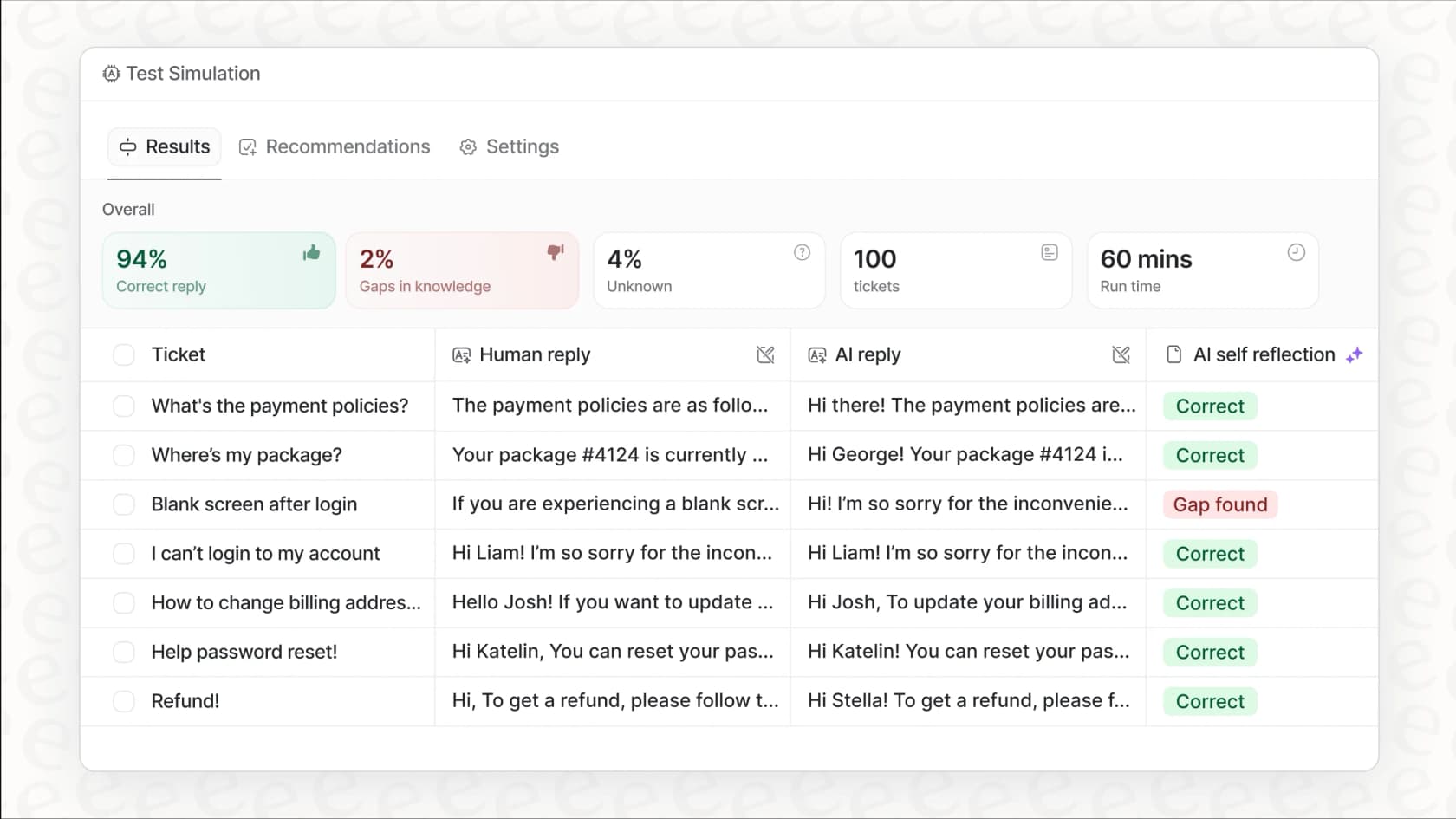
A safer way to launch is to have the AI draft before it answers anyone. An industrial automation company runs eesel this way: every support ticket arrives with a drafted answer left as an internal note, and engineers ask the technical library directly.
Where does Rovo fall short, and when should you use eesel instead?
Rovo is a fair deal for what it covers. It is built into Jira and Confluence, search respects your existing permissions, Search, definitions and summaries cost no credits, and every paid seat brings an allowance.
The limits are in the metering. From December 3, 2026, credits past the pool cost $0.01 each with extra usage on by default, and the JSM self-service agent and Request Resolver are Premium Rovo features at variable credits (How Rovo credits work). Users have also hit quality limits. One Jira user wrote that a dozen duplicated tickets came out inconsistent: "I could have just copy pasted a dozen tickets faster" (Reddit).
eesel is an AI teammate that works inside Jira Service Management and Confluence, and across Slack, Microsoft Teams and helpdesks like Zendesk and Freshdesk. It acts on tickets: it replies to customers, adds internal notes, assigns, labels and transitions issues, and reads Confluence live for answers.
Rovo has Slack and Teams apps too, but everyone who asks it something needs an Atlassian account on a Rovo-enabled site, and replies in public channels need a shared account an admin sets up. With eesel, the person asking needs no Atlassian seat. One difference to know: eesel reads Confluence through one Atlassian API token, so it sees what that account can see rather than each asker's own permissions. Pricing is one monthly plan, not per-user credits.
See the Jira integration, Confluence integration, or more Rovo alternatives.
| Feature | Atlassian Rovo | eesel AI |
|---|---|---|
| Pricing Model | Included with paid plans up to a pooled credit allowance; $0.01 per extra credit from Dec 3, 2026, on by default. | Monthly plans based on credits (1 credit = 1 ticket or chat), from $299/month for 500. Free plan with 100 credits. Pay a year upfront for two months free. |
| Setup & Onboarding | On by default for paid Cloud plans; custom agents are built in Rovo Studio. | Self-serve. Connect your helpdesk, Jira Service Management, Slack or Teams yourself. |
| Service desk AI | Virtual service agent from $0.30 past 1,000 conversations; Customer Service AI agent $1 per resolution. | The same 1 credit per ticket or chat, however long. |
| Flexibility | Jira, Confluence, 40+ third-party connectors, Slack and Teams apps. | Jira Service Management, Confluence (read), Slack, Teams, email, Zendesk, Freshdesk and more; every integration included. |
| Control | You configure agent behaviors and rules inside Rovo Studio. | You get fine-grained control to define the AI's personality, what it can do, and which tickets it automates. |
Rovo is still the better pick if your team lives entirely in Atlassian and mostly wants search and summaries it already pays for.
Is Rovo AI free? Navigating the shift to AI-powered teamwork
Atlassian Rovo is an ambitious AI suite, and including it in every paid Cloud plan gets a lot more people using AI. The answer to "is Rovo AI free?" is: free up to your allowance on a paid plan, never on the Free plan, and metered past the allowance from December 3, 2026.
The price per credit is now known. What stays harder to forecast is how many credits Premium features use per request, and that extra usage is on unless an admin sets a cap. When you're picking an AI platform, predictability and control are just as important as the features on the box.
Before you commit to a platform, make sure its long-term plan fits with your budget and how your team actually works. Check your Rovo usage under Insights, then Platform usage, and set a spending cap before December 3.
Want an AI teammate priced per ticket instead of per credit? Try eesel AI and see what it handles on your own queue.
Frequently asked questions
I'm hearing different things; is Rovo AI free indefinitely, or should I expect future costs?
Rovo AI is included at no extra charge with paid Standard, Premium and Enterprise Atlassian Cloud plans, up to a pooled monthly credit allowance. It is not free indefinitely for heavy use: from December 3, 2026, credits past the allowance are billed at $0.01 each under Atlassian's Rovo pricing, with extra usage on by default.
Given that is Rovo AI free for now, how do the "credit system" and "usage quotas" actually work?
Rovo operates on a credit system, where different actions consume different amounts. Search, definitions and summaries are free; a Chat quick answer or basic agent run costs 10 credits; Think deeper and advanced agents use a variable amount. Each user adds a monthly allowance, pooled across your company. Going over costs nothing until December 3, 2026, when extra usage billing starts.
What's the timeline for how long is Rovo AI free before Atlassian implements its consumption-based pricing?
Atlassian has finished rolling out Rovo to paid Cloud plans. It announced usage-based pricing on September 1, 2026, and extra usage billing for Rovo credits takes effect on December 3, 2026.
If our team exceeds the monthly credit limits, what are the implications while is Rovo AI free under the current model?
Until December 3, 2026, there is no charge for exceeding your team's monthly credit allowance. From that date, metered features keep working and are billed at $0.01 per credit up to any spending cap an admin sets. If an admin turns extra usage off, metered features pause until the allowance resets, while free features like Search keep working.
Once the pay-as-you-go model is active, how will our organization be charged, and how can we budget when is Rovo AI free is no longer the case?
Extra usage is billed in arrears at the list price of $0.01 per Rovo credit ($10 per 1,000). Admins get alerts at 80% and 100% of the allowance, can set a spending cap, and can buy prepaid annual credit packs with volume discounts. The Platform usage dashboard in Atlassian Administration shows usage by app and user and a forecast range for the current billing cycle.
Which specific Atlassian Cloud plans currently include Rovo AI at no extra cost; essentially, for whom is Rovo AI free right now?
Rovo AI is bundled into all Standard, Premium, and Enterprise Cloud plans for Jira, Confluence, Service Collection (which now includes Jira Service Management) and Teamwork Collection. Free plans and Atlassian Government Cloud do not include it, and the organization must use a verified business domain. The standalone Rovo Standard seat is free only while it is in beta.
