
Advanced Java refers to the specialized area of Java programming used for building web, enterprise, and database-driven applications. It extends Core Java by providing powerful APIs, frameworks, and tools that help developers create scalable, secure, and high-performance systems used in real-world applications.
- Build dynamic web applications using Servlets, JSP, and JSF.
- Handle enterprise-level workloads with EJB and Spring.
- Manage databases efficiently using JDBC and JPA.
- Write clean, reusable, and modular code with frameworks like Spring.
- Integrate applications with SOAP and REST APIs.
Architecture of Advanced Java Applications
Advanced Java architecture defines how application components are structured and interact, helping organize code into layers for better scalability and maintainability.
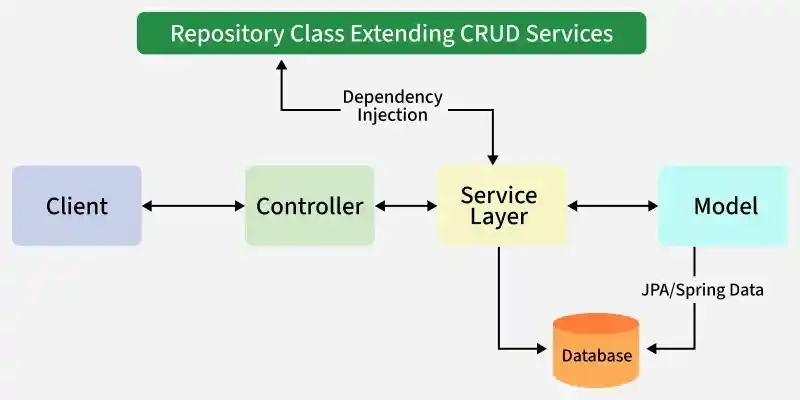
Different layers interact to process client requests efficiently:
- Client: Sends requests to the application (browser, mobile app, or API client).
- Controller Layer: Receives client requests and forwards them to the service layer.
- Service Layer: Contains business logic and processes the request before interacting with the database.
- Repository Layer: Handles database operations using JPA/Spring Data and performs CRUD operations.
- Model (Entity): Represents the data structure mapped to database tables.
- Database: Stores and retrieves application data.
Important Technologies in Advanced Java
1. Java EE (Jakarta EE)
A platform for building scalable, enterprise-level applications.
- Servlets: Handle client requests and responses, create dynamic web content.
- JSP: Embeds Java into HTML, simplifies web page creation with dynamic content.
- JSF: UI framework for building component-based, event-driven web apps.
- EJB: Manages complex business logic, transactions, and scalability in enterprise apps.
2. JDBC
JDBC stands for Java Database Connectivity; it connects Java applications with relational databases using SQL queries.
- Perform CRUD operations
- Execute SQL queries
- Manage transactions
3. Hibernate
Hibernate is an Object-Relational Mapping (ORM) framework that simplifies database operations by mapping Java objects to database tables.
- Reduces the need for writing SQL
- Improves performance with caching
- Simplifies database operations
4. JPA (Java Persistence API)
Java Persistence API is a collection of classes and methods to persist or store a vast amount of data into a database. JPA is a specification for storing and managing Java objects in databases using Object-Relational Mapping (ORM).
- Spring Data JPA: Adds a higher-level abstraction over JPA, reducing boilerplate code for database operations.
- Spring Repository: Extends JPA with APIs for CRUD, pagination, and sorting through CrudRepository and PagingAndSortingRepository.
5. Spring Framework
Spring Framework is a lightweight, open-source Java framework that simplifies enterprise application development with features like dependency injection, modularity, and integration support.
6. Spring Boot
Spring Boot is a Java-based framework that simplifies building stand-alone, production-ready Spring applications with minimal configuration and embedded servers.
7. Java Design Patterns
Java Design Patterns are the reusable solutions to common problems that frequently arise during the software designing and development phase.
Applications of Advanced Java
- Banking Systems: Used for secure transactions, account management, and financial processing.
- E-commerce Platforms: Powers online shopping systems with features like payments, orders, and inventory management.
- Enterprise Applications: Used in ERP, CRM, and large-scale business management systems.
- Web Applications: Builds dynamic websites and backend systems using Servlets, JSP, and Spring.
- REST APIs & Microservices: Develops scalable APIs for communication between distributed systems.
- Cloud-Based Applications: Supports building and deploying applications on cloud platforms.
