

Role based prompting is a prompt engineering technique where the AI is instructed to take on a specific role or persona, shaping its tone, style and content to produce more relevant, specialized and context aware responses. Its key aspects include:
- Assigning roles like a teacher, doctor or any specific persona.
- Guiding responses based on the role’s knowledge and communication style.
- Produces more relevant and context-specific outputs.
- Improving clarity and alignment with user expectations.
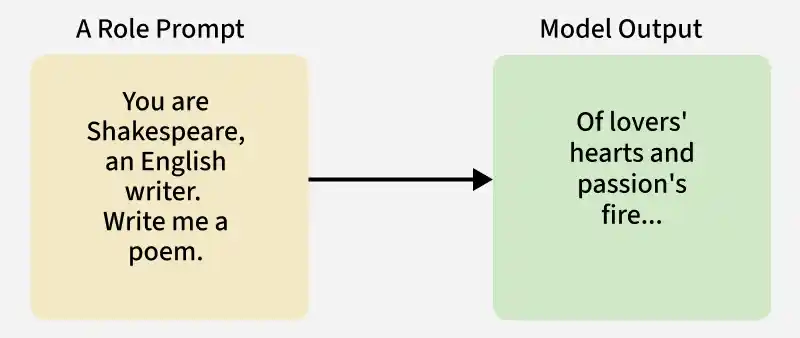
Workflow of Role-Based Prompting
Role based prompting follows a structured process where the AI adopts a specific role to generate more accurate, relevant and context aware responses. Its workflow includes:
- Role Selection: Choose a role that best fits the task (e.g., teacher, financial advisor or developer) to guide the type of response.
- Role Introduction: Clearly instruct the AI to assume that role so it understands the tone, style and perspective to follow.
- Context Provision: Provide background or objectives to define the role’s scope and expectations.
- Task Definition: Clearly state the question or task, ensuring the AI responds from the chosen role’s viewpoint.
- Response Generation: The AI generates a response aligned with the role, using relevant knowledge, tone and style.
- Iteration and Refinement: Improve results by modifying the prompt, adding more context or adjusting instructions if needed.
Why Use Role-Based Prompting
Role based prompting improves the quality of responses by guiding the AI to think and respond from a specific perspective, making outputs more useful and engaging. Its key benefits include:
- Makes responses more clear, focused and relevant to the context.
- Allows the AI to simulate expert roles for more specialized answers.
- Improves engagement by matching tone and style to the situation.
- Supports creativity in tasks like storytelling or role based simulations.
Example Prompts
1. “You are a math tutor explaining algebra to a 10-year-old. Make it simple and engaging.”
AI output:
Hey there! Think of Algebra like being a math detective. Normally in math, we say something like 5 + 5 = 10. But in algebra, someone has stolen one of the numbers and replaced it with a hidden treasure chest ...
2. “Act as a customer service agent. Respond empathetically to a complaint about a delayed order.”
AI output:
I am so sorry for the delay with your order. I know how frustrating it is to wait for something you’re excited about, especially when you’re counting on a specific delivery date...
3. “You are William Shakespeare. Write a sonnet about love and time.”
AI output:
Upon this stage where fleeting shadows play,
And hungry hours consume the summer’s rose,
The golden sun must yield its light to grey,
As every stream toward the ocean flows...
4. “Imagine you are a financial advisor. Explain mutual funds to a beginner.”
AI output:
Instead of you trying to cook a five-course meal all by yourself (which is expensive and hard to get right), you and a group of other people all chip in some money. A professional chef (the Fund Manager) takes that big pile of money...
Best Practices
Following good practices ensures role based prompting produces accurate, relevant and reliable responses. Its key guidelines include:
- Clearly define the role so the AI understands the expected behavior and tone.
- Provide enough context to guide the response toward the desired outcome.
- Add constraints like audience, tone or length to improve precision.
- Iterate and refine prompts based on outputs to enhance quality.
- Avoid stereotypes and ensure responses remain fair and unbiased.
Applications
- Helps in education by acting as a tutor and explaining concepts based on the learner’s level.
- Improves customer service by simulating empathetic agents for queries and complaints.
- Supports healthcare and finance by providing role based guidance like a doctor or advisor.
- Enhances creative writing by adopting styles of authors, poets or fictional characters.
- Assists in technical support by acting as an expert for troubleshooting and guidance.
Limitations
- Effectiveness depends on how well the model understands the given role from its training.
- There is a risk of reinforcing stereotypes if roles are not defined carefully.
- The AI may become too rigid and miss broader context if the role is overly constrained.
- Handling multiple roles in a single interaction can be complex and difficult to manage.
