

The Human Genome Project (HGP) was an international research initiative that aimed to identify, map, and sequence the entire human genome. It successfully sequenced approximately 3.3 billion DNA base pairs and was completed in 2003, providing a foundation for modern genetics and personalized medicine.
History of the Human Genome Project
- The Human Genome Program (HGP) was carried out in the United States by the National Institutes of Health (Human Genome Research Institute), under the leadership of Francis Collins, and the Department of Energy (Ari Patrinos).
- The human genome's 90% completion of sequencing was revealed by Celera Genomics CEO Craig Venter in 2001 (Draft sequence).
- The entire sequence was produced and released in 2003 (finished sequence).
- In 2006, a more precise sequence was available, and it will take some more time to fix minor errors (1 in 10,000 DNA subunits).
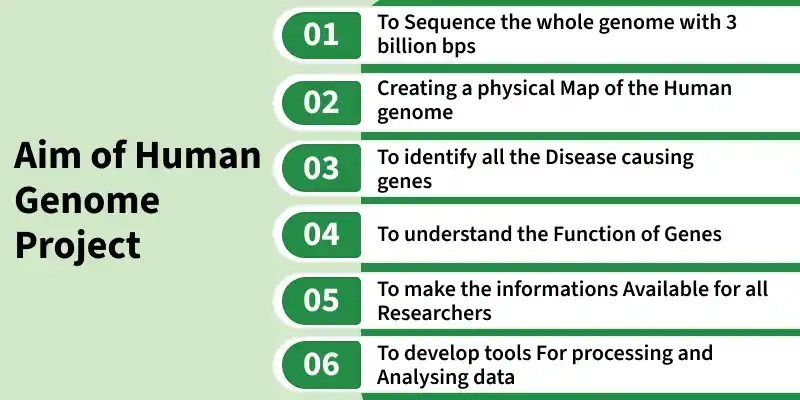
Goals of the Human Genome Project
- To determine the entire sequence of human DNA.
- To develop improved tools for data analysis.
- To identify all the genes that are present in human DNA.
- To transfer the related technologies to the private sector.
- To create genome sequence databases to store the data.
- To take care of ethical, legal, and social issues that may arise from the project.
Genome Donors
- The Human Genome Project did not use the sequence from a single individual to create the human genome. Instead, it is a composite of information from numerous sources, all of whose identities have been rendered purposefully anonymous to preserve their privacy.
- To find volunteers, get their informed consent, and collect blood samples, the project researchers followed a methodical procedure. In Buffalo, New York, blood donors contributed the majority of the human genome sequence, with 93% coming from 11 donors and 70% from one donor, respectively.
Process of the Human Genome Project
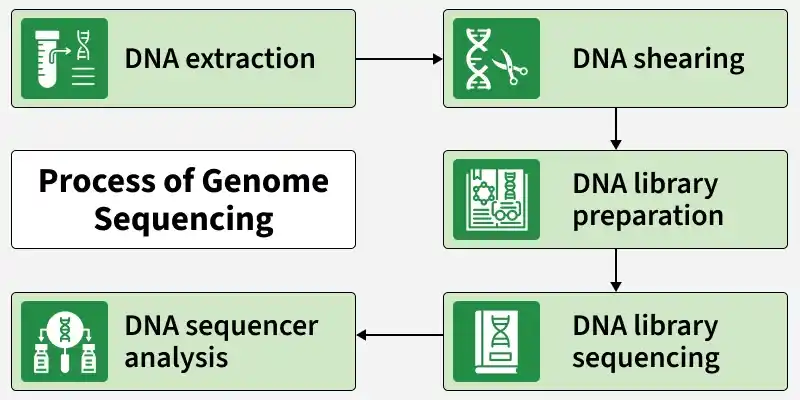
- First, the complete DNA will be isolated from a cell
- Then, using restriction enzymes, we will divide the DNA into small fragments.
- Commonly used vectors known as BAC (bacterial artificial chromosomes) and YAC (yeast artificial chromosomes) will amplify the small fragments.
- Now, these fragments will get sequenced using an automated DNA sequencer that works on the principle of a method developed by Frederick Sanger.
- Now, these sequences will get rearranged based on some overlapping regions present in them.
- Now, for sequencing, we require overlapping fragments.
- Now all the information related to the genome will be stored in a computer-based program.
- These successions were hence commented on and were allotted to every chromosome.
- Along these lines, the whole genome was sequenced and stored as a genome database on a computer.
- Genome mapping was the next goal that was accomplished with the assistance of microsatellites, i.e., the repetitive DNA sequence.
Techniques and Methods of the Human Genome Project
The Human Genome Project utilised Sanger sequencing to determine the sequences of moderately small fragments of human DNA (900 bp or less).
- These fragments were then used to sort out bigger DNA fragments and, eventually, whole chromosomes.
- Genomics research is accelerated through the advancement of next-generation sequencing technologies.
- Expressed sequence tags in which genes have been differentiated into those that make up part of the genome and others that express RNA.
- Sequence Annotation, where the whole genome was first sequenced and functional tags were assigned later.
Features
- Our genome contains 3164.7 million base pairs in its entirety.
- A gene contains 3000 nucleotides on average.
- Moreover, over half of the genes' functions are unknown at this time.
- Less than 2 % of the genome codes for proteins.
- The majority of the genome is made up of repetitive sequences that serve no particular role in coding, but these redundant codes can aid in our understanding of how humanity's genetic makeup has changed throughout history.
Applications and Proposed Benefits
- From molecular medicine to human evolution, the sequencing of the human genome has advantages in many areas.
- The Human Genome Project can advance forensic applied sciences, help with biofuels and other energy applications, agriculture, animal husbandry, bioprocessing, risk assessment, and bioarchaeology.
- By sequencing the DNA, the Human Genome Project will enable researchers to better understand diseases, such as genotyping of specific viruses to direct appropriate treatment; identification of mutations linked to different types of cancer; medication design, and more accurate prediction of their effects; and biofuels.
- The commercialisation of genomics research about DNA-based products, an enormously lucrative business, is another benefit that has been put forth.
Developments of the Human Genome Project
- It is believed that a thorough understanding of the human genome would open up new possibilities for medicine and biotechnology.
- Finding the genetic variants that raise the risk for prevalent diseases like cancer and diabetes was the next step after having the sequence in hand. Additionally, the etiologies of cancer, Alzheimer's disease, and other clinically relevant conditions are thought to benefit from the knowledge of the human genome and may, in the long run, result in considerable improvements in their management.
- The examination of similarities in DNA sequences from other organisms is revealing new directions in the study of evolution.
The data collected for this study is anticipated to shed light on several issues regarding the similarities and differences between humans and their closest living relatives (the primates, as well as the other mammals). - The study served as an example and a platform for genetic research in other industries, such as agriculture. For example, a significant understanding of how domestication has affected the evolution of the plant has been gained by examining the genetic makeup of Tritium aestivum (the world's most popular bread wheat)
