

Software testing certifications help professionals validate their skills in manual testing, automation, and quality assurance practices. They improve job opportunities and provide structured knowledge of testing tools and methodologies used in the industry.
- Enhances knowledge of software testing concepts and tools.
- Improves career opportunities in QA and testing roles.
- Validates professional skills through industry-recognized credentials.
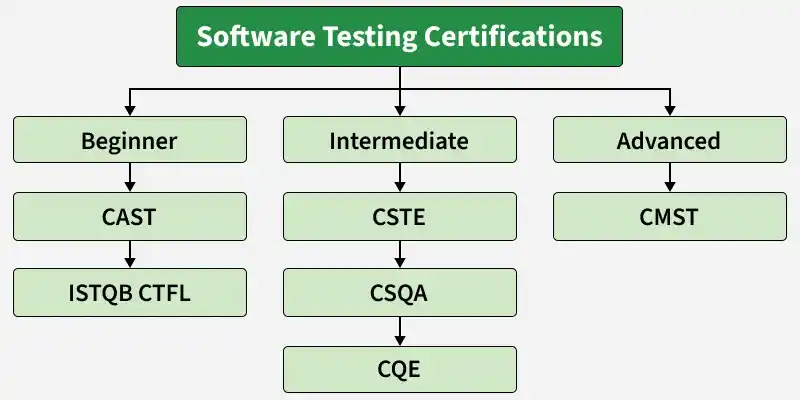
1. CAST (Certified Associate in Software Testing)
CAST is an entry-level certification that validates basic knowledge of software testing principles and quality practices.
Eligibility (varies by provider)
- Bachelor’s degree from an accredited institution, OR
- Associate degree + some IT experience, OR
- Relevant IT work experience
Key Areas Covered
- Fundamentals of software testing
- Test design techniques (black-box methods)
- Test lifecycle basics
- Risk and defect identification
- Basic test reporting and metrics
Note: CAST certification is offered by different testing bodies, so eligibility and fees may vary.
2. CSQA (Certified Software Quality Analyst)
CSQA is a professional certification focused on software quality assurance and process improvement.
Eligibility (any one)
- Bachelor’s degree + 2 years IT experience
- Associate degree + 3–4 years experience
- Equivalent IT experience (around 6 years)
Key Areas Covered
- Software quality assurance principles
- Quality control and process improvement
- Software audits and governance
- Customer satisfaction and quality metrics
- COTS and outsourcing evaluation
3. ISTQB (International Software Testing Qualifications Board)
ISTQB is the most widely recognized global certification in software testing.
Levels
- Foundation Level (CTFL)
- Advanced Level (Test Analyst, Test Manager, Technical Test Analyst)
- Expert Level (limited availability)
Key Areas Covered
- Software Testing Life Cycle (STLC)
- Test design techniques
- Defect management
- Risk-based testing
- Agile and DevOps testing
- Test planning and strategy
4. CQE (Certified Quality Engineer – ASQ)
CQE is a globally recognized quality engineering certification by ASQ.
Eligibility
- 8 years work experience, OR
- 3–4 years in a responsible quality-related position (depending on education)
Exam Format (approximate)
- ~175 multiple-choice questions
- Duration: ~5 hours
- Includes scored and unscored questions
Key Areas Covered
- Statistical quality control
- Process capability and improvement
- Measurement systems
- Quality management systems
- Risk analysis and sampling
5. CMST (Certified Manager of Software Testing)
CMST is a management-level certification focused on software testing leadership and strategy.
Eligibility (any one)
- Bachelor’s degree + 4 years testing experience
- Associate degree + 6 years experience
- Around 8 years IT/testing experience
Exam Pattern (varies)
- ~100 multiple-choice questions
- Passing score typically ~70%
Key Areas Covered
- Test planning and management
- Resource and team management
- Risk and quality control
- Project tracking and reporting
- Test strategy and governance
Note: CMST is not as globally standardized as ISTQB or ASQ certifications.
6. CSTE (Certified Software Tester – QAI)
CSTE is a professional certification that focuses on software testing standards and practices.
Eligibility (any one)
- Bachelor’s degree + 2 years experience
- Associate degree + 3 years experience
- 4 years degree + 2 years experience
- OR 6 years IT experience
Key Areas Covered
- Software testing principles
- STLC and defect lifecycle
- Test planning and execution
- Quality control techniques
- Risk-based testing
7. ISTQB CTFL (Foundation Level)
CTFL is the entry-level ISTQB certification and is the most popular worldwide.
Exam Format
- 40 multiple-choice questions
- Duration: 60 minutes (or 75 with non-native language extension)
- Passing score: ~65%
Key Areas Covered
- Basics of software testing
- Test levels and types
- Agile testing basics
- Defect lifecycle
- Test design techniques
