
A computer forensic report is a structured document that records the evidence, analysis, findings and conclusions of a digital forensic investigation. It provides a clear summary of the investigation and supports legal, regulatory and organizational requirements.
- Includes details such as the evidence examined, forensic tools used, investigation timeline and key findings.
- Helps investigators, security teams and courts understand what happened during the incident and the evidence supporting the conclusions.
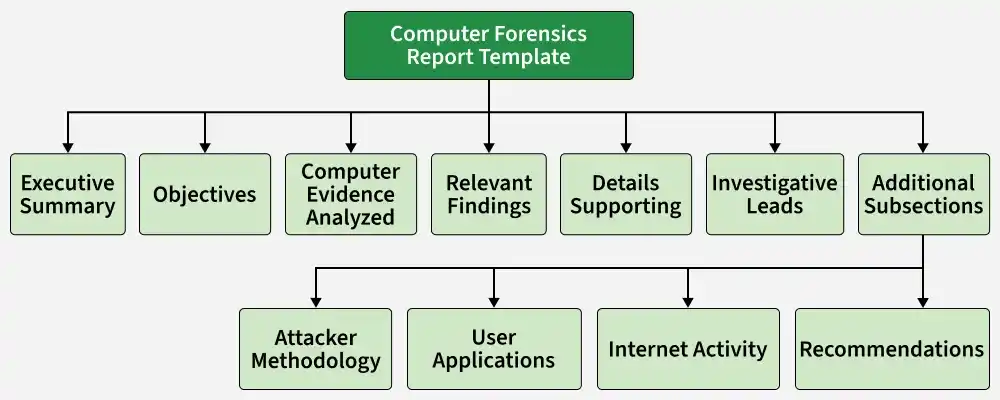
1. Executive Summary
Provides a concise overview of the incident, investigation scope and major conclusions. It allows non-technical stakeholders to quickly understand the case outcome.
- Summarizes the incident timeline, affected assets and overall business impact.
- Provides a high-level assessment of the investigation outcome and forensic conclusions.
2. Objectives
Defines the purpose and scope of the forensic examination. It establishes what the investigation intends to determine and analyze.
- Defines the forensic examination requirements based on the reported incident.
- Establishes the scope of evidence acquisition and analysis.
3. Computer Evidence Analyzed
Documents all digital evidence collected and examined during the investigation. Proper documentation ensures evidence integrity and traceability.
- Identifies the digital assets acquired, including storage devices, memory dumps and log files.
- Verifies evidence integrity using cryptographic hash values (MD5/SHA-256).
4. Relevant Findings
Presents the significant evidence discovered through forensic analysis. These findings directly support the investigation objectives.
- Identifies Indicators of Compromise (IoCs) such as malicious files, IP addresses, domains or registry changes.
- Establishes the root cause and attack sequence from the collected evidence.
5. Details Supporting Findings
Provides technical evidence and analysis supporting the investigation results. This section enables validation and peer review of findings.
- Includes file metadata, registry entries, event logs, packet captures and timestamps supporting the conclusions.
- Documents the forensic tools, commands and examination procedures used during analysis.
6. Investigative Leads
Identifies additional areas requiring further examination. It helps investigators uncover related activities and hidden evidence.
- Identifies new artifacts, user accounts or network endpoints requiring additional examination.
- Recommends correlation with external threat intelligence to identify related attacks.
7. Attacker Methodology
Analyzes the tactics, techniques and procedures used during the attack. Understanding attacker behavior helps improve future defenses.
- Analyzes attacker Tactics, Techniques and Procedures (TTPs) using frameworks such as MITRE ATT&CK.
- Documents persistence, privilege escalation, lateral movement and data exfiltration techniques.
8. User Applications
Examines software installed or executed on the system. Application analysis helps identify unauthorized or suspicious activity.
- Examines application execution history using artifacts such as Prefetch, ShimCache and AmCache.
- Identifies unauthorized software installations and abnormal application behavior.
9. Internet Activity
Investigates web and network-related activities associated with the incident. This analysis helps reconstruct user and attacker actions.
- Analyzes DNS queries, proxy logs, browser artifacts and network connections for malicious communication.
- Detects Command-and-Control (C2) traffic and unauthorized external data transfers.
10. Recommendations
Provides actionable measures to strengthen security and prevent similar incidents. Recommendations are based on weaknesses identified during the investigation.
- Recommends implementing security hardening, patch management and least-privilege access controls.
- Suggests deploying Endpoint Detection and Response (EDR), SIEM and continuous threat monitoring to improve security visibility.
