
A computer is an electronic device that accepts data as input, processes it according to given instructions, produces meaningful output, and stores the data and results for future use. It consists of hardware and software components that work together to perform various tasks and provide useful services to the user.
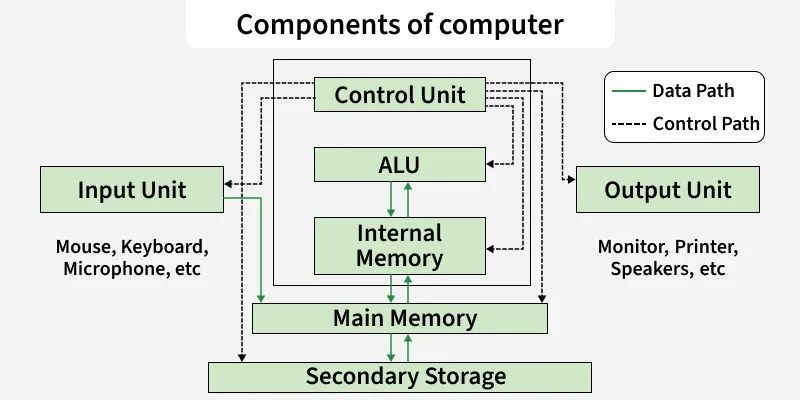
Components of a Computer
1. Input Unit:
The input unit consists of input devices attached to the computer. These devices are used to enter data and instructions, which are then converted into a form (binary language) that the computer can understand. Common input devices include keyboard, mouse, joystick, scanner, etc. The input unit acts as a link between the user and the computer by sending data to the CPU for processing
2. Central Processing Unit:
The CPU is considered the brain of the computer because it controls all operations and processes the data. It performs a cycle of fetching instructions from memory, decoding them, executing them, and storing or displaying the results. The CPU consists of three main components: Arithmetic and Logic Unit (ALU), Control Unit (CU), and Memory Registers
A. Arithmetic and Logic Unit (ALU): The ALU performs all arithmetic calculations such as addition, subtraction, multiplication, and division. It also performs logical operations like comparisons (greater than, less than, equal to). It is a major part of the CPU responsible for processing data.
B. Control Unit:The Control Unit manages and coordinates all activities of the computer. It controls data flow between the CPU, memory, and input/output devices. It decodes instructions and ensures that each operation is carried out correctly by sending control signals
C. Memory Registers: Registers are small, high-speed storage locations inside the CPU used to store temporary data and instructions during processing. They hold data currently being used by the CPU, such as operands, instructions, or addresses, and help in fast processing.
For example, the Accumulator (ACC) is an important register in the CPU. It holds one of the values used in calculations inside the Arithmetic and Logic Unit (ALU).
Apart from registers, the internal memory (also called primary memory or main memory) is where data and instructions are stored temporarily while a program runs. This memory is called RAM (Random Access Memory). Every piece of data in RAM is stored at a unique location with an address, so the processor can access it quickly without searching the entire memory. Since RAM provides direct access to any data location, it is called Random Access Memory.
- Memory Unit is the primary storage of the computer.
- It stores both data and instructions.
- Data and instructions are stored permanently in this unit so that they are available whenever required.
3. Output Unit :
The output unit consists of output devices that are attached to the computer. It converts the binary data coming from the CPU to human understandable form. The common output devices are monitor, printer, plotter, etc.
- The output unit displays or prints the processed data in a user-friendly format.
- The output unit is formed by attaching the output devices of a computer.
- The output unit accepts the information from the CPU and displays it in a user-readable form.
Characteristics of a Computer
- Speed: Computers can perform millions of calculations per second. The computation speed is extremely fast.
- Accuracy: Because computers operate on pre-programmed software, there is no space for human error.
- Diligence: They can perform complex and long calculations at the same time and with the same accuracy.
- Versatile: Computers are designed to be versatile. They can carry out multiple operations at the same time.
- Storage: Computers can store a large amount of data/ instructions in its memory, which can be retrieved at any point of time.
