

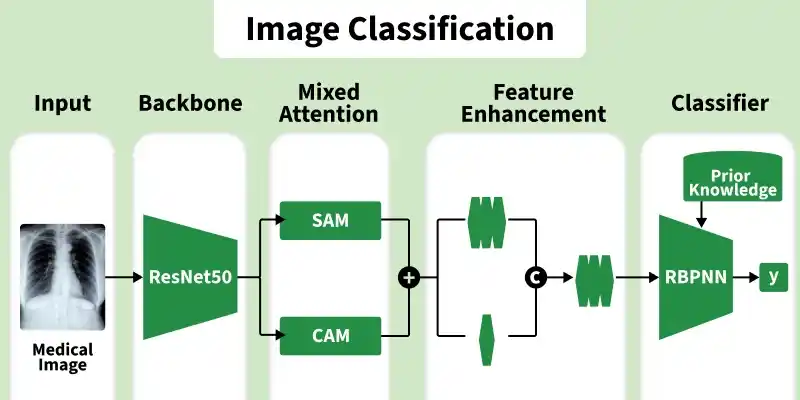
Image classification is the process of assigning a predefined label to an image based on its visual content. It enables a model to automatically recognize patterns such as shapes, textures, and objects to categorize images into learned classes.
- Relies on feature extraction to convert raw pixel data into meaningful representations.
- Uses trained models to map extracted features to the most probable class label.
Types
- Binary Classification: It involves classifying images into one of two categories. For example, determining whether an image contains a cat or not.
- Multiclass Classification: It involves categorizing images into more than two classes. For example, classifying images of different types of animals.
- Multilabel Classification: It allows an image to be associated with multiple labels. For example, an image might be classified as both "sunset" and "beach."
- Hierarchical Classification: It involves classifying images at multiple levels of hierarchy. For example, an image of an animal can first be classified as a "mammal" and then further classified as "cat" or "dog".
Image classification vs. Object Localization vs. Object Detection
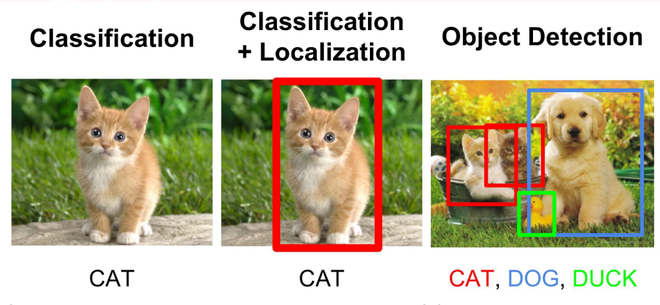
- Image Classification: Assigns a single label to the entire image, such as cat, dog, or bird. It typically uses models like CNNs and transfer learning.
- Object Localization: Identifies the main object in an image and marks its position using a bounding box.
- Object Detection: Combines classification and localization to detect multiple objects in an image, each with its own label and bounding box.
To know more about this refer to this article.
Working
- Data Collection and Preprocessing: A large labeled image dataset is collected and preprocessed through resizing, normalization, and augmentation to improve model robustness.
- Feature Extraction: Traditional methods rely on manual features like edges and textures, while CNNs automatically learn features directly from raw pixel data.
- Model Training: The dataset is split into training and validation sets, and a CNN is trained using backpropagation and gradient descent to minimize prediction error while reducing overfitting.
- Evaluation and Testing: The model is evaluated on unseen data using metrics such as accuracy, precision, and recall to measure performance.
- Deployment: The trained model is deployed for real-time or batch image classification in practical applications.
Algorithms
Some of the algorithms used for Image Classification are:
- Supervised Learning: Models are trained on labeled datasets where each image has a known class. Algorithms like SVM and Decision Trees learn to predict labels for new images based on these examples.
- Unsupervised Learning: When image labels are unavailable, techniques such as clustering and autoencoders group or represent images based on visual similarities and patterns without predefined categories.
- Deep Learning: Convolutional Neural Networks automatically learn complex features from raw pixel data improving accuracy over traditional methods.
- Transfer Learning: Transfer Learning uses pre-trained CNN models and fine tunes them for specific classification tasks reducing training time and resources and achieving high accuracy even with smaller datasets.
Evaluation Metrics
To measure the performance of an image classification model, several metrics which are commonly used are:
- Accuracy: The overall percentage of correctly classified images is called Accuracy.
- Precision: How many of the images predicted as a certain class are actually correct is calculated using Precision.
- Recall: The proportion of actual images of a class that were correctly identified is called Recall.
- F1-Score: The harmonic mean of precision and recall, balancing both metrics is called F1 Score.
- Confusion Matrix: A tabular summary showing correct and incorrect predictions for each class is called Confusion Matrix.
Applications
- Medical Imaging: Used to detect and diagnose diseases from X-rays, MRIs, and CT scans.
- Autonomous Vehicles: Helps self-driving cars understand and interpret their surroundings.
- Facial Recognition: Identifies and verifies individuals using facial features.
- Retail and E-commerce: Used for product categorization, inventory management, and visual search.
- Environmental Monitoring: Analyzes satellite and aerial images for environmental analysis and change detection.
Advantages
- High Accuracy: Deep learning models like CNNs achieve strong performance in image classification tasks.
- Automatic Feature Learning: Models learn features directly from raw images without manual feature extraction.
- Scalable: Can handle large datasets and improve performance with more data.
- Wide Applications: Used across industries such as healthcare, automotive, and security systems.
Challenges
- Data Requirements: Requires large, high-quality labeled datasets, which are expensive to create.
- Variability in Images: Differences in lighting, angles, and backgrounds can reduce performance.
- Computational Cost: Training deep learning models needs significant processing power and memory.
