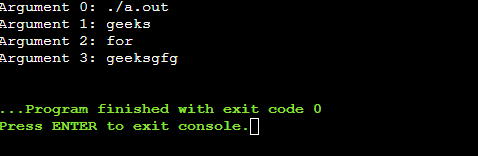
Command Line Arguments in C are values passed to a C program when it is executed from the command line, allowing users to provide input without modifying the source code. They make programs more flexible by accepting dynamic input at runtime.
- Allow users to pass input values directly when running the program from the command line.
- Make programs more flexible and reusable by processing different inputs without changing the source code.
#include <stdio.h>

int main(int argc, char *argv[])
{
    // argc → number of arguments
    // argv → array of arguments

    if (argc > 1)
    {
        printf("Hello, %s!\n", argv[1]);
    }
    else
    {
        printf("Hello, World!\n");
    }

    return 0;
}
Output
Hello, World!
Explanation
- The program checks whether a command-line argument is provided using argc.
- If a name is passed, it prints a personalized greeting; otherwise, it displays "Hello, World!" using the values stored in argv.
Use of Command Line Arguments
Command-line arguments allow a program to receive input directly when it is executed, making it more flexible and reusable.
- They eliminate the need to modify the source code or prompt the user for input every time the program runs.
- They are useful for automation, scripting, and running the same program with different inputs.
Working of Command-Line Arguments
Command-line arguments are passed to the main() function when the program starts and can be accessed using argc and argv.
- argc stores the total number of command-line arguments, while argv is an array containing each argument as a string.
- Arguments are separated by spaces, and values containing spaces should be enclosed in quotation marks.
Example: Display Command-Line Arguments Passed to a C Program
To compile and run a C program in the command prompt, follow the steps written below:
- Save the program as Hello.c
- Open the command prompt window and compile the program using: gcc Hello.c -o Hello
- After successful compilation, run the program by writing the arguments: Hello [arguments]
- For example: Hello Geeks at GeeksforGeeks
- Press Enter and you will get the desired output
#include <stdio.h>

int main(int argc, char *argv[])
{
    if (argc == 1)
    {
        printf("No command-line arguments passed.\n");
    }
    else
    {
        for (int i = 0; i < argc; i++)
        {
            printf("Argument %d: %s\n", i, argv[i]);
        }
    }
    return 0;
}
OUTPUT: