

A mutex (Mutual Exclusion) is a synchronization primitive that protects shared resources from concurrent access, helping prevent race conditions in multithreaded programs.
- Allows exclusive access to critical sections.
- Ensures predictable behavior while accessing shared data.
#include <iostream>
#include <thread>
using namespace std;

int counter = 0;

void increment() {
    counter++;
}

int main() {
    thread t1(increment);
    thread t2(increment);

    t1.join();
    t2.join();

    cout << counter;
}
Output
2
Explanation: Both threads update the shared variable counter concurrently. Since the update is not synchronized, the final value is unpredictable. A mutex can be used to ensure that only one thread modifies the shared resource at a time.
Syntax
The use of mutex can be divided into three steps:
Create mutex
std::mutex mtx;
Locking a Mutex
mtx.lock();
Locks the mutex so that no other thread can access the protected resource.
Unlocking a Mutex
mtx.unlock();
Releases the mutex, allowing waiting threads to access the shared resource.
Need for Mutex
A mutex is required when multiple threads access the same shared resource concurrently.
- Shared data may be modified simultaneously by multiple threads.
- Concurrent updates can produce inconsistent or unpredictable results.
- Critical sections require exclusive access to shared resources.
- A mutex allows only one thread to access the resource at a time.
Working of Mutex
Mutex synchronization follows these steps:
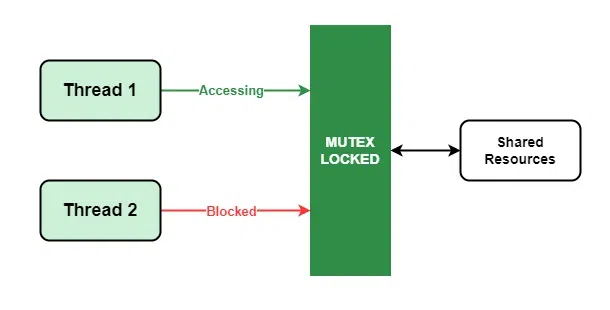
- A thread requests ownership of the mutex using lock().
- If the mutex is available, the thread enters the critical section.
- Other threads wait until the mutex is released.
- After completing its work, the thread calls unlock().
Example Without Mutex
The following program demonstrates a race condition caused by two threads updating the same shared variable simultaneously.
#include <iostream>
#include <thread>

using namespace std;

// Shared resource
int number = 0;

// function to increment the number
void increment(){

    // increment number by 1 for 1000000 times
    for(int i=0; i<1000000; i++){
        number++;
    }
}

int main()
{
    // Create thread t1 to perform increment()
    thread t1(increment);

    // Create thread t2 to perform increment()
    thread t2(increment);

    // Start both threads simultaneously
    t1.join();
    t2.join();

    // Print the number after the execution of both threads
    cout << "Number after execution of t1 and t2 is " << number;

    return 0;
}
Output
The same program is executed three times to observe the behavior when modifying shared resources without thread synchronization.
Run 1:
Number after execution of t1 and t2 is 1058072

Run 2:
Number after execution of t1 and t2 is 1456656

Run 3:
Number after execution of t1 and t2 is 2000000

Explanation: Since both threads update the shared variable without synchronization, race conditions occur and the output becomes unpredictable.
Example Using Mutex
The following program uses a mutex to synchronize access to the shared variable.
#include <iostream>
#include <thread>

using namespace std;

// import mutex from C++ standard library
#include <mutex>

// Create object for mutex
mutex mtx;

// Shared resource
int number = 0;

// function to increment the number
void increment(){

    // Lock the thread using lock
    mtx.lock();

    // increment number by 1 for 1000000 times
    for(int i=0; i<1000000; i++){
        number++;
    }

    // Release the lock using unlock()
    mtx.unlock();
}

int main()
{
    // Create thread t1 to perform increment()
    thread t1(increment);

    // Create thread t2 to perform increment()
    thread t2(increment);

    // Start both threads simultaneously
    t1.join();
    t2.join();

    // Print the number after the execution of both threads
    std::cout<<"Number after execution of t1 and t2 is "<<number;

    return 0;
}
Output
The same program is executed three times to observe the behavior when modifying shared resource with thread synchronization using mutex.
Run 1:
Number after execution of t1 and t2 is 2000000

Run 2:
Number after execution of t1 and t2 is 2000000

Run 3:
Number after execution of t1 and t2 is 2000000
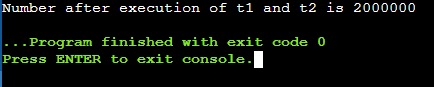
Explanation: The mutex ensures that only one thread updates the shared variable at a time. Other threads wait until the mutex is released, eliminating race conditions and producing a consistent result.
Advantages of Mutex
Using a mutex provides several benefits:
- Prevents race conditions while accessing shared resources.
- Ensures data consistency in multithreaded programs.
- Allows safe execution of critical sections.
Limitations of Mutex
Despite its usefulness, mutexes have some drawbacks:
- Threads may spend time waiting for a lock.
- Excessive locking can reduce application performance.
- Manual lock and unlock management is error-prone.
