

Neo4j is a leading open-source graph database management system and a NoSQL database designed to store, manage and query highly connected data efficiently. Unlike traditional relational databases such as MySQL, which organize data in tables. This graph-based approach enables fast traversal of complex relationships.
- Nodes represent entities such as people, products, locations or any other data objects.
- Relationships connect nodes and define how the entities are related to each other.
- Properties are key-value pairs that store additional information about nodes and relationships.
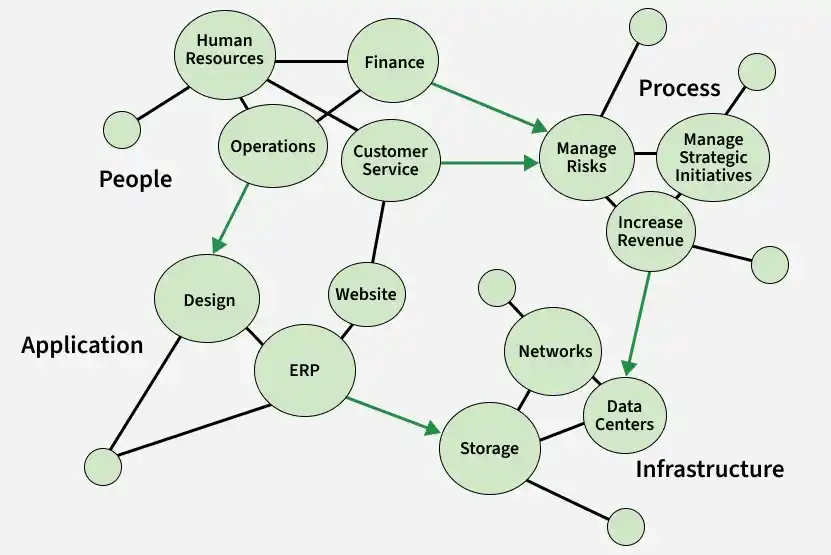
The diagram shows that People use Applications and IT Infrastructure to execute Business Processes, helping the organization achieve goals like managing risks and increasing revenue.
- People: Includes departments like Human Resources, Finance, Operations and Customer Service. These teams perform business activities.
- Process: Business processes such as Manage Risks, Manage Strategic Initiatives and Increase Revenue help the organization achieve its objectives.
- Application: Software systems like ERP, Website and Design applications support employees and automate business operations.
- Infrastructure: IT resources such as Networks, Storage and Data Centers provide the technical foundation for applications to run.
Neo4j Architecture
Neo4j consists of the following main components:
- Storage Engine: Stores graph data efficiently.
- Query Engine: Executes and optimizes Cypher queries.
- Transaction Manager: Ensures ACID properties and data consistency.
- Index Manager: Speeds up node searches using indexes.
- Cluster Manager: Provides replication, high availability and fault tolerance.
Features of Neo4j
- High Performance and Scalability: Neo4j is designed to handle massive amounts of data and complex queries quickly and efficiently. Its native graph storage and processing engine ensure high performance and scalability, even with billions of nodes and relationships.
- Cypher Query Language: Neo4j uses Cypher, a powerful and expressive query language tailored for graph databases. Cypher makes it easy to create, read, update and delete data, allowing users to perform complex queries with concise and readable syntax.
- ACID Compliance: Neo4j ensures data integrity and reliability through ACID (Atomicity, Consistency, Isolation, Durability) compliance. This guarantees that all database transactions are processed reliably and ensures the consistency of the database even in the event of failures.
- Flexible Schema: Unlike traditional databases, Neo4j offers a flexible schema, allowing users to add or modify data models without downtime. This adaptability makes it ideal for evolving data structures and rapidly changing business requirements.
Core Concepts of Neo4j
Neo4j stores data using three main components:
1. Nodes: Nodes represent entities or objects such as Person, Customer, Product, City or Movie.
Example: Person {name: "Alice", age: 28}
2. Relationships: Relationships connect two nodes. They have a direction, a type and can store properties.
Example: (Alice)-[:FRIEND_OF]->(Bob)
3. Properties: Properties are key-value pairs that store information about nodes or relationships.
Examples:
- Node: Book {title: "Database Systems", price: 850}
- Relationship: (Alice)-[:PURCHASED {date: "2026-06-01"}]->(Laptop)
Cypher Query Language
Cypher is Neo4j's declarative query language used to create, retrieve, update and delete graph data.
Important Neo4j Cypher Commands
1. Create a Node:
CREATE (p:Person {
   name: "John",
   age: 30
})
2. Create a Relationship:
MATCH (a:Person {name:"John"})
MATCH (b:Person {name:"Alice"})
CREATE (a)-[:FRIEND_OF]->(b)
3. Retrieve Nodes:
MATCH (p:Person)
RETURN p;
4. Update Properties:
MATCH (p:Person {name:"John"})
SET p.age = 31;
5. Delete a Node:
MATCH (p:Person {name:"John"})
DETACH DELETE p;
Note: DETACH DELETE removes the node along with all its relationships.
How Neo4j Differs from Relational Databases
- Tables vs Graphs: Relational databases store data in tables using primary and foreign keys and Neo4j stores data as nodes and relationships, enabling faster and simpler queries on connected data.
- Foreign Keys vs Relationships: In relational databases, relationships are represented using foreign keys. To retrieve related information, the database must perform JOIN operations across multiple tables.
Advantages
- Representation of connected data and also represent semi-structured data is easy.
- Its high performance, scalability and flexibility have made it one of the most widely adopted graph databases for handling interconnected data.
- Retrieval or traversal or navigation of connected data is fast and uses simple and powerful data model.
Limitations
- OLAP support for these types of databases is not well executed.
- In this area, still there are lots of research happening around.
