

The essential data that ensures the continued operation of distributed systems can be stored and managed with the help of etcd, an open-source distributed key-value store. Most outstandingly, it deals with the arrangement information, state information, and metadata for Kubernetes, the famous compartment organization stage.Like every appropriated responsibility, containerized jobs have complex administration necessities that become more complicated as the responsibility scales.
What is ETCD?
etcd (pronounced et-see-dee) is an open-source, distributed, value-based framework for shared storage, service discovery, and coordination for distributed systems or clusters of machines. etcd is an open-source, distributed key-value store used to capture and manage the critical data a system needs to continue operating. It manages configuration information, state information, and metadata specifically for the popular container orchestration platform Kubernetes. The name "etcd" comes from two concepts; unix directory "/etc" and "d" system directory. ""/etc.
What is Kubernetes ETCD?
Implementing it as a fact-based version that could perform distributed tasks isn't a small mission. But etcd is constructed for overall performance and has been engineered from the ground up to have the following functions: Fully replicated: Each node in the etcd cluster has access to the full statistics garage. Basically, select etcd to store metadata or hook up with a particular utility. Choose the NewSQL database if you keep more than a few GB of records or need complete SQL queries. Zookeeper offers robust consistency, a easy API, and a mature ecosystem, even as etcd gives a linear, rich API and easy integration with Kubernetes. Both are dependable systems appropriate for connecting and invoking offerings in disbursed applications.
Kubernetes improves on the most common way of dealing with these responsibilities by planning errands, for example, design, sending, administration revelation, load adjusting, position booking, and wellbeing observation across all groups, which can run on numerous machines in various areas. However, to accomplish this coordination, Kubernetes needs an information store that gives a solitary, reliable wellspring of reality with regards to the situation with the framework—every one of its bunches and units and the application cases inside them—at some random moment. etcd is the information store used to make and keep up with this variant of reality.
etcd serves a comparative job for Cloud Foundry (interface lives outside ibm.com)—the open source, multi-cloud Stage as an Administration (PaaS)—and is a feasible choice for planning basic framework and metadata across bunches of any dispersed application. The name "etcd" comes from a naming convention inside the Linux registry structure: In UNIX, all framework setup documents for a solitary framework are contained in an envelope called "/and so on;" "d" means "circulated."
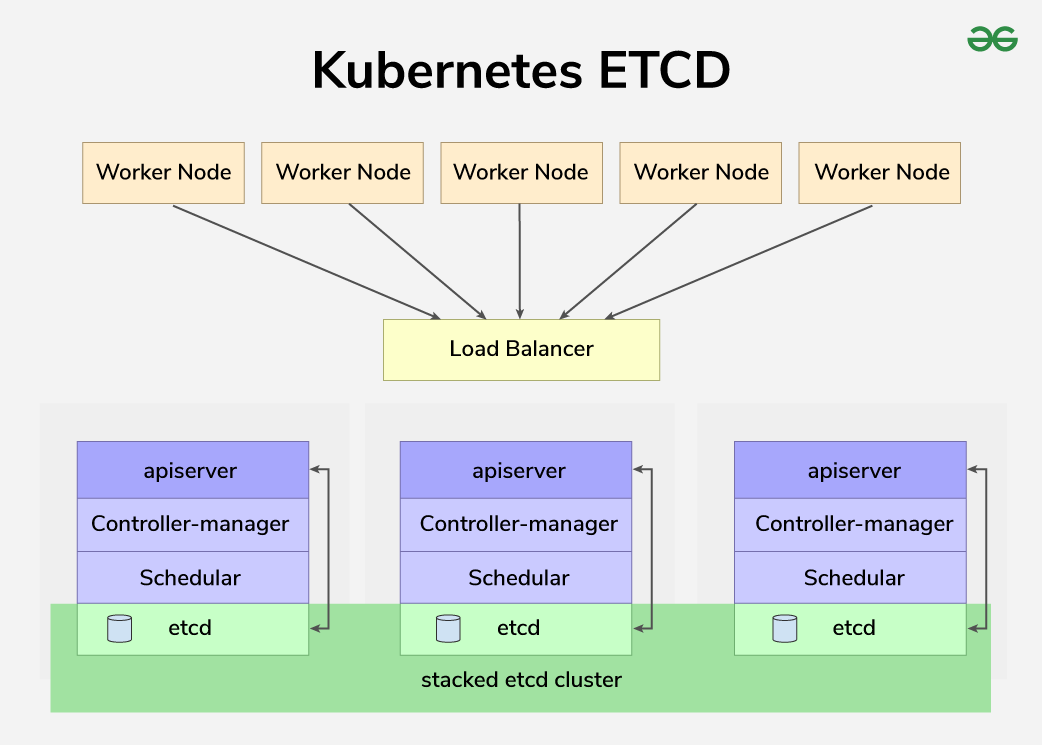
Role of ETCD
ETCD shops all cluster data consisting of modern kingdom, favored state, aid configuration, and performance records. DevOps can consequently use a unmarried node or more than one nodes, including an etcd cluster running Kubernetes’ ETCD API, to manage those clusters. ETCD is an open-source, distributed key-fee save used to capture and manipulate essential records that systems need to preserve running. It manages configuration records, nation information, and metadata, Kubernetes in particular for a popular orchestration platform.
Raft consensus algorithm explanation
To start, Raft states that each node in the reversible state machine (server) can remain in one of three states: master, candidate, and slave. Under normal circumstances, the level may remain at one of the three levels above. Only the administrator can work with the client; Every desire to follow guides the leader. A candidate may request votes to become a director. The follower responds only to the candidates (leaders) or the leader.
To preserve server state(s), the Raft algorithm divides time into small words of arbitrary length. Each word is represented by a number called the word number, which increases automatically.
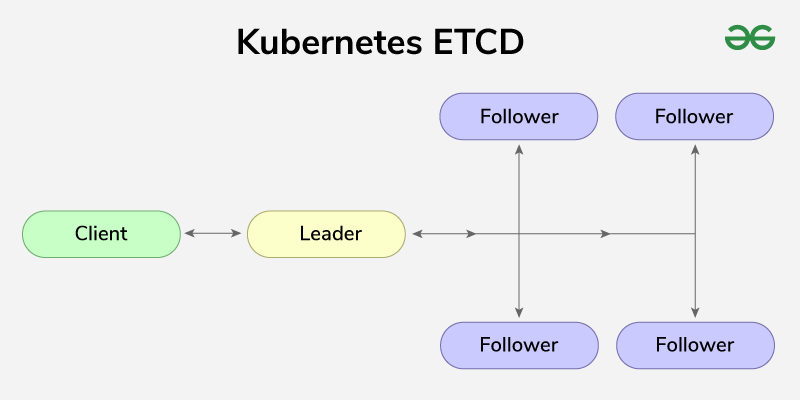
Session Number
This session number is maintained by each node and propagated during communication between nodes. Each period begins with an election to determine a new leader. Candidates request votes from other servers (members) to collect votes. If a majority is reached, the candidate becomes the president of the current term. If the majority is not achieved, this is called split voting and the term ends without a leader. Therefore a word can have at least one leader.
Purpose of Maintaining Word Number
- By looking at the word number of each node, the following tasks are performed:
- Servers update the term number if their term number is less than the term number of other servers in the cluster. This means that when a new term begins the word number will equal the leader or candidate and will be updated to match the last remaining (Leader)
- Candidate or Leader in the state they are following if their term has not expired (others below). If at any point another server has too much time, they can instantly become the leader.
- As we said before, the word server number is also transmitted. If the request reaches the time limit, the request will not be accepted. This essentially means that server nodes will not accept requests from servers with lower numbers. The Raft algorithm uses two types of remote calls (RPCs) to perform tasks: node to simulate login, and also heartbeat to check if the server is up. Still awake. When heartbeat is enabled, the server is active and the server is offline. Please note that heart rate does not include the input signal.
Why ETCD?
It's very hard to act because the records backbone that continues a dispersed obligation going for walks. However, etcd became designed from the ground as much as have the following characteristics:
Completely imitated: Each hub in an etcd bunch methods the total statistics store.
- Easily accessible: etcd is built to gracefully tolerate hardware failures and network partitions and to have no single point of failure.
- Dependably steady: Each datum 'read' returns the most recent information 'compose' across all groups.
- Fast: etcd has been tested at 10,000 writes per second as a benchmark.
- Secure: etcd supports client certificate authentication via secure socket layer (SSL) and automatic Transport Layer Security (TLS). Since etcd stores essential and exceptionally delicate setup information, directors ought to execute job based admittance controls inside the sending and guarantee that colleagues communicating with etcd are restricted to the most un-favored degree of access important to play out their positions.
- Simple: Any application, from straightforward web applications to exceptionally complex compartment arrangement motors like Kubernetes, can peruse or compose information to etcd utilizing standard HTTP/JSON instruments.
CoreOS and History of ETCD
- CoreOS was released in 2013 with the aim of improving the security and reliability of the Internet. The team has developed cloud-native open source software and products that help companies run their applications efficiently and reliably in any environment.
- Red Hat purchased CoreOS at the beginning of 2018 and shared its sales and integration plans.
- On May 26, 2020, CoreOS Container Linux reached end of life and will no longer receive updates.
- CoreOS has developed open source tools that form the basis of modern operating system architecture. Open source tools are still freely used and leverage the power of cloud native. Projects such as Etcd (distributed key value storage), Container Linux (lightweight container-based operating system), Kubernetes (container orchestration), Prometheus (container management system) and others were further developed by Red Hat's CoreOS team. The world's largest developer of open source software.
etcd and Kubernetes
etcd is one of the core parts of Kubernetes and is the primary key-value store for making a Kubernetes cluster that works and can handle faults. Each cluster's state data are stored in etcd by the Kubernetes API server. Kubernetes utilizes etcd's "watch" capability to screen this information and to reconfigure itself when changes happen. The "watch" function can initiate a response when values that represent the cluster's ideal and actual states diverge.
etcd vs. ZooKeeper vs. Consul
Consul | ZooKeeper | etcd |
|---|---|---|
Consular uses a robust model that ensures all nodes in the cluster have the same information at the same time, ensuring reliable and predictable behavior for a given system. | Zookeeper, however, performs robust operations using a steady protocol that lets in studying and writing . | Etcdmirrors consular mode with a strong consistency mechanism, making sure that statistics stays inside the variety of bought deployed products, making suitable for scenarios that require stable guarantees |
A GOOD HTTP API facilitates integration with different programming languages, allowing developers to interact with the service seamlessly. | Zookeeper, on the other hand, relies on proprietary APIs and client libraries aimed primarily at Java developers, which can limit its adoption in multilingual environments. | etcd fills the gap by providing a gRPC API and client libraries for a variety of programming languages, including Go, Python, and JavaScript, offering a comprehensive language and easy integration into a variety of environments. |
Consul's and other key/price stores that allow arbitrary mixtures of facts and keys provide flexibility and comfort in data presentation. | Zookeeper, alternatively, makes use of a machine structure much like a namespace | Etcd bridges the space by using supplying a gRPC API together with client libraries for a couple of programming languages, which includes Go, Python, and JavaScript, making sure broader language help and simplicity of integration throughout diverse ecosystems. |
Consul excels in capabilities such as provider discovery, configuration control, and keep price distribution, making it an quintessential a part of contemporary microservices. | Zookeeper reveals its niche in coordination and coordination of operations in allotted structures, along with querying directors and locking locks, and gives the underlying architecture for complex programs. | etcd excels in use cases involving configuration and coordination across distributed systems, contributing to the flawless performance of Kubernetes clusters and local environments. |
etcd vs. Redis
etcd | Redis |
|---|---|
Distributed key-value store. | Remember key/value database information. The is designed for high-speed, low-speed data access. Supports disk persistence using |
Is designed for highly available and consistent shared resource storage and service discovery. | Snapshots and AOF logs. |
Use a consensus-based approach to strong insurance. | Connection requires manual configuration. |
More APIs for working with structured data, including version and release keys. | Simple APIs for working with key/value data. |
Advantages and Dis-Advantages
- Fully replicated: Every node in an etcd cluster has access the full data store.
- Highly available: etcd is designed to have no single point of failure and gracefully tolerate hardware failures and network partitions.
- Reliably consistent: Every data 'read' returns the latest data 'write' across all clusters.
If etcd malfunctions, it can cause failures on the Kubernetes cluster. You won't be able to deploy any changes to the Kubernetes cluster and hence business SLAs could be severely impacted. etcd is also complex because it has several moving parts.
Conclusion
In summary, Zookeeper offers strong consistency, a simple API, and a mature environment, while etcd offers a linear, rich API and easy integration with Kubernetes. Both are reliable systems suitable for establishing and naming connections in distributed applications. etcd is one of the most important parts of Kubernetes and is the core value store for running Kubernetes clusters and can handle errors. The state of each cluster is stored in etcd and the Kubernetes API server. Kubernetes uses etcd's "monitoring" feature to display this information and update itself when changes occur. The "Watch" function can initiate an analysis when the values represent the best aspect of the set and the accuracy of different cases. But etcd has more fault tolerance, strong failsafes and continuous availability, and most importantly, etcd protects all data stored on disk; The actually sacrifices speed to be more reliable and acceptable. Kubernetes uses etcd to store all its data: configuration information, configuration, and metadata.
