

One's complement is a method of representing binary numbers by inverting every bit of a binary value. It is widely used in digital electronics and computer systems for representing signed numbers and performing binary arithmetic operations.
- It is obtained by replacing every 0 with 1 and every 1 with 0.
- It simplifies operations such as binary subtraction using complement arithmetic.
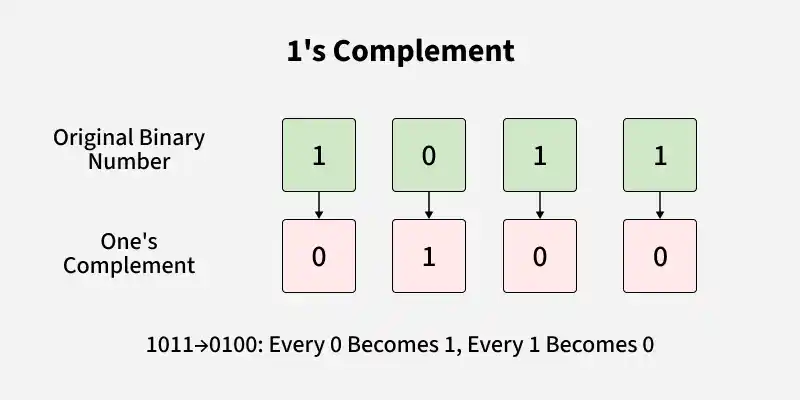
How to Find One's Complement
To find the 1's complement of a binary number:
- Write the binary number.
- Replace every 0 with 1.
- Replace every 1 with 0.
- The resulting binary number is the 1's complement.
Examples
Example 1
Binary Number: 11010011
Replace each 0 with 1 and each 1 with 0.
11010011 → 00101100
1's Complement = 00101100
Example 2
Binary Number: 00111.001
Replace each 0 with 1 and each 1 with 0 (the binary point remains unchanged).
00111.001 → 11000.110
1's Complement = 11000.110
1's Complement of 4-Bit Binary Numbers
| Number | Binary Representation | 1's complement |
|---|---|---|
| 0 | 0000 | 1111 |
| 1 | 0001 | 1110 |
| 2 | 0010 | 1101 |
| 3 | 0011 | 1100 |
| 4 | 0100 | 1011 |
| 5 | 0101 | 1010 |
| 6 | 0110 | 1001 |
| 7 | 0111 | 1000 |
| 8 | 1000 | 0111 |
| 9 | 1001 | 0110 |
| 10 | 1010 | 0101 |
| 11 | 1011 | 0100 |
| 12 | 1100 | 0011 |
| 13 | 1101 | 0010 |
| 14 | 1110 | 0001 |
| 15 | 1111 | 0000 |
Representation of Negative Numbers Using 1's Complement
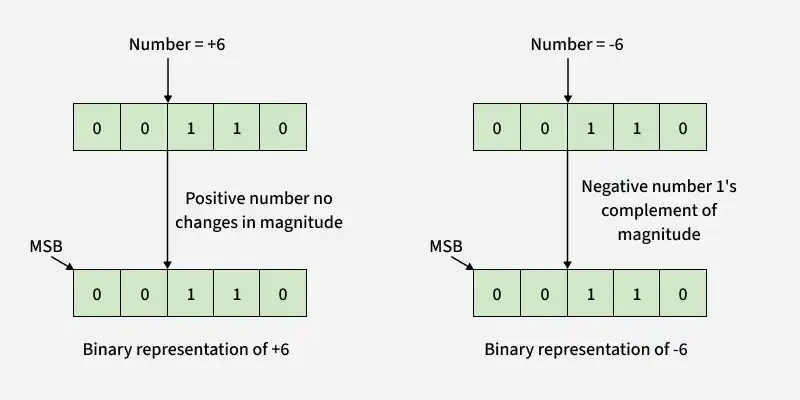
In 1's complement representation:
- Positive numbers remain unchanged.
- Negative numbers are represented by taking the 1's complement of the corresponding positive binary number.
- The leftmost bit (MSB) acts as the sign bit.
Range of 1's Complement Numbers
For an n-bit 1's complement representation:
- Minimum value: -(2(n-1)-1)
- Maximum value: +(2(n-1)-1)
Note: 1's complement has two representations for zero:
- Positive zero:
0000...0000- Negative zero:
1111...1111
