
A matching in a Bipartite Graph is a set of the edges chosen in such a way that no two edges share an endpoint. A maximum matching is a matching that contains the maximum possible number of edges. There can be more than one maximum matching for a given bipartite graph.
Why do we care?
There are many real world problems that can be formed as Bipartite Matching. For example, consider the following problem:
"There are M job applicants and N jobs. Each applicant has a subset of jobs that he/she is interested in. Each job opening can only accept one applicant and a job applicant can be appointed for only one job. Find an assignment of jobs to applicants in such that as many applicants as possible get jobs."
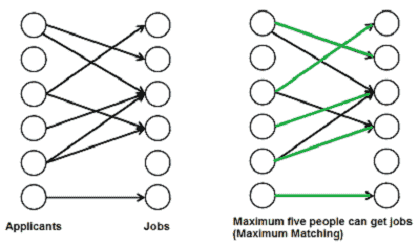
We strongly recommend to read the following post first. "Ford-Fulkerson Algorithm for Maximum Flow Problem"
Maximum Bipartite Matching and Max Flow Problem:
Maximum Bipartite Matching (MBP) problem can be solved by converting it into a flow network.
1. Build a Flow Network : There must be a source and sink in a flow network. So we add a source and add edges from source to all applicants. Similarly, add edges from all jobs to sink. The capacity of every edge is marked as 1 unit.
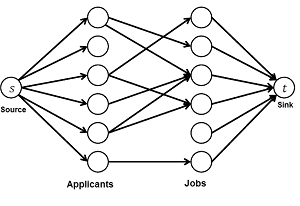
2. Find the maximum flow: We use Ford-Fulkerson algorithm to find the maximum flow in the flow network built in step 1. The maximum flow is actually the MBP we are looking for.
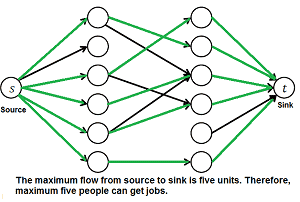
Let's solve a problem for better understanding:
There are m job applicants and n job openings. Each applicant is interested in a subset of the available jobs. You are given a binary matrix mat[][] of size m × n, where:
- mat[i][j] = 1 indicates that the i-th applicant is interested in the j-th job.
- mat[i][j] = 0 indicates that the applicant is not interested in that job.
Each job can be assigned to only one applicant, and each applicant can be assigned to at most one job. Determine the maximum number of applicants that can be assigned jobs according to their interests.
Example:
Input: mat = [[1, 1, 0, 1, 1], [0, 1, 0, 0, 1], [1, 1, 0, 1, 1]]
Output: 3
Explanation: The following is one of the possible assignments:
First applicant gets the 1st job.
Second applicant gets the 2nd job.
Third applicant gets the 4th job.Input: mat = [[1, 1], [0, 1], [0, 1], [0, 1], [0, 1], [1, 0]]
Output: 2
Explanation: The following is one of the possible assignments:
First applicant gets the 1st job.
Second applicant gets the 2nd job

Table of Content
[Expected Approach] Using Ford - Fulkerson Algorithm - O(V * E) Time and O(V + E) Space
This problem can be viewed as a simplified version of the Ford–Fulkerson algorithm on a bipartite graph where every edge has capacity 1. The idea is to use DFS to find an augmenting path for each applicant. For every applicant, we try all jobs he is interested in. If a job is free, we assign it directly. Otherwise, we recursively try to reassign the currently assigned applicant to another job. If reassignment is possible, we assign the current job to the new applicant. Every successful DFS represents an augmenting path and increases the maximum matching by 1.
- Create an array assignedApplicant[] to store which applicant is assigned to each job and initialize all values as -1.
- For every applicant, perform a DFS traversal to try assigning a job.
- In DFS, iterate through all jobs that the current applicant is interested in.
- If a job is not visited and is free, assign that job to the applicant.
- If the job is already assigned, recursively try to reassign the currently assigned applicant to another job.
- If assignment/reassignment is successful, increase the maximum matching count by 1.
#include <bits/stdc++.h>
using namespace std;

// Function to check whether an applicant can get a job
// using DFS traversal
bool canAssignJob(int applicant, vector<vector<int>> &mat, vector<bool> &visitedJobs,
                  vector<int> &assignedApplicant, int totalJobs)
{
    // Try every job one by one
    for (int job = 0; job < totalJobs; job++)
    {
        // If applicant is interested in this job
        // and this job is not visited yet
        if (mat[applicant][job] == 1 && !visitedJobs[job])
        {
            // Mark current job as visited
            visitedJobs[job] = true;

            // If job is free OR previously assigned
            // applicant can get another job
            if (assignedApplicant[job] == -1 ||
                canAssignJob(assignedApplicant[job], mat, visitedJobs, assignedApplicant, totalJobs))
            {
                // Assign current job to applicant
                assignedApplicant[job] = applicant;

                return true;
            }
        }
    }

    // No job could be assigned
    return false;
}

// Function to find maximum bipartite matching
int maximumMatch(vector<vector<int>> &mat)
{
    int totalApplicants = mat.size();
    int totalJobs = mat[0].size();

    // assignedApplicant[j] stores the applicant
    // assigned to job j
    // -1 means no applicant assigned
    vector<int> assignedApplicant(totalJobs, -1);

    // Stores final maximum matching count
    int maximumMatching = 0;

    // Try assigning jobs to every applicant
    for (int applicant = 0; applicant < totalApplicants; applicant++)
    {
        // Keeps track of visited jobs
        // during current DFS call
        vector<bool> visitedJobs(totalJobs, false);

        // If applicant gets a job
        if (canAssignJob(applicant, mat, visitedJobs, assignedApplicant, totalJobs))
        {
            maximumMatching++;
        }
    }

    return maximumMatching;
}
// Driver Code
int main()
{
    vector<vector<int>> mat = {{0, 1, 1, 0, 0, 0}, {1, 0, 0, 1, 0, 0}, {0, 0, 1, 0, 0, 0},
                               {0, 0, 1, 1, 0, 0}, {0, 0, 0, 0, 0, 0}, {0, 0, 0, 0, 0, 1}};

    cout << maximumMatch(mat);

    return 0;
}
import java.util.*;

public class GFG {

    // Function to check whether an applicant can get a job
    // using DFS traversal
    static boolean canAssignJob(int applicant, int[][] mat,
                                 boolean[] visitedJobs,
                                 int[] assignedApplicant,
                                 int totalJobs)
    {
        // Try every job one by one
        for (int job = 0; job < totalJobs; job++) {

            // If applicant is interested in this job
            // and this job is not visited yet
            if (mat[applicant][job] == 1
                && !visitedJobs[job]) {

                // Mark current job as visited
                visitedJobs[job] = true;

                // If job is free OR previously assigned
                // applicant can get another job
                if (assignedApplicant[job] == -1
                    || canAssignJob(assignedApplicant[job],
                                    mat, visitedJobs,
                                    assignedApplicant,
                                    totalJobs)) {

                    // Assign current job to applicant
                    assignedApplicant[job] = applicant;

                    return true;
                }
            }
        }

        // No job could be assigned
        return false;
    }

    // Function to find maximum bipartite matching
    static int maximumMatch(int[][] mat)
    {
        int totalApplicants = mat.length;
        int totalJobs = mat[0].length;

        // assignedApplicant[j] stores applicant
        // assigned to job j
        int[] assignedApplicant = new int[totalJobs];

        // Initially all jobs are unassigned
        Arrays.fill(assignedApplicant, -1);

        int maximumMatching = 0;

        // Try assigning every applicant
        for (int applicant = 0; applicant < totalApplicants;
             applicant++) {

            // Keeps track of visited jobs
            boolean[] visitedJobs = new boolean[totalJobs];

            // If applicant gets a job
            if (canAssignJob(applicant, mat, visitedJobs,
                             assignedApplicant,
                             totalJobs)) {

                maximumMatching++;
            }
        }

        return maximumMatching;
    }

    public static void main(String[] args)
    {
        int[][] mat = {
            { 0, 1, 1, 0, 0, 0 }, { 1, 0, 0, 1, 0, 0 },
            { 0, 0, 1, 0, 0, 0 }, { 0, 0, 1, 1, 0, 0 },
            { 0, 0, 0, 0, 0, 0 }, { 0, 0, 0, 0, 0, 1 }
        };

        System.out.println(maximumMatch(mat));
    }
}
# Function to check whether an applicant can get a job
# using DFS traversal
def canAssignJob(applicant, mat, visitedJobs, assignedApplicant, totalJobs):

    # Try every job one by one
    for job in range(totalJobs):

        # If applicant is interested in this job
        # and this job is not visited yet
        if (mat[applicant][job] == 1 and
                not visitedJobs[job]):

            # Mark current job as visited
            visitedJobs[job] = True

            # If job is free OR previously assigned
            # applicant can get another job
            if (assignedApplicant[job] == -1 or canAssignJob(assignedApplicant[job], mat, visitedJobs, assignedApplicant, totalJobs)):

                # Assign current job to applicant
                assignedApplicant[job] = applicant

                return True

    # No job could be assigned
    return False

# Function to find maximum bipartite matching
def maximumMatch(mat):

    totalApplicants = len(mat)
    totalJobs = len(mat[0])

    # assignedApplicant[j] stores applicant
    # assigned to job j
    assignedApplicant = [-1] * totalJobs

    maximumMatching = 0

    # Try assigning every applicant
    for applicant in range(totalApplicants):

        # Keeps track of visited jobs
        visitedJobs = [False] * totalJobs

        # If applicant gets a job
        if canAssignJob(applicant, mat, visitedJobs, assignedApplicant, totalJobs):

            maximumMatching += 1

    return maximumMatching


# Driver Code
if __name__ == "__main__":
    mat = [
        [0, 1, 1, 0, 0, 0],
        [1, 0, 0, 1, 0, 0],
        [0, 0, 1, 0, 0, 0],
        [0, 0, 1, 1, 0, 0],
        [0, 0, 0, 0, 0, 0],
        [0, 0, 0, 0, 0, 1]
    ]

    print(maximumMatch(mat))
using System;

class GFG {

    // Function to check whether an applicant can get a job
    // using DFS traversal
    static bool CanAssignJob(int applicant, int[][] mat,
                             bool[] visitedJobs,
                             int[] assignedApplicant,
                             int totalJobs)
    {
        // Try every job one by one
        for (int job = 0; job < totalJobs; job++) {
            // If applicant is interested in this job
            // and this job is not visited yet
            if (mat[applicant][job] == 1
                && !visitedJobs[job]) {
                // Mark current job as visited
                visitedJobs[job] = true;

                // If job is free OR previously assigned
                // applicant can get another job
                if (assignedApplicant[job] == -1
                    || CanAssignJob(assignedApplicant[job],
                                    mat, visitedJobs,
                                    assignedApplicant,
                                    totalJobs)) {
                    // Assign current job to applicant
                    assignedApplicant[job] = applicant;

                    return true;
                }
            }
        }

        // No job could be assigned
        return false;
    }

    // Function to find maximum bipartite matching
    static int maximumMatch(int[][] mat)
    {
        int totalApplicants = mat.Length;
        int totalJobs = mat[0].Length;

        // assignedApplicant[j] stores applicant
        // assigned to job j
        int[] assignedApplicant = new int[totalJobs];

        // Initially all jobs are unassigned
        Array.Fill(assignedApplicant, -1);

        int maximumMatching = 0;

        // Try assigning every applicant
        for (int applicant = 0; applicant < totalApplicants;
             applicant++) {
            // Keeps track of visited jobs
            bool[] visitedJobs = new bool[totalJobs];

            // If applicant gets a job
            if (CanAssignJob(applicant, mat, visitedJobs,
                             assignedApplicant,
                             totalJobs)) {
                maximumMatching++;
            }
        }

        return maximumMatching;
    }

    static void Main()
    {
        int[][] mat = { new int[] { 0, 1, 1, 0, 0, 0 },
                        new int[] { 1, 0, 0, 1, 0, 0 },
                        new int[] { 0, 0, 1, 0, 0, 0 },
                        new int[] { 0, 0, 1, 1, 0, 0 },
                        new int[] { 0, 0, 0, 0, 0, 0 },
                        new int[] { 0, 0, 0, 0, 0, 1 } };

        Console.WriteLine(maximumMatch(mat));
    }
}
// Function to check whether an applicant can get a job
// using DFS traversal
function canAssignJob(applicant, mat, visitedJobs,
                      assignedApplicant, totalJobs)
{
    // Try every job one by one
    for (let job = 0; job < totalJobs; job++) {

        // If applicant is interested in this job
        // and this job is not visited yet
        if (mat[applicant][job] === 1
            && !visitedJobs[job]) {

            // Mark current job as visited
            visitedJobs[job] = true;

            // If job is free OR previously assigned
            // applicant can get another job
            if (assignedApplicant[job] === -1
                || canAssignJob(assignedApplicant[job], mat,
                                visitedJobs,
                                assignedApplicant,
                                totalJobs)) {

                // Assign current job to applicant
                assignedApplicant[job] = applicant;

                return true;
            }
        }
    }

    // No job could be assigned
    return false;
}

// Function to find maximum bipartite matching
function maximumMatch(mat)
{
    const totalApplicants = mat.length;
    const totalJobs = mat[0].length;

    // assignedApplicant[j] stores applicant
    // assigned to job j
    const assignedApplicant = new Array(totalJobs).fill(-1);

    let maximumMatching = 0;

    // Try assigning every applicant
    for (let applicant = 0; applicant < totalApplicants;
         applicant++) {

        // Keeps track of visited jobs
        const visitedJobs
            = new Array(totalJobs).fill(false);

        // If applicant gets a job
        if (canAssignJob(applicant, mat, visitedJobs,
                         assignedApplicant, totalJobs)) {

            maximumMatching++;
        }
    }

    return maximumMatching;
}

// Driver Code
const mat = [
    [ 0, 1, 1, 0, 0, 0 ], [ 1, 0, 0, 1, 0, 0 ],
    [ 0, 0, 1, 0, 0, 0 ], [ 0, 0, 1, 1, 0, 0 ],
    [ 0, 0, 0, 0, 0, 0 ], [ 0, 0, 0, 0, 0, 1 ]
];

console.log(maximumMatch(mat));
Output
5
Time Complexity: O(V * E), where V is the number of vertices in the graph and E is the number of edges. The algorithm iterates over each vertex in the graph and then performs a DFS on the corresponding edges to find the maximum bipartite matching.
Space Complexity: O(V + E) as it uses a two-dimensional boolean array to store the graph and an array to store the maximum matching.
[Optimized Approach] Using Hopcroft–Karp Algorithm - O(sqrt(V) * E) Time and O(V) Space
Let us define few terms before we discuss the algorithm
Free Node or Vertex: Given a matching M, a node that is not part of matching is called free node. Initially all vertices as free (See first graph of below diagram). In second graph, u2 and v2 are free. In third graph, no vertex is free.
Matching and Not-Matching edges: Given a matching M, edges that are part of matching are called Matching edges and edges that are not part of M (or connect free nodes) are called Not-Matching edges. In first graph, all edges are non-matching. In second graph, (u0, v1), (u1, v0) and (u3, v3) are matching and others not-matching.
Alternating Paths: Given a matching M, an alternating path is a path in which the edges belong alternatively to the matching and not matching. All single edges paths are alternating paths. Examples of alternating paths in middle graph are u0-v1-u2 and u2-v1-u0-v2.
Augmenting path: Given a matching M, an augmenting path is an alternating path that starts from and ends on free vertices. All single edge paths that start and end with free vertices are augmenting paths. In below diagram, augmenting paths are highlighted with blue color. Note that the augmenting path always has one extra matching edge. The Hopcroft Karp algorithm is based on below concept. A matching M is not maximum if there exists an augmenting path. It is also true other way, i.e, a matching is maximum if no augmenting path exists So the idea is to one by one look for augmenting paths. And add the found paths to current matching.
Hopcroft Karp Algorithm:
1) Initialize Maximal Matching M as empty.
2) While there exists an Augmenting Path p
- Remove matching edges of p from M and add not-matching edges of p to M
- (This increases size of M by 1 as p starts and ends with a free vertex)
3) Return M.
Below diagram shows working of the algorithm.
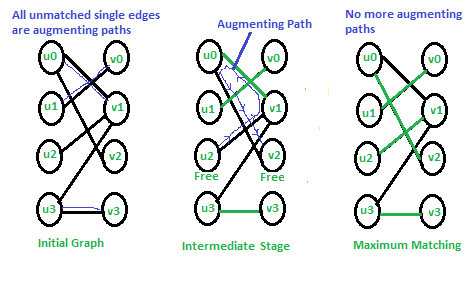 The idea is to use BFS (Breadth First Search) to find augmenting paths. Since BFS traverses level by level, it is used to divide the graph in layers of matching and not matching edges. A dummy vertex NIL is added that is connected to all vertices on the left side and all vertices on the right side. The following arrays are used to find augmenting paths. Distance to NIL is initialized as INF (infinite). If we start from a dummy vertex and come back to it using alternating paths of distinct vertices, then there is an augmenting path.
- pairU[]: An array of size m+1 where m is the number of vertices on the left side of the Bipartite Graph. pairU[u] stores paa r of u on the right side if u is matched and NIL otherwise.
- pairV[]: An array of size n+1 where n is several vertices on the right side of the Bipartite Graph. pairV[v] stores a pair of v on the left side if v is matched and NIL otherwise.
- dist[]: An array of size m+1 where m is several vertices on the left side of the Bipartite Graph. dist[u] is initialized as 0 if u is not matching and INF (infinite) otherwise. dist[] of NIL is also initialized as INF
Once an augmenting path is found, DFS (Depth First Search) is used to add augmenting paths to current matching. DFS simply follows the distance array setup by BFS. It fills values in pairU[u] and pairV[v] if v is next to u in BFS.
#include <bits/stdc++.h>
using namespace std;

// BFS Function
// Builds layers using shortest augmenting paths
bool bfs(vector<vector<int>> &mat, vector<int> &pairU, vector<int> &pairV, vector<int> &dist,
         int totalApplicants, int totalJobs)
{
    // Queue used for BFS traversal
    queue<int> q;

    // Traverse all applicants
    for (int applicant = 1; applicant <= totalApplicants; applicant++)
    {
        // If applicant is free
        if (pairU[applicant] == 0)
        {
            // Free applicants belong to level 0
            dist[applicant] = 0;

            // Push applicant into queue
            q.push(applicant);
        }
        else
        {
            // Mark matched applicants as unvisited
            dist[applicant] = INT_MAX;
        }
    }

    // Distance to NIL node
    dist[0] = INT_MAX;

    // Perform BFS traversal
    while (!q.empty())
    {
        // Get current applicant
        int applicant = q.front();

        // Remove from queue
        q.pop();

        // If current layer is useful
        if (dist[applicant] < dist[0])
        {
            // Traverse all jobs
            for (int job = 1; job <= totalJobs; job++)
            {
                // If edge exists
                if (mat[applicant - 1][job - 1])
                {
                    // Get applicant assigned
                    // to current job
                    int nextApplicant = pairV[job];

                    // If not visited
                    if (dist[nextApplicant] == INT_MAX)
                    {
                        // Assign next BFS layer
                        dist[nextApplicant] = dist[applicant] + 1;

                        // Push into queue
                        q.push(nextApplicant);
                    }
                }
            }
        }
    }

    // If NIL node reachable,
    // augmenting path exists
    return dist[0] != INT_MAX;
}

// DFS Function
// Finds augmenting paths using BFS layers
bool canAssignJob(int applicant, vector<vector<int>> &mat, vector<int> &pairU, vector<int> &pairV,
                  vector<int> &dist, int totalJobs)
{
    // If NIL node reached,
    // augmenting path found
    if (applicant == 0)
    {
        return true;
    }

    // Traverse all jobs
    for (int job = 1; job <= totalJobs; job++)
    {
        // If edge exists
        if (mat[applicant - 1][job - 1])
        {
            // Get applicant assigned
            // to current job
            int nextApplicant = pairV[job];

            // Follow only valid BFS layers
            if (dist[nextApplicant] == dist[applicant] + 1)
            {
                // Recursively try to find
                // augmenting path
                if (canAssignJob(nextApplicant, mat, pairU, pairV, dist, totalJobs))
                {
                    // Assign current job
                    // to current applicant
                    pairV[job] = applicant;

                    // Assign current applicant
                    // to current job
                    pairU[applicant] = job;

                    // Matching successful
                    return true;
                }
            }
        }
    }

    // Mark node as useless
    dist[applicant] = INT_MAX;

    // No augmenting path found
    return false;
}


// Function to find maximum bipartite matching
int maximumMatch(vector<vector<int>> &mat)
{
    // Number of applicants
    int totalApplicants = mat.size();

    // Number of jobs
    int totalJobs = mat[0].size();

    // pairU[u] stores job assigned
    // to applicant u
    vector<int> pairU(totalApplicants + 1, 0);

    // pairV[v] stores applicant assigned
    // to job v
    vector<int> pairV(totalJobs + 1, 0);

    // Distance array used in BFS
    vector<int> dist(totalApplicants + 1);

    // Stores final maximum matching
    int maximumMatching = 0;

    // Repeat while augmenting path exists
    while (bfs(mat, pairU, pairV, dist, totalApplicants, totalJobs))
    {
        // Traverse all applicants
        for (int applicant = 1; applicant <= totalApplicants; applicant++)
        {
            // If applicant is free
            if (pairU[applicant] == 0)
            {
                // Try assigning a job
                if (canAssignJob(applicant, mat, pairU, pairV, dist, totalJobs))
                {
                    // Increase matching count
                    maximumMatching++;
                }
            }
        }
    }

    // Return final answer
    return maximumMatching;
}

int main()
{
    // Adjacency matrix representation
    // mat[i][j] = 1 means
    // applicant i interested in job j
    vector<vector<int>> mat = {{0, 1, 1, 0, 0, 0}, {1, 0, 0, 1, 0, 0}, {0, 0, 1, 0, 0, 0},
                               {0, 0, 1, 1, 0, 0}, {0, 0, 0, 0, 0, 0}, {0, 0, 0, 0, 0, 1}};

    // Print maximum matching
    cout << maximumMatch(mat);

    return 0;
}
import java.util.*;

public class GFG {
    // BFS Function
    // Builds layers using shortest augmenting paths
    static boolean bfs(int[][] mat, int[] pairU,
                       int[] pairV, int[] dist,
                       int totalApplicants, int totalJobs)
    {
        // Queue used for BFS traversal
        Queue<Integer> q = new LinkedList<>();

        // Traverse all applicants
        for (int applicant = 1;
             applicant <= totalApplicants; applicant++) {
            // If applicant is free
            if (pairU[applicant] == 0) {
                // Free applicants belong to level 0
                dist[applicant] = 0;

                // Push applicant into queue
                q.offer(applicant);
            }
            else {
                // Mark matched applicants as unvisited
                dist[applicant] = Integer.MAX_VALUE;
            }
        }

        // Distance to NIL node
        dist[0] = Integer.MAX_VALUE;

        // Perform BFS traversal
        while (!q.isEmpty()) {
            // Get current applicant
            int applicant = q.poll();

            // If current layer is useful
            if (dist[applicant] < dist[0]) {
                // Traverse all jobs
                for (int job = 1; job <= totalJobs; job++) {
                    // If edge exists
                    if (mat[applicant - 1][job - 1] == 1) {
                        // Get applicant assigned
                        // to current job
                        int nextApplicant = pairV[job];

                        // If not visited
                        if (dist[nextApplicant]
                            == Integer.MAX_VALUE) {
                            // Assign next BFS layer
                            dist[nextApplicant]
                                = dist[applicant] + 1;

                            // Push into queue
                            q.offer(nextApplicant);
                        }
                    }
                }
            }
        }

        // If NIL node reachable,
        // augmenting path exists
        return dist[0] != Integer.MAX_VALUE;
    }

    // DFS Function
    // Finds augmenting paths using BFS layers
    static boolean canAssignJob(int applicant, int[][] mat,
                                int[] pairU, int[] pairV,
                                int[] dist, int totalJobs)
    {
        // If NIL node reached,
        // augmenting path found
        if (applicant == 0) {
            return true;
        }

        // Traverse all jobs
        for (int job = 1; job <= totalJobs; job++) {
            // If edge exists
            if (mat[applicant - 1][job - 1] == 1) {
                // Get applicant assigned
                // to current job
                int nextApplicant = pairV[job];

                // Follow only valid BFS layers
                if (dist[nextApplicant]
                    == dist[applicant] + 1) {
                    // Recursively try to find
                    // augmenting path
                    if (canAssignJob(nextApplicant, mat,
                                     pairU, pairV, dist,
                                     totalJobs)) {
                        // Assign current job
                        // to current applicant
                        pairV[job] = applicant;

                        // Assign current applicant
                        // to current job
                        pairU[applicant] = job;

                        // Matching successful
                        return true;
                    }
                }
            }
        }

        // Mark node as useless
        dist[applicant] = Integer.MAX_VALUE;

        // No augmenting path found
        return false;
    }

    // Function to find maximum bipartite matching
    static int maximumMatch(int[][] mat)
    {
        // Number of applicants
        int totalApplicants = mat.length;

        // Number of jobs
        int totalJobs = mat[0].length;

        // pairU[u] stores job assigned
        // to applicant u
        int[] pairU = new int[totalApplicants + 1];

        // pairV[v] stores applicant assigned
        // to job v
        int[] pairV = new int[totalJobs + 1];

        // Distance array used in BFS
        int[] dist = new int[totalApplicants + 1];

        // Stores final maximum matching
        int maximumMatching = 0;

        // Repeat while augmenting path exists
        while (bfs(mat, pairU, pairV, dist, totalApplicants,
                   totalJobs)) {
            // Traverse all applicants
            for (int applicant = 1;
                 applicant <= totalApplicants;
                 applicant++) {
                // If applicant is free
                if (pairU[applicant] == 0) {
                    // Try assigning a job
                    if (canAssignJob(applicant, mat, pairU,
                                     pairV, dist,
                                     totalJobs)) {
                        // Increase matching count
                        maximumMatching++;
                    }
                }
            }
        }

        // Return final answer
        return maximumMatching;
    }

    public static void main(String[] args)
    {
        // Adjacency matrix representation
        int[][] mat = {
            { 0, 1, 1, 0, 0, 0 }, { 1, 0, 0, 1, 0, 0 },
            { 0, 0, 1, 0, 0, 0 }, { 0, 0, 1, 1, 0, 0 },
            { 0, 0, 0, 0, 0, 0 }, { 0, 0, 0, 0, 0, 1 }
        };

        // Print maximum matching
        System.out.println(maximumMatch(mat));
    }
}
from collections import deque

# BFS Function
# Builds layers using shortest augmenting paths


def bfs(mat, pairU, pairV, dist, totalApplicants, totalJobs):

    # Queue used for BFS traversal
    q = deque()

    # Traverse all applicants
    for applicant in range(1, totalApplicants + 1):

        # If applicant is free
        if pairU[applicant] == 0:

            # Free applicants belong to level 0
            dist[applicant] = 0

            # Push applicant into queue
            q.append(applicant)

        else:
            # Mark matched applicants as unvisited
            dist[applicant] = float('inf')

    # Distance to NIL node
    dist[0] = float('inf')

    # Perform BFS traversal
    while q:

        # Get front applicant
        applicant = q.popleft()

        # If current layer is useful
        if dist[applicant] < dist[0]:

            # Traverse all jobs
            for job in range(1, totalJobs + 1):

                # If edge exists
                if mat[applicant - 1][job - 1]:

                    # Get applicant assigned to this job
                    nextApplicant = pairV[job]

                    # If not visited
                    if dist[nextApplicant] == float('inf'):

                        # Assign next BFS layer
                        dist[nextApplicant] = (
                            dist[applicant] + 1
                        )

                        # Push into queue
                        q.append(nextApplicant)

    # If NIL node reachable,
    # augmenting path exists
    return dist[0] != float('inf')


# DFS Function
# Finds augmenting paths using BFS layers
def canAssignJob(applicant, mat, pairU, pairV, dist, totalJobs):

    # If NIL node reached,
    # augmenting path found
    if applicant == 0:
        return True

    # Traverse all jobs
    for job in range(1, totalJobs + 1):

        # If edge exists
        if mat[applicant - 1][job - 1]:

            # Get applicant assigned to current job
            nextApplicant = pairV[job]

            # Follow only valid BFS layers
            if dist[nextApplicant] == (
                dist[applicant] + 1
            ):

                # Recursively try to find
                # augmenting path
                if canAssignJob(nextApplicant, mat, pairU, pairV, dist, totalJobs):

                    # Assign current job
                    # to current applicant
                    pairV[job] = applicant

                    # Assign current applicant
                    # to current job
                    pairU[applicant] = job

                    # Matching successful
                    return True

    # Mark node as useless
    dist[applicant] = float('inf')

    # No augmenting path found
    return False


# Function to find maximum bipartite matching
def maximumMatch(mat):

    # Number of applicants
    totalApplicants = len(mat)

    # Number of jobs
    totalJobs = len(mat[0])

    # pairU[u] stores job assigned
    # to applicant u
    pairU = [0] * (totalApplicants + 1)

    # pairV[v] stores applicant assigned
    # to job v
    pairV = [0] * (totalJobs + 1)

    # Distance array used in BFS
    dist = [0] * (totalApplicants + 1)

    # Stores final maximum matching
    maximumMatching = 0

    # Repeat while augmenting path exists
    while bfs(mat, pairU, pairV, dist, totalApplicants, totalJobs):

        # Traverse all applicants
        for applicant in range(1, totalApplicants + 1):

            # If applicant is free
            if pairU[applicant] == 0:

                # Try assigning a job
                if canAssignJob(applicant, mat, pairU, pairV, dist, totalJobs):

                    # Increase matching count
                    maximumMatching += 1

    # Return final answer
    return maximumMatching


# Driver Code
if __name__ == "__main__":

    # Adjacency matrix representation
    # mat[i][j] = 1 means
    # applicant i interested in job j
    mat = [
        [0, 1, 1, 0, 0, 0],
        [1, 0, 0, 1, 0, 0],
        [0, 0, 1, 0, 0, 0],
        [0, 0, 1, 1, 0, 0],
        [0, 0, 0, 0, 0, 0],
        [0, 0, 0, 0, 0, 1]
    ]

    # Print maximum matching
    print(maximumMatch(mat))
using System;
using System.Collections.Generic;

class Program {

    // BFS Function
    // Builds layers using shortest augmenting paths
    static bool bfs(int[][] mat, int[] pairU, int[] pairV,
                    int[] dist, int totalApplicants,
                    int totalJobs)
    {
        // Queue used for BFS traversal
        Queue<int> q = new Queue<int>();

        // Traverse all applicants
        for (int applicant = 1;
             applicant <= totalApplicants; applicant++) {
            // If applicant is free
            if (pairU[applicant] == 0) {
                // Free applicants belong to level 0
                dist[applicant] = 0;

                // Push applicant into queue
                q.Enqueue(applicant);
            }
            else {
                // Mark matched applicants as unvisited
                dist[applicant] = int.MaxValue;
            }
        }

        // Distance to NIL node
        dist[0] = int.MaxValue;

        // Perform BFS traversal
        while (q.Count > 0) {
            // Get current applicant
            int applicant = q.Dequeue();

            // If current layer is useful
            if (dist[applicant] < dist[0]) {
                // Traverse all jobs
                for (int job = 1; job <= totalJobs; job++) {
                    // If edge exists
                    if (mat[applicant - 1][job - 1] == 1) {
                        // Get applicant assigned
                        // to current job
                        int nextApplicant = pairV[job];

                        // If not visited
                        if (dist[nextApplicant]
                            == int.MaxValue) {
                            // Assign next BFS layer
                            dist[nextApplicant]
                                = dist[applicant] + 1;

                            // Push into queue
                            q.Enqueue(nextApplicant);
                        }
                    }
                }
            }
        }

        // If NIL node reachable,
        // augmenting path exists
        return dist[0] != int.MaxValue;
    }

    // DFS Function
    // Finds augmenting paths using BFS layers
    static bool CanAssignJob(int applicant, int[][] mat,
                             int[] pairU, int[] pairV,
                             int[] dist, int totalJobs)
    {
        // If NIL node reached,
        // augmenting path found
        if (applicant == 0) {
            return true;
        }

        // Traverse all jobs
        for (int job = 1; job <= totalJobs; job++) {
            // If edge exists
            if (mat[applicant - 1][job - 1] == 1) {
                // Get applicant assigned
                // to current job
                int nextApplicant = pairV[job];

                // Follow only valid BFS layers
                if (dist[nextApplicant]
                    == dist[applicant] + 1) {
                    // Recursively try to find
                    // augmenting path
                    if (CanAssignJob(nextApplicant, mat,
                                     pairU, pairV, dist,
                                     totalJobs)) {
                        // Assign current job
                        // to current applicant
                        pairV[job] = applicant;

                        // Assign current applicant
                        // to current job
                        pairU[applicant] = job;

                        // Matching successful
                        return true;
                    }
                }
            }
        }

        // Mark node as useless
        dist[applicant] = int.MaxValue;

        // No augmenting path found
        return false;
    }

    // Function to find maximum bipartite matching
    static int maximumMatch(int[][] mat)
    {
        // Number of applicants
        int totalApplicants = mat.Length;

        // Number of jobs
        int totalJobs = mat[0].Length;

        // pairU[u] stores job assigned
        // to applicant u
        int[] pairU = new int[totalApplicants + 1];

        // pairV[v] stores applicant assigned
        // to job v
        int[] pairV = new int[totalJobs + 1];

        // Distance array used in BFS
        int[] dist = new int[totalApplicants + 1];

        // Stores final maximum matching
        int maximumMatching = 0;

        // Repeat while augmenting path exists
        while (bfs(mat, pairU, pairV, dist, totalApplicants,
                   totalJobs)) {
            // Traverse all applicants
            for (int applicant = 1;
                 applicant <= totalApplicants;
                 applicant++) {
                // If applicant is free
                if (pairU[applicant] == 0) {
                    // Try assigning a job
                    if (CanAssignJob(applicant, mat, pairU,
                                     pairV, dist,
                                     totalJobs)) {
                        // Increase matching count
                        maximumMatching++;
                    }
                }
            }
        }

        // Return final answer
        return maximumMatching;
    }

    static void Main()
    {
        // Adjacency matrix representation
        int[][] mat = { new int[] { 0, 1, 1, 0, 0, 0 },
                        new int[] { 1, 0, 0, 1, 0, 0 },
                        new int[] { 0, 0, 1, 0, 0, 0 },
                        new int[] { 0, 0, 1, 1, 0, 0 },
                        new int[] { 0, 0, 0, 0, 0, 0 },
                        new int[] { 0, 0, 0, 0, 0, 1 } };

        // Print maximum matching
        Console.WriteLine(maximumMatch(mat));
    }
}
// BFS Function
// Builds layers using shortest augmenting paths
function bfs(mat, pairU, pairV, dist, totalApplicants,
             totalJobs)
{
    // Queue used for BFS traversal
    let queue = [];

    // Traverse all applicants
    for (let applicant = 1; applicant <= totalApplicants;
         applicant++) {
        // If applicant is free
        if (pairU[applicant] === 0) {
            // Free applicants belong to level 0
            dist[applicant] = 0;

            // Push applicant into queue
            queue.push(applicant);
        }
        else {
            // Mark matched applicants as unvisited
            dist[applicant] = Infinity;
        }
    }

    // Distance to NIL node
    dist[0] = Infinity;

    // Pointer for queue traversal
    let front = 0;

    // Perform BFS traversal
    while (front < queue.length) {
        // Get current applicant
        let applicant = queue[front];

        // Move queue pointer ahead
        front++;

        // If current layer is useful
        if (dist[applicant] < dist[0]) {
            // Traverse all jobs
            for (let job = 1; job <= totalJobs; job++) {
                // If edge exists
                if (mat[applicant - 1][job - 1]) {
                    // Get applicant assigned
                    // to current job
                    let nextApplicant = pairV[job];

                    // If not visited
                    if (dist[nextApplicant] === Infinity) {
                        // Assign next BFS layer
                        dist[nextApplicant]
                            = dist[applicant] + 1;

                        // Push into queue
                        queue.push(nextApplicant);
                    }
                }
            }
        }
    }

    // If NIL node reachable,
    // augmenting path exists
    return dist[0] !== Infinity;
}

// DFS Function
// Finds augmenting paths using BFS layers
function canAssignJob(applicant, mat, pairU, pairV, dist,
                      totalJobs)
{
    // If NIL node reached,
    // augmenting path found
    if (applicant === 0) {
        return true;
    }

    // Traverse all jobs
    for (let job = 1; job <= totalJobs; job++) {
        // If edge exists
        if (mat[applicant - 1][job - 1]) {
            // Get applicant assigned
            // to current job
            let nextApplicant = pairV[job];

            // Follow only valid BFS layers
            if (dist[nextApplicant]
                === dist[applicant] + 1) {
                // Recursively try to find
                // augmenting path
                if (canAssignJob(nextApplicant, mat, pairU,
                                 pairV, dist, totalJobs)) {
                    // Assign current job
                    // to current applicant
                    pairV[job] = applicant;

                    // Assign current applicant
                    // to current job
                    pairU[applicant] = job;

                    // Matching successful
                    return true;
                }
            }
        }
    }

    // Mark node as useless
    dist[applicant] = Infinity;

    // No augmenting path found
    return false;
}

// Function to find maximum bipartite matching
function maximumMatch(mat)
{
    // Number of applicants
    let totalApplicants = mat.length;

    // Number of jobs
    let totalJobs = mat[0].length;

    // pairU[u] stores job assigned
    // to applicant u
    let pairU = new Array(totalApplicants + 1).fill(0);

    // pairV[v] stores applicant assigned
    // to job v
    let pairV = new Array(totalJobs + 1).fill(0);

    // Distance array used in BFS
    let dist = new Array(totalApplicants + 1).fill(0);

    // Stores final maximum matching
    let maximumMatching = 0;

    // Repeat while augmenting path exists
    while (bfs(mat, pairU, pairV, dist, totalApplicants,
               totalJobs)) {
        // Traverse all applicants
        for (let applicant = 1;
             applicant <= totalApplicants; applicant++) {
            // If applicant is free
            if (pairU[applicant] === 0) {
                // Try assigning a job
                if (canAssignJob(applicant, mat, pairU,
                                 pairV, dist, totalJobs)) {
                    // Increase matching count
                    maximumMatching++;
                }
            }
        }
    }

    // Return final answer
    return maximumMatching;
}

// Driver Code

// Adjacency matrix representation
// mat[i][j] = 1 means
// applicant i interested in job j
let mat = [
    [ 0, 1, 1, 0, 0, 0 ], [ 1, 0, 0, 1, 0, 0 ],
    [ 0, 0, 1, 0, 0, 0 ], [ 0, 0, 1, 1, 0, 0 ],
    [ 0, 0, 0, 0, 0, 0 ], [ 0, 0, 0, 0, 0, 1 ]
];

// Print maximum matching
console.log(maximumMatch(mat));
Output
5
