
Radix Sort is a linear sorting algorithm (for fixed length digit counts) that sorts elements by processing them digit by digit.
- It is an efficient non-comparison sorting algorithm for sorting integers or strings with fixed-length keys as it compare digit by digit (or character by character).
- It repeatedly distributes the elements into buckets based on each digit's value. This is different from other algorithms like Merge Sort or Quick Sort where we compare elements directly.
- By repeatedly sorting the elements by their significant digits, from the least significant to the most significant, it achieves the final sorted order.
- We use a stable algorithm like Counting Sort to sort the individual digits so that the overall algorithm remains stable.
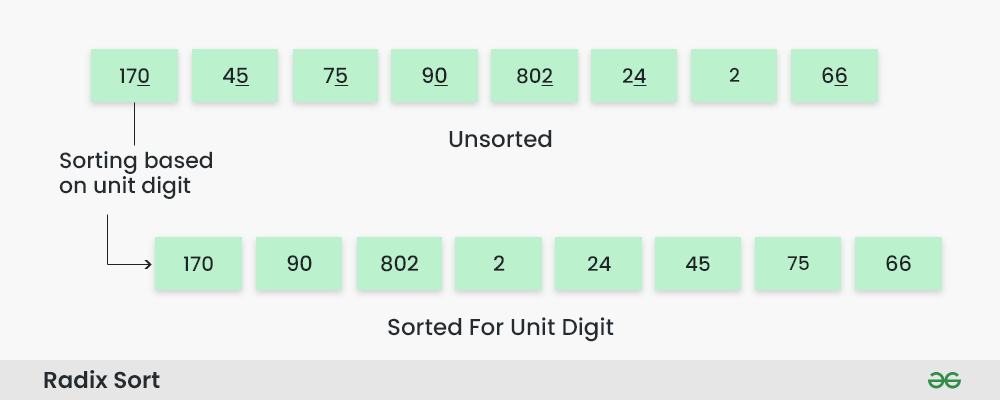
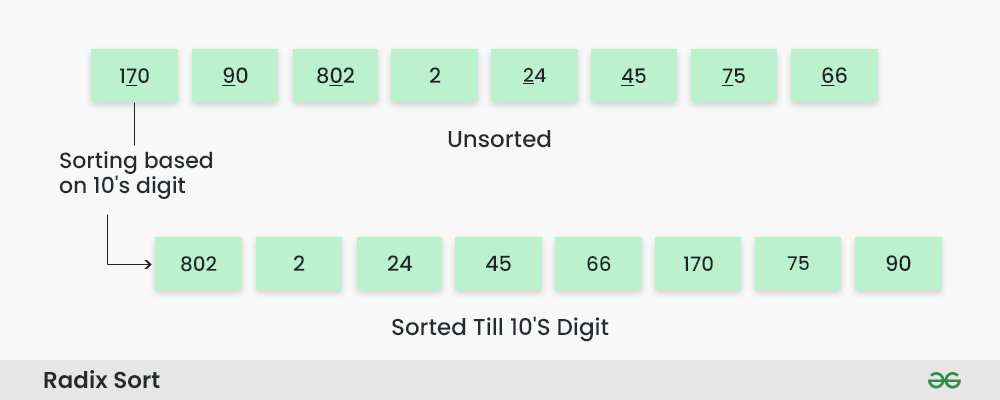
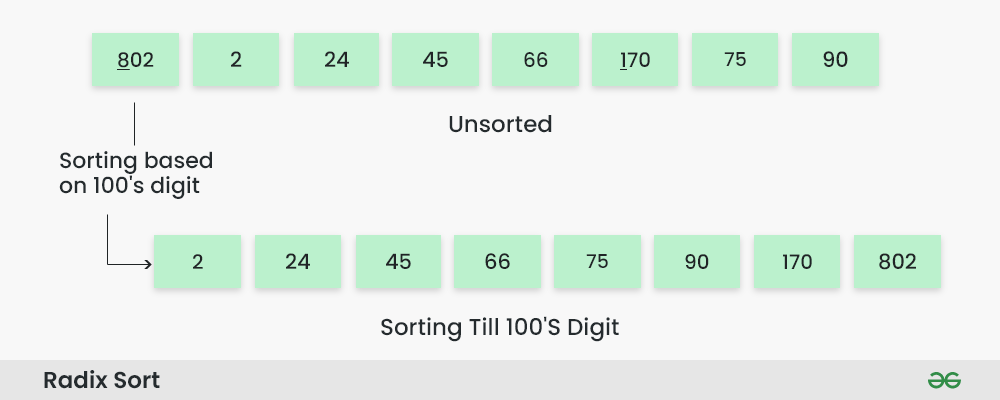
To perform radix sort on the array [170, 45, 75, 90, 802, 24, 2, 66], we follow these steps:
Step 1: Find the largest element, which is 802. It has three digits, so we will iterate three times.
Step 2: Sort the elements based on the unit place digits (X=0).
Step 3: Sort the elements based on the tens place digits.
Step 4: Sort the elements based on the hundreds place digits.
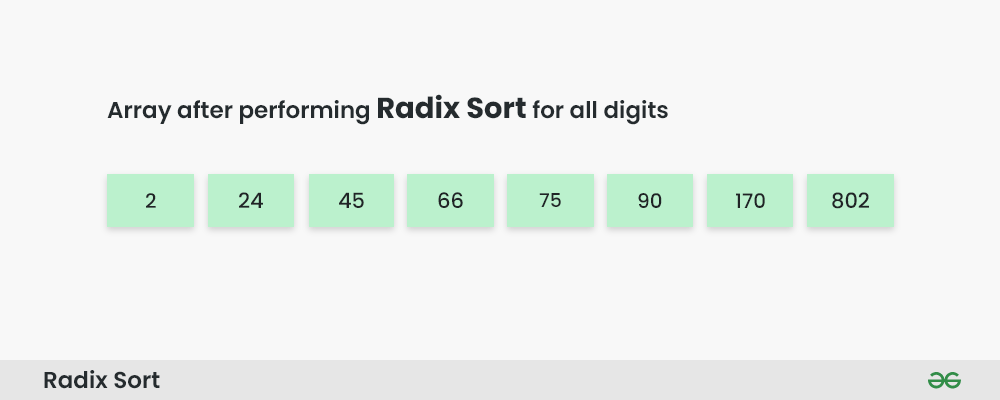
Step 5: The array is now sorted in ascending order.
Below is the implementation for the above illustrations:
Try It Yourself
// C++ implementation of Radix Sort

#include <iostream>
using namespace std;

// A utility function to get maximum
// value in arr[]
int getMax(int arr[], int n)
{
    int mx = arr[0];
    for (int i = 1; i < n; i++)
        if (arr[i] > mx)
            mx = arr[i];
    return mx;
}

// A function to do counting sort of arr[]
// according to the digit
// represented by exp.
void countSort(int arr[], int n, int exp)
{

    // Output array
    int output[n];
    int i, count[10] = { 0 };

    // Store count of occurrences
    // in count[]
    for (i = 0; i < n; i++)
        count[(arr[i] / exp) % 10]++;

    // Change count[i] so that count[i]
    // now contains actual position
    // of this digit in output[]
    for (i = 1; i < 10; i++)
        count[i] += count[i - 1];

    // Build the output array
    for (i = n - 1; i >= 0; i--) {
        output[count[(arr[i] / exp) % 10] - 1] = arr[i];
        count[(arr[i] / exp) % 10]--;
    }

    // Copy the output array to arr[],
    // so that arr[] now contains sorted
    // numbers according to current digit
    for (i = 0; i < n; i++)
        arr[i] = output[i];
}

// The main function to that sorts arr[]
// of size n using Radix Sort
void radixsort(int arr[], int n)
{

    // Find the maximum number to
    // know number of digits
    int m = getMax(arr, n);

    // Do counting sort for every digit.
    // Note that instead of passing digit
    // number, exp is passed. exp is 10^i
    // where i is current digit number
    for (int exp = 1; m / exp > 0; exp *= 10)
        countSort(arr, n, exp);
}

// A utility function to print an array
void print(int arr[], int n)
{
    for (int i = 0; i < n; i++)
        cout << arr[i] << " ";
}

// Driver Code
int main()
{
    int arr[] = { 170, 45, 75, 90, 802, 24, 2, 66 };
    int n = sizeof(arr) / sizeof(arr[0]);

    // Function Call
    radixsort(arr, n);
    print(arr, n);
    return 0;
}
#include <stdio.h>

// A utility function to get the maximum
// value in arr[]
int getMax(int arr[], int n) {
    int mx = arr[0];
    for (int i = 1; i < n; i++)
        if (arr[i] > mx)
            mx = arr[i];
    return mx;
}

// A function to do counting sort of arr[]
// according to the digit represented by exp
void countSort(int arr[], int n, int exp) {
    int output[n]; // Output array
    int count[10] = {0}; // Initialize count array as 0

    // Store count of occurrences in count[]
    for (int i = 0; i < n; i++)
        count[(arr[i] / exp) % 10]++;

    // Change count[i] so that count[i] now
    // contains actual position of this digit
    // in output[]
    for (int i = 1; i < 10; i++)
        count[i] += count[i - 1];

    // Build the output array
    for (int i = n - 1; i >= 0; i--) {
        output[count[(arr[i] / exp) % 10] - 1] = arr[i];
        count[(arr[i] / exp) % 10]--;
    }

    // Copy the output array to arr[],
    // so that arr[] now contains sorted
    // numbers according to current digit
    for (int i = 0; i < n; i++)
        arr[i] = output[i];
}

// The main function to sort arr[] of size
// n using Radix Sort
void radixSort(int arr[], int n) {

    // Find the maximum number to know
    // the number of digits
    int m = getMax(arr, n);

    // Do counting sort for every digit
    // exp is 10^i where i is the current
    // digit number
    for (int exp = 1; m / exp > 0; exp *= 10)
        countSort(arr, n, exp);
}

// A utility function to print an array
void printArray(int arr[], int n) {
    for (int i = 0; i < n; i++)
        printf("%d ", arr[i]);
    printf("\n");
}

// Driver code
int main() {
    int arr[] = {170, 45, 75, 90, 802, 24, 2, 66};
    int n = sizeof(arr) / sizeof(arr[0]);

    // Function call
    radixSort(arr, n);
    printArray(arr, n);
    return 0;
}
// Radix sort Java implementation

import java.io.*;
import java.util.*;

class Radix {

    // A utility function to get maximum value in arr[]
    static int getMax(int arr[], int n)
    {
        int mx = arr[0];
        for (int i = 1; i < n; i++)
            if (arr[i] > mx)
                mx = arr[i];
        return mx;
    }

    // A function to do counting sort of arr[] according to
    // the digit represented by exp.
    static void countSort(int arr[], int n, int exp)
    {
        int output[] = new int[n]; // output array
        int i;
        int count[] = new int[10];
        Arrays.fill(count, 0);

        // Store count of occurrences in count[]
        for (i = 0; i < n; i++)
            count[(arr[i] / exp) % 10]++;

        // Change count[i] so that count[i] now contains
        // actual position of this digit in output[]
        for (i = 1; i < 10; i++)
            count[i] += count[i - 1];

        // Build the output array
        for (i = n - 1; i >= 0; i--) {
            output[count[(arr[i] / exp) % 10] - 1] = arr[i];
            count[(arr[i] / exp) % 10]--;
        }

        // Copy the output array to arr[], so that arr[] now
        // contains sorted numbers according to current
        // digit
        for (i = 0; i < n; i++)
            arr[i] = output[i];
    }

    // The main function to that sorts arr[] of
    // size n using Radix Sort
    static void radixsort(int arr[], int n)
    {
        // Find the maximum number to know number of digits
        int m = getMax(arr, n);

        // Do counting sort for every digit. Note that
        // instead of passing digit number, exp is passed.
        // exp is 10^i where i is current digit number
        for (int exp = 1; m / exp > 0; exp *= 10)
            countSort(arr, n, exp);
    }

    // A utility function to print an array
    static void print(int arr[], int n)
    {
        for (int i = 0; i < n; i++)
            System.out.print(arr[i] + " ");
    }

    // Main driver method
    public static void main(String[] args)
    {
        int arr[] = { 170, 45, 75, 90, 802, 24, 2, 66 };
        int n = arr.length;

        // Function Call
        radixsort(arr, n);
        print(arr, n);
    }
}
# Python program for implementation of Radix Sort
# A function to do counting sort of arr[] according to
# the digit represented by exp.


def countingSort(arr, exp1):

    n = len(arr)

    # The output array elements that will have sorted arr
    output = [0] * (n)

    # initialize count array as 0
    count = [0] * (10)

    # Store count of occurrences in count[]
    for i in range(0, n):
        index = arr[i] // exp1
        count[index % 10] += 1

    # Change count[i] so that count[i] now contains actual
    # position of this digit in output array
    for i in range(1, 10):
        count[i] += count[i - 1]

    # Build the output array
    i = n - 1
    while i >= 0:
        index = arr[i] // exp1
        output[count[index % 10] - 1] = arr[i]
        count[index % 10] -= 1
        i -= 1

    # Copying the output array to arr[],
    # so that arr now contains sorted numbers
    i = 0
    for i in range(0, len(arr)):
        arr[i] = output[i]

# Method to do Radix Sort


def radixSort(arr):

    # Find the maximum number to know number of digits
    max1 = max(arr)

    # Do counting sort for every digit. Note that instead
    # of passing digit number, exp is passed. exp is 10^i
    # where i is current digit number
    exp = 1
    while max1 / exp >= 1:
        countingSort(arr, exp)
        exp *= 10


# Driver code
arr = [170, 45, 75, 90, 802, 24, 2, 66]

# Function Call
radixSort(arr)

for i in range(len(arr)):
    print(arr[i], end=" ")

# This code is contributed by Mohit Kumra
# Edited by Patrick Gallagher
// C# implementation of Radix Sort
using System;

class GFG {
    public static int getMax(int[] arr, int n)
    {
        int mx = arr[0];
        for (int i = 1; i < n; i++)
            if (arr[i] > mx)
                mx = arr[i];
        return mx;
    }

    // A function to do counting sort of arr[] according to
    // the digit represented by exp.
    public static void countSort(int[] arr, int n, int exp)
    {
        int[] output = new int[n]; // output array
        int i;
        int[] count = new int[10];

        // initializing all elements of count to 0
        for (i = 0; i < 10; i++)
            count[i] = 0;

        // Store count of occurrences in count[]
        for (i = 0; i < n; i++)
            count[(arr[i] / exp) % 10]++;

        // Change count[i] so that count[i] now contains
        // actual
        //  position of this digit in output[]
        for (i = 1; i < 10; i++)
            count[i] += count[i - 1];

        // Build the output array
        for (i = n - 1; i >= 0; i--) {
            output[count[(arr[i] / exp) % 10] - 1] = arr[i];
            count[(arr[i] / exp) % 10]--;
        }

        // Copy the output array to arr[], so that arr[] now
        // contains sorted numbers according to current
        // digit
        for (i = 0; i < n; i++)
            arr[i] = output[i];
    }

    // The main function to that sorts arr[] of size n using
    // Radix Sort
    public static void radixsort(int[] arr, int n)
    {
        // Find the maximum number to know number of digits
        int m = getMax(arr, n);

        // Do counting sort for every digit. Note that
        // instead of passing digit number, exp is passed.
        // exp is 10^i where i is current digit number
        for (int exp = 1; m / exp > 0; exp *= 10)
            countSort(arr, n, exp);
    }

    // A utility function to print an array
    public static void print(int[] arr, int n)
    {
        for (int i = 0; i < n; i++)
            Console.Write(arr[i] + " ");
    }

    // Driver Code
    public static void Main()
    {
        int[] arr = { 170, 45, 75, 90, 802, 24, 2, 66 };
        int n = arr.Length;

        // Function Call
        radixsort(arr, n);
        print(arr, n);
    }

    // This code is contributed by DrRoot_
}
// Radix sort JavaScript implementation

"use strict";

// A utility function to get maximum value in arr[]
function getMax(arr) {
  const length = arr.length;
  let mx = arr[0];
  for (let i = 1; i < length; i++) {
    if (arr[i] > mx) mx = arr[i];
  }
  return mx;
}

// A function to do counting sort of arr[] according to
// the digit represented by exp.
function countSort(arr, exp) {
  const length = arr.length;
  let output = Array(length); // output array
  let count = Array(10).fill(0, 0);

  // Store count of occurrences in count[]
  for (let i = 0; i < length; i++) {
    const digit = Math.floor(arr[i] / exp) % 10;
    count[digit]++;
  }

  // Change count[i] so that count[i] now contains
  // actual position of this digit in output[]
  for (let i = 1; i < 10; i++) {
    count[i] += count[i - 1];
  }

  // Build the output array
  for (let i = length - 1; i >= 0; i--) {
    const digit = Math.floor(arr[i] / exp) % 10;
    output[count[digit] - 1] = arr[i];
    count[digit]--;
  }

  return output;
}

// The main function to that sorts arr[] using Radix Sort
function radixSort(arr) {
  // Find the maximum number to know number of digits
  const maxNumber = getMax(arr);
  // Create a shallow copy where the sorted values will be kept
  let sortedArr = [...arr];

  // Do counting sort for every digit. Note that
  // instead of passing digit number, exp is passed.
  // exp is 10^i where i is current digit number
  for (let exp = 1; Math.floor(maxNumber / exp) > 0; exp *= 10) {
    // Get the Count sort iteration
    const sortedIteration = countSort(sortedArr, exp);
    sortedArr = sortedIteration;
  }

  return sortedArr;
}

/*Driver Code*/
const arr = [170, 45, 75, 90, 802, 24, 2, 66];

// Function Call
const sortedArr = radixSort(arr);

console.log(sortedArr.join(" "));

// This code is contributed by beeduhboodee
<?php
// PHP implementation of Radix Sort


// A function to do counting sort of arr[]
// according to the digit represented by exp.
function countSort(&$arr, $n, $exp)
{
    $output = array_fill(0, $n, 0); // output array
    $count = array_fill(0, 10, 0);

    // Store count of occurrences in count[]
    for ($i = 0; $i < $n; $i++)
        $count[ ($arr[$i] / $exp) % 10 ]++;

    // Change count[i] so that count[i]
    // now contains actual position of
    // this digit in output[]
    for ($i = 1; $i < 10; $i++)
        $count[$i] += $count[$i - 1];

    // Build the output array
    for ($i = $n - 1; $i >= 0; $i--)
    {
        $output[$count[ ($arr[$i] /
                         $exp) % 10 ] - 1] = $arr[$i];
        $count[ ($arr[$i] / $exp) % 10 ]--;
    }

    // Copy the output array to arr[], so
    // that arr[] now contains sorted numbers
    // according to current digit
    for ($i = 0; $i < $n; $i++)
        $arr[$i] = $output[$i];
}

// The main function to that sorts arr[]
// of size n using Radix Sort
function radixsort(&$arr, $n)
{

    // Find the maximum number to know
    // number of digits
    $m = max($arr);

    // Do counting sort for every digit. Note
    // that instead of passing digit number,
    // exp is passed. exp is 10^i where i is
    // current digit number
    for ($exp = 1; $m / $exp > 0; $exp *= 10)
        countSort($arr, $n, $exp);
}

// A utility function to print an array
function PrintArray(&$arr,$n)
{
    for ($i = 0; $i < $n; $i++)
        echo $arr[$i] . " ";
}

// Driver Code
$arr = array(170, 45, 75, 90, 802, 24, 2, 66);
$n = count($arr);

// Function Call
radixsort($arr, $n);
PrintArray($arr, $n);

// This code is contributed by rathbhupendra
?>
// Radix sort Dart implementation

/// A utility function to get the maximum value of a `List<int>` [array]
int getMax(List<int> array) {
  int max = array[0];

  for (final it in array) {
    if (it > max) {
      max = it;
    }
  }

  return max;
}

/// A function to do counting sort of `List<int>` [array] according to the
/// digit represented by [exp].
List<int> countSort(List<int> array, int exp) {
  final length = array.length;
  final outputArr = List.filled(length, 0);
  // A list where index represents the digit and value represents the count of
  // occurrences
  final digitsCount = List.filled(10, 0);

  // Store count of occurrences in digitsCount[]
  for (final item in array) {
    final digit = item ~/ exp % 10;
    digitsCount[digit]++;
  }

  // Change digitsCount[i] so that digitsCount[i] now contains actual position
  // of this digit in outputArr[]
  for (int i = 1; i < 10; i++) {
    digitsCount[i] += digitsCount[i - 1];
  }

  // Build the output array
  for (int i = length - 1; i >= 0; i--) {
    final item = array[i];
    final digit = item ~/ exp % 10;
    outputArr[digitsCount[digit] - 1] = item;
    digitsCount[digit]--;
  }

  return outputArr;
}

/// The main function to that sorts a `List<int>` [array] using Radix sort
List<int> radixSort(List<int> array) {
  // Find the maximum number to know number of digits
  final maxNumber = getMax(array);
  // Shallow copy of the input array
  final sortedArr = List.of(array);

  // Do counting sort for every digit. Note that instead of passing digit
  // number, exp is passed. exp is 10^i, where i is current digit number
  for (int exp = 1; maxNumber ~/ exp > 0; exp *= 10) {
    final sortedIteration = countSort(sortedArr, exp);
    sortedArr.clear();
    sortedArr.addAll(sortedIteration);
  }

  return sortedArr;
}

void main() {
  const array = [170, 45, 75, 90, 802, 24, 2, 66];

  final sortedArray = radixSort(array);

  print(sortedArray);
}

// This code is contributed by beeduhboodee
Output
2 24 45 66 75 90 170 802
Complexity Analysis of Radix Sort:
- Time Complexity: O(d * (n + b)), where d is the number of digits, n is the number of elements, and b is the base of the number system being used. In practical implementations, radix sort is often faster than other comparison-based sorting algorithms, such as quicksort or merge sort, for large datasets, especially when the keys have many digits.
- Auxiliary Space: O(n + b), where n is the number of elements and b is the base of the number system. This space is needed to create buckets for each digit value.
