
Array interview questions are commonly asked to evaluate your understanding of array concepts, memory representation, time complexity, and problem-solving techniques. This collection covers the most frequently asked Array interview questions to help you prepare for coding and technical interviews.
- Covers the most frequently asked Array interview questions with concise answers.
- Suitable for both freshers and experienced professionals preparing for technical interviews.
Table of Content
Theoretical Questions for Interviews
1. What is an Array?
An Array is a linear data structure that stores elements of the same data type in contiguous memory locations. It allows direct access to elements using their index, making retrieval very fast.
- Stores elements in contiguous memory.
- Supports random access using indexes.
- Suitable for storing fixed-size collections of data.
2. How do you declare an Array?
Each programming language has its own syntax for declaring arrays, but the basic concept is the same: specify the data type and the size (or initialize directly).
data_type array_name[array_size];
int arr[5];
This declaration creates an array named arr that can store 5 integer elements.
3. Why do arrays use 0-based indexing?
Arrays use 0-based indexing because the index directly represents the offset from the starting memory address, making address calculations simple and efficient.
- First element is 0 positions away from the base address.
- Simplifies memory address calculation.
- Enables efficient element access.
4. What is the time complexity of accessing an element in an Array?
Since array elements are stored in contiguous memory, any element can be accessed directly using its index.
| Operation | Time Complexity |
|---|---|
| Access | O(1) |
| Search (Unsorted) | O(n) |
| Search (Sorted - Binary Search) | O(log n) |
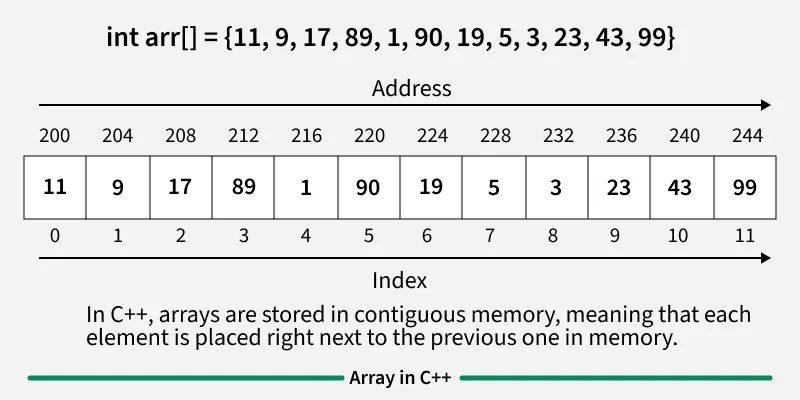
5. How is the memory representation of an Array handled?
Arrays are stored in contiguous memory locations, allowing efficient access to elements using their indices.
- Elements are stored in contiguous memory locations.
- Contiguous storage improves cache performance.
- Direct address calculation enables O(1) random access.
6. Is it possible to declare an Array without specifying its size?
Yes, an array can be declared without specifying its size if it is initialized at the time of declaration. The compiler automatically determines the array size based on the number of elements provided.
- With Initialization: Size is inferred automatically from the initialized elements.
- Without Initialization: The array size must be specified (in languages like C and C++).
7. Why are arrays stored in contiguous memory?
Arrays are stored in contiguous memory locations to enable efficient element access and improve overall performance.
- Enables O(1) random access using array indices.
- Improves CPU cache performance.
- Faster traversal due to spatial locality.
8. How do you find the smallest and second smallest elements in an Array?
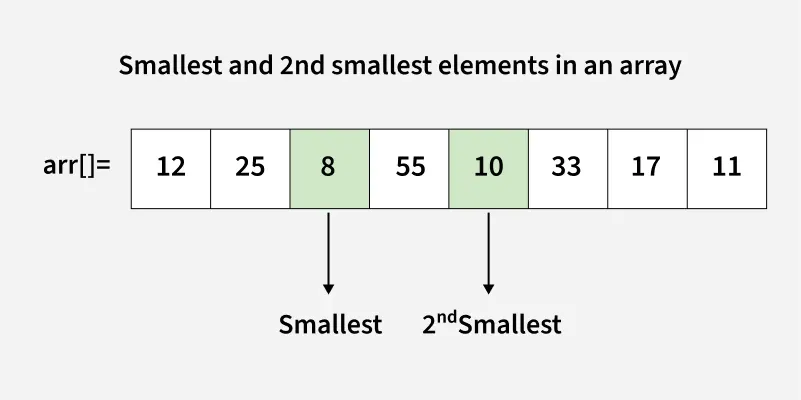
The smallest and second smallest elements can be found by traversing the array once while keeping track of the two minimum values. This approach is more efficient than sorting the array.
Approach:
- Initialize the smallest and second smallest values, then traverse the array to update them whenever a smaller element is found.
- This algorithm runs in O(n) time and uses O(1) extra space.
9. How do you find the largest and second largest elements in an Array?
The largest and second largest elements can be found by traversing the array once while maintaining the two maximum values. This avoids the overhead of sorting.
Approach:
- Initialize the largest and second largest values, then update them during a single traversal of the array.
- This algorithm runs in O(n) time and uses O(1) extra space.

10. What is the time complexity of searching in an Array?
The time complexity of searching in an array depends on the search technique used and whether the array is sorted. Linear Search works on both sorted and unsorted arrays, while Binary Search requires the array to be sorted.
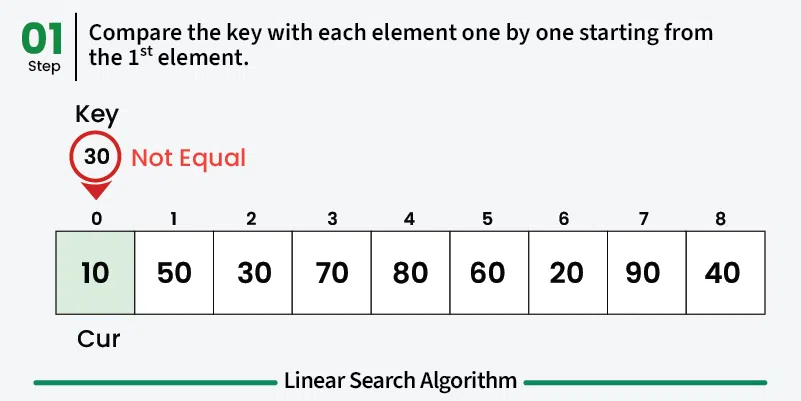
Linear Search: Traverse the array element by element until the target is found. Time Complexity: O(n).
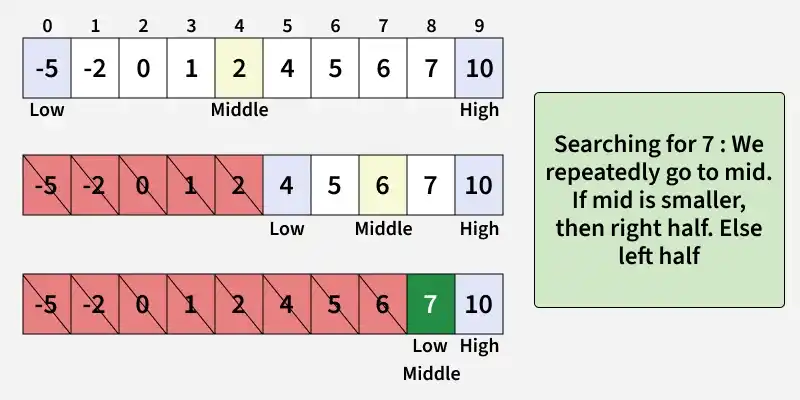
Binary Search: Repeatedly divide a sorted array into halves until the target is found. Time Complexity: O(log n).
11. What is the time complexity of inserting and deleting at the beginning of an Array?
Inserting or deleting an element at the beginning of an array requires shifting all the existing elements by one position. Therefore, both operations take linear time.
- Insertion at the Beginning: Shift all elements one position to the right, then insert the new element. Time Complexity: O(n).
- Deletion at the Beginning: Remove the first element, then shift all remaining elements one position to the left. Time Complexity: O(n).
12. What is the time complexity of inserting and deleting at the end of an Array?
Inserting or deleting an element at the beginning of an array requires shifting all the existing elements by one position. Therefore, both operations take linear time.
Approach:
- Insertion at the Beginning: Shift all elements one position to the right, then insert the new element. Time Complexity: O(n).
- Deletion at the Beginning: Remove the first element, then shift all remaining elements one position to the left. Time Complexity: O(n).
13. What is the time complexity of merging two sorted arrays?
Merging two sorted arrays requires traversing both arrays once while comparing their elements.
- Traverse both arrays simultaneously.
- Compare the current elements and insert the smaller one first.
- Time Complexity: O(n + m) and Space Complexity: O(n + m).

14. What is the time complexity of removing duplicates from an unsorted array?
The time complexity depends on the approach used. Using a hash-based data structure is the most efficient method, while a nested loop approach requires more time but no extra space.
Approach:
- Using a Hash Set: Traverse the array once and store unique elements in a hash set. Time Complexity: O(n), Space Complexity: O(n).
- Without Extra Space: Compare each element with the remaining elements using nested loops. Time Complexity: O(n²), Space Complexity: O(1).
15. What is a Multi-dimensional Array?
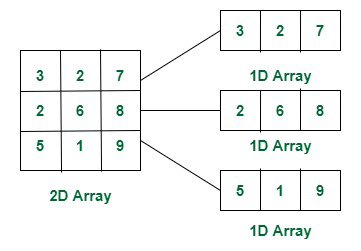
A multidimensional array is an array with two or more dimensions, used to organize data in a tabular or grid-like structure.
- A two-dimensional array represents data in rows and columns.
- Commonly used to store matrices and tables.
- Can have three or more dimensions for complex data.
16. What happens when an array is accessed out of bounds?
Accessing an array outside its valid index range results in undefined or invalid behavior, depending on the programming language. It can lead to runtime errors, exceptions, or unexpected program behavior.
- In languages like Java, accessing an invalid index throws an ArrayIndexOutOfBoundsException.
- In languages like C and C++, out-of-bounds access results in undefined behavior, which may produce incorrect values or cause the program to crash.
17. How do you reverse an array in-place?
An array can be reversed in-place by swapping elements from both ends until the pointers meet.
- Use two pointers, one at the beginning and one at the end.
- Swap the elements and move both pointers toward the center.
- Time Complexity: O(n) and Space Complexity: O(1).
18. What is a jagged array?
A jagged array is an array of arrays in which each sub-array can have a different number of elements.
- Each row can have a different number of elements.
- Helps reduce memory usage when row sizes vary.
- Useful for representing irregular or uneven data.

19. How do you find duplicate elements in an array?
Duplicate elements can be identified by checking whether an element has already appeared in the array. The most efficient solution uses a hash-based data structure to track visited elements.
Approach:
- Using a Hash Set: Traverse the array and store each element in a hash set. If an element already exists, it is a duplicate.
- Using Nested Loops: Compare each element with all subsequent elements to identify duplicates.
20. What are the advantages and disadvantages of arrays?
Arrays provide fast element access but have limitations due to their fixed size and memory layout.
Advantages
- O(1) random access using indices.
- Efficient memory usage and cache performance.
- Simple to implement and traverse.
Disadvantages
- Fixed size after creation.
- Insertion and deletion are costly due to element shifting.
- Require contiguous memory allocation.
21. What is the difference between an Array and a Linked List?
Although both are linear data structures, they differ significantly in storage and performance.
| Array | Linked List |
|---|---|
| Contiguous memory | Non-contiguous memory |
| Random access (O(1)) | Sequential access (O(n)) |
| Fixed size | Dynamic size |
| Insertion/Deletion is O(n) | Insertion/Deletion is O(1) if node is known |
| Better cache performance | Extra memory for pointers |
22. What is a sparse array?
A sparse array is an array in which most elements are empty or contain the default value, while only a few elements store meaningful data.
- Most elements contain the default value (typically zero).
- Can be represented efficiently using maps or coordinate lists.
- Reduces memory usage for sparse datasets.
Coding Interview Questions
The following list of 50 array coding problems covers a range of difficulty levels, from easy to hard, to help candidates prepare for interviews.
Easy Problems
- Second Largest Element
- Third Largest Element
- Reverse an Array
- Reverse Array in Groups
- Rotate Array
- Three Great Candidates
- Max Consecutive Ones
- Move All Zeroes To End
- Wave Array
- Plus One
- Stock Buy and Sell – One Transaction
- Stock Buy and Sell – Multiple Transactions
- Remove Duplicates from Sorted Array
- Alternate Positive Negative
- Array Leaders
- Missing and Repeating in Array
- Missing Ranges of Numbers
- Sum of all Subarrays
Medium Problems
- Next Permutation
- Majority Element
- Majority Element II
- Minimize the Heights II
- Maximum Subarray Sum
- Maximum Product Subarray
- Product of Array Except Self
- Subarrays with Product Less Than K
- Split Into Three Equal Sum Segments
- Maximum Consecutive 1s After Flipping 0s
- Last Moment Before Ants Fall Out of Plank
- Find 0 with Farthest 1s in a Binary
- Intersection of Interval Lists
- Rearrange Array Elements by Sign
- Meeting Scheduler for Two Persons
- Longest Mountain Subarray
- Transform and Sort Array
- Minimum Swaps To Group All Ones
- Minimum Moves To Equalize Array
- Minimum Indices To Equal Even-Odd Sums
