
Linked List interview questions are commonly asked to assess your understanding of data structures, pointers, and problem-solving techniques. This collection covers the most important questions to help you prepare for coding and technical interviews.
- Covers the most frequently asked Linked List interview questions with concise answers.
- Suitable for both freshers and experienced professionals preparing for technical interviews.
Table of Content
Theoretical Questions for Interviews
1. What is a Linked List?
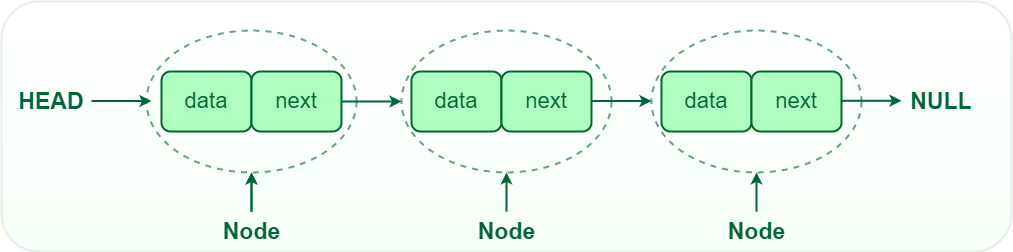
A Linked List is a linear data structure where elements are stored as individual nodes. Each node contains data and a reference (pointer) to the next node, allowing dynamic memory allocation.
- Nodes are not stored in contiguous memory.
- Size can grow or shrink dynamically.
- Used when frequent insertions and deletions are required.

2. How do you create an Linked List?
A linked list is created by defining a node structure and linking multiple nodes together using pointers or references.
- Create a node containing data and next pointer.
- Connect each node with the next node.
- Store the first node's address in the head pointer.
3. What is the head pointer in a Linked List?
The head pointer stores the address of the first node in the linked list. Without it, the entire list becomes inaccessible.
- Starting point of traversal.
- If head is NULL, the list is empty.
- Required for insertion, deletion, and searching.
4. What are the different types of linked lists?
Linked Lists are classified based on how nodes are connected. Each type serves different use cases.
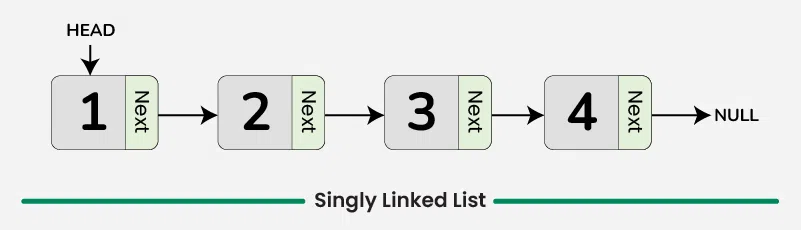
1. Singly linked list: Contains nodes where each node points only to the next node in the sequence.
- One-way traversal.
- Less memory usage.
- Simplest linked list implementation.
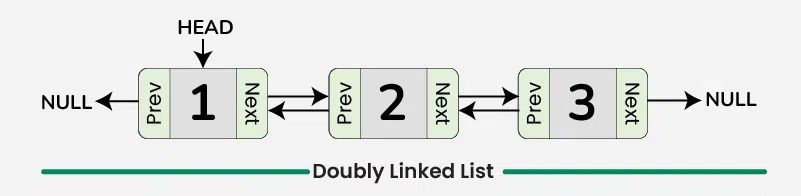
2. Doubly linked list: Stores references to both the next and previous nodes, enabling traversal in both directions.
- Supports forward and backward traversal.
- Easier deletion of nodes.
- Uses extra memory for the previous pointer.
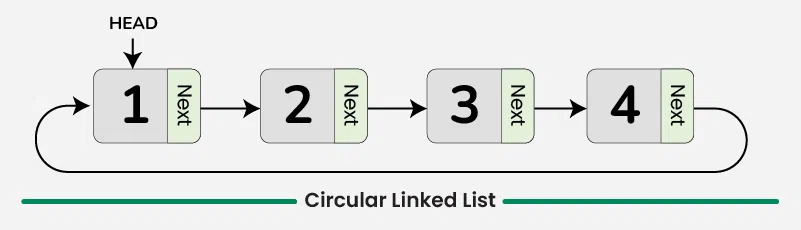
3. Circular linked list: Last node points back to the first node instead of NULL, forming a loop.
- No NULL at the end.
- Suitable for cyclic operations.
- Used in scheduling algorithms.
5. What are the advantages of a Linked List?
A Linked List offers dynamic memory allocation and allows efficient insertion and deletion of elements without shifting existing data. It is ideal for applications where the size of the data changes frequently.
- Memory is allocated as needed, so there is no need to define the size in advance.
- Elements can be inserted or deleted efficiently without shifting other elements.
- Memory is allocated only when required, reducing memory wastage.
- Used to implement dynamic data structures such as stacks, queues, graphs, memory management, and caching systems.
6. What are the disadvantages of a Linked List?
Although Linked Lists are flexible, they require extra memory for storing pointers and do not support direct access to elements, making some operations slower than arrays.
- Elements must be accessed sequentially, making search operations slower.
- Each node stores both data and a pointer, increasing memory usage.
- Nodes are not stored contiguously, resulting in slower traversal due to poor cache locality.
- In languages like C and C++, improper memory deallocation can lead to memory leaks.
7. What is the difference between an Array and a Linked List?
Arrays store elements in contiguous memory, whereas linked lists store nodes at different memory locations connected by pointers.
| Array | Linked List |
|---|---|
| Fixed size | Dynamic size |
| Random access O(1) | Sequential access O(n) |
| Slow insertion/deletion | Fast insertion/deletion |
| Better cache locality | Poor cache locality |
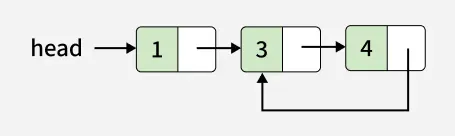
8. What is a cycle/loop in Singly Linked List?
A cycle (or loop) in a Singly Linked List occurs when the next pointer of a node points back to a previous node instead of NULL. As a result, traversing the list never reaches the end and continues indefinitely.
- A node points back to an earlier node, creating a circular path.
- The list cannot be fully traversed because it enters an infinite loop.
- A cycle is commonly detected using Floyd's Cycle Detection Algorithm (Tortoise and Hare).
9. What is the slow and fast pointer approach in a linked list, and how does it work?
The slow and fast pointer (also known as the Tortoise and Hare) approach uses two pointers that traverse the linked list at different speeds. The slow pointer moves one node at a time, while the fast pointer moves two nodes at a time.
- Slow Pointer: Moves one node in each iteration.
- Fast Pointer: Moves two nodes in each iteration.
- Applications: Used to detect cycles, find the middle node, and locate the starting point of a loop efficiently in O(n) time with O(1) extra space.
10. What is time complexity of Linked List operations?
The time complexity of common operations on a singly-linked list are as follows:
| Operation | Time Complexity |
|---|---|
| Insert at Beginning | O(1) |
| Insert at End | O(n) |
| Delete at Beginning | O(1) |
| Delete at End | O(n) |
| Search | O(n) |
| Traversal | O(n) |
11. Why doesn't a Linked List support direct indexing?
A Linked List does not support direct indexing because its nodes are stored at different memory locations and are connected through pointers. To access a specific element, the list must be traversed sequentially from the head node.
- No Contiguous Memory: Nodes are scattered in memory rather than stored consecutively.
- Sequential Access: Each node must be visited one by one to reach the desired element.
- No Index-Based Access: Unlike arrays, elements cannot be accessed directly using an index.
- Access Time: Retrieving the nth element takes O(n) time instead of O(1) as in arrays.
12. Which data structures are implemented using Linked Lists?
Linked Lists are commonly used to implement several dynamic data structures because they allow efficient insertion and deletion of elements without requiring contiguous memory.
- Stack: Supports efficient push and pop operations at the head of the list.
- Queue: Enables efficient enqueue and dequeue operations.
- Deque (Double-Ended Queue): Allows insertion and deletion from both ends.
- Graphs and Hash Tables: Used for adjacency lists in graphs and separate chaining in hash tables.
13. How do you detect a loop in a Linked List?
A loop in a Linked List can be efficiently detected using Floyd's Cycle Detection Algorithm (Slow and Fast Pointer). If the slow and fast pointers meet while traversing the list, it indicates that a cycle exists.
- Initialize slow and fast pointers at the head of the list.
- Move slow one step and fast two steps in each iteration.
- If both pointers meet, a loop is present.
- If the fast pointer reaches NULL, the list does not contain a loop.
14. How do you find the middle element of a Linked List?
The middle element of a Linked List can be found efficiently using the slow and fast pointer approach. The slow pointer moves one node at a time, while the fast pointer moves two nodes at a time. When the fast pointer reaches the end, the slow pointer will be at the middle node.
- Initialize both slow and fast pointers at the head.
- Move slow by one node and fast by two nodes in each iteration.
- When fast reaches NULL (or fast->next becomes NULL), slow points to the middle element.
- This approach works in O(n) time and O(1) extra space.
15. Why is merge sort better than quicksort in a singly linked list?
Merge sort is preferred for Singly Linked Lists because it does not require random access to elements and can efficiently split and merge nodes by simply changing pointers. In contrast, Quicksort relies on random access for partitioning, which is inefficient in linked lists.
- Efficient for Linked Lists: Merging is done by rearranging pointers without extra shifting.
- No Random Access Required: Works well with sequential node traversal.
- Guaranteed Time Complexity: Runs in O(n log n) time in the worst case.
- Stable Sorting Algorithm: Maintains the relative order of equal elements.
16. What are the applications of a Doubly Linked List?
A Doubly Linked List is used in applications that require traversal in both forward and backward directions. Since each node stores pointers to both the next and previous nodes, insertion, deletion, and navigation become more efficient.
- Browser History: Enables forward and backward navigation between visited pages.
- Undo/Redo Operations: Used in text editors and other applications to reverse or reapply actions.
- LRU Cache: Helps efficiently manage recently used data in caching systems.
- Music and Image Viewers: Allows users to move to the previous or next item easily.
17. What are the applications of a Circular Linked List?
A circular doubly linked list is used in applications where data needs to be processed continuously in a circular manner. Since the last node points back to the first node, traversal can continue without restarting from the head.
- Round Robin CPU Scheduling: Allocates CPU time to processes in a cyclic order.
- Circular Queues: Efficiently manages buffers and queue-based systems.
- Multiplayer Games: Cycles through players' turns repeatedly.
- Music Playlists and Image Slideshows: Continuously loops through songs or images without interruption.
Coding Problems for Interviews
The following list of 50 linked list coding problems covers a range of difficulty levels, from easy to hard, to help candidates prepare for interviews.
Easy Problems
- Middle of a linked list
- Reverse a Linked List
- Reverse a Doubly Linked List
- Rotate a linked list
- Nth node from End
- Delete Last Occurrence
- Delete Middle
- Merge Alternate Positions
- Circular List Traversal
- Queue using Linked List
- Stack using singly linked list
- Pairwise Swap
- Count Occurrences
Medium Problems
- Detect Loop
- Length of the Loop
- Reverse in groups
- Intersection Point
- Delete without Head pointer
- Merge two sorted linked lists
- Sort a List of 0s, 1s and 2s
- Palindrome Linked List
- Remove all occurrences of a given list
- Split a Circular Linked List into two halves
- Pair Sum in Doubly Linked List
- Add two numbers represented by Linked lists
- Multiply two numbers represented by Linked Lists
- Swap Kth nodes from beginning and end
- Rotate Doubly linked list by N nodes
- Binary Tree to Doubly Linked List
- Linked List from a 2D matrix
- Reverse a Sublist
- Delete N nodes after M
- Rearrange a given linked list in-place
- Partition around a given value
