
A Cayley table is a tabular representation of the binary operation of a finite group.
- It shows the result obtained by combining every pair of group elements using the group's operation.
- Similar to a multiplication table, it helps visualize the structure of a group and verify important group properties such as closure, identity, inverses, and commutativity.
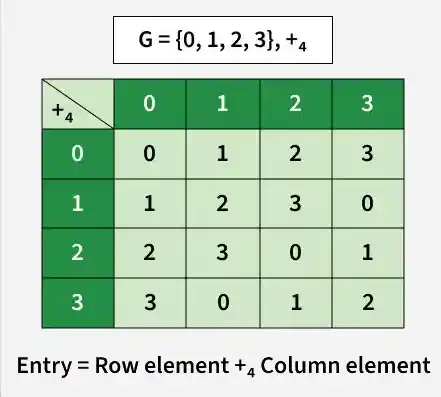
Some of the common features of a Cayley table are the following:
- Every row and column of the table should contain each element exactly once.
- If the table does not have this property, it can not represent a group; the cancellation law does not hold.
- The identity element of the group should not only appear in every row and column (exactly once), but it should also be “distributed symmetrically” about the main diagonal. Otherwise, one or more elements in the table do not have an inverse.
- There should not be any entries in the table that is not a row/column label. Otherwise, the operation is not closed.
- There should be one row in which the column labels appear in order, this indicates the presence of an identity element. The column of this element should reflect the row labels. Otherwise, there is no identity.
Properties
- Closure: Every entry in the table must be an element of the group.
- Associativity: The operation must be associative, but this property is not directly visible in the table. It is a requirement for the structure to be a group.
- Identity Element: Each row and each column must contain the identity element exactly once.
- Inverses: Each row and each column must contain each element of the group exactly once (this implies that each element has an inverse).
Constructing Cayley Table
To construct Cayley Table for any binary operation, we can use the following steps:
Step 1: Write the elements of the group along the top row and the left column of a square table.
Step 2: Fill in each cell of the table with the result of the group operation applied to the elements corresponding to the row and the column.
Example: Let's construct the Cayley table of the group Z5 , the integers {0, 1, 2, 3, 4} under addition mod 5.
Solution:
Step 1: We'll label the rows and columns with the elements of Z5, in the same order from left to right and top to bottom.
| + | 0 | 1 | 2 | 3 | 4 |
|---|---|---|---|---|---|
| 0 | 0 | 1 | 2 | 3 | 4 |
| 1 | _ | _ | _ | _ | _ |
| 2 | _ | _ | _ | _ | _ |
| 3 | _ | _ | _ | _ | _ |
| 4 | _ | _ | _ | _ | _ |
Step 2: We’ll fill in the table. Each entry is the result of adding the row label to the column label, then reducing mod 5.
| + | 0 | 1 | 2 | 3 | 4 |
|---|---|---|---|---|---|
| 0 | 0 | 1 | 2 | 3 | 4 |
| 1 | 1 | 2 | 3 | 4 | 0 |
| 2 | 2 | 3 | 4 | 0 | 1 |
| 3 | 3 | 4 | 0 | 1 | 2 |
| 4 | 4 | 0 | 1 | 2 | 3 |
Every entry belongs to the set ({0,1,2,3}), confirming closure.
Identifying a Cyclic Group Using a Cayley Table
A Cayley table alone does not always make the generator immediately obvious, but it helps verify whether the group behaves like a cyclic group when used alongside the group elements.
Follow these steps:
- Identify the identity element from the row and column that reproduce all group elements.
- Choose a non-identity element as a candidate generator.
- Repeatedly apply the group operation to that element.
- Check whether every group element is generated before returning to the identity.
- If such an element exists, the group is cyclic.
Example: For the group (
Therefore, (
Cayley Table vs Cyclic Group
| Basis | Cayley Table | Cyclic Group |
|---|---|---|
| Definition | A Cayley table is a tabular representation of the binary operation of a finite group. | A cyclic group is a group in which every element can be generated from a single element called a generator. |
| Purpose | It displays the result of combining every pair of group elements. | It describes a special type of group generated by one element. |
| Representation | Represented as a matrix with group elements as row and column headings. | Represented using generator notation, such as (G=\langle a\rangle). |
| Focus | Focuses on the group's operation and interactions between elements. | Focuses on generating all elements from a single generator. |
| Applicability | Can be constructed for any finite group. | Refers only to groups that have at least one generator. |
| Information Provided | Shows closure, identity, inverses, and whether the group is commutative. | Identifies generators, the order of the group, and the structure of the group. |
| Symmetry | Symmetric only if the group is abelian. | Every cyclic group is abelian, so its Cayley table is always symmetric. |
| Example | The Cayley table of |
