
Eigen Decomposition is a linear algebra technique that breaks a square matrix into its eigenvalues and eigenvectors. It helps simplify matrix calculations and understand how a matrix transforms data.
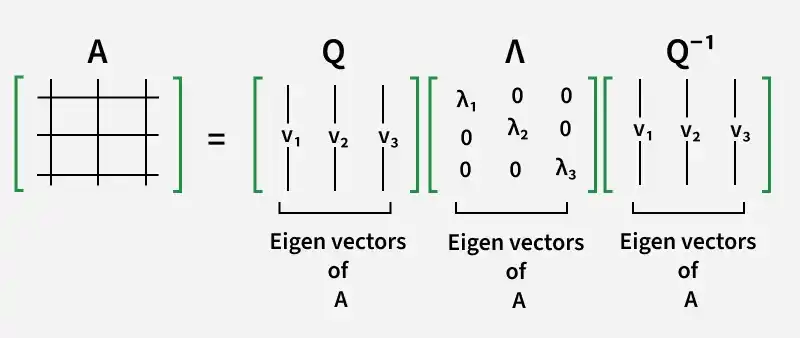
For a square matrix A, if Av = λv
where λ is an eigenvalue and v is the corresponding eigenvector, then the matrix can be decomposed as:
A = QΛQ⁻¹
where,
- Q is the matrix of eigenvectors.
- Λ is the diagonal matrix of eigenvalues.
- Q⁻¹ is the inverse of Q.
This decomposition represents the original matrix in terms of its eigenvalues and eigenvectors, making many matrix operations easier to perform.
Steps to Perform Eigen Decomposition
To perform Eigen decomposition on a matrix, follow these steps:
- Step 1: Find the Eigenvalues:
Solve the characteristic equation:
det (A−λI=0
Here, A is the square matrix, λ is the eigenvalue, and I is the identity matrix of the same dimension as A.
- Step 2: Find the Eigenvectors:
For each eigenvalue λ, substitute it back into the equation:
(A−λI)v=0
This represents a system of linear equations where v is the eigenvector corresponding to the eigenvalue λ.
- Step 3: Construct the Eigenvector Matrix V:
Place all the eigenvectors as columns in the matrix V. If there are n distinct eigenvalues, V will be an n×n matrix..
- Step 4 Form the Diagonal Matrix Λ:
Construct a diagonal matrix Λ by placing the eigenvalues on its diagonal:
- Step 5: Calculate the Inverse of V:
Find V-1, the inverse of the eigenvector matrix V, if the matrix is invertible.
Example of Eigen Decomposition
Define the matrix,
Find the eigenvalues by solving det(A - λI) = 0
The characteristic equation is: A−λI = 0
Find the eigenvectors corresponding to each eigenvalue
For,
For,
Form the matrix V of eigenvectors and Λ of eigenvalues
Perform the Eigen decomposition
Optionally, compute the inverse of V
Importance of Eigen decomposition
Eigen decomposition is important because it simplifies many matrix operations and helps analyze data more efficiently.
- Simplifies Matrix Calculations: Makes complex matrix operations easier to perform.
- Dimensionality Reduction: Used in techniques like PCA to reduce large datasets while preserving important information.
- Data Analysis: Helps identify patterns and relationships in data.
- Physics Applications: Used to study system behavior and transformations in fields such as quantum mechanics.
- Image Processing: Supports image compression, enhancement, and feature extraction.
- Machine Learning: Forms the basis of many algorithms used for data analysis and prediction.
