
An indeterminate form is a mathematical expression obtained while evaluating a limit that does not immediately reveal the limit's value. The expression alone is insufficient to determine whether the limit exists or what its value might be.
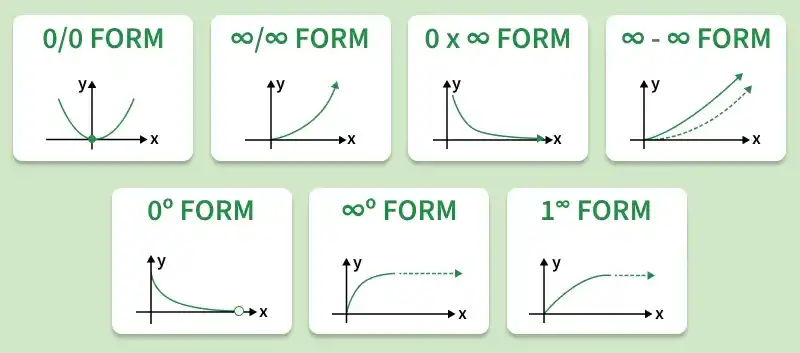
For example:
\lim\limits_{x\to 0}\frac{x}{x} Direct substitution gives:
\frac{0}{0} However, the actual limit is: 1
This shows that the form (0/0) does not determine the limit by itself.
Types of Indeterminate Forms
1. Zero by Zero Form (0/0): This form occurs when both the numerator and denominator approach zero.
Example:
\lim_{x\to 2}\frac{x^2-4}{x-2} Substituting (x=2):
\frac{0}{0}
2. Infinity by Infinity Form (∞/∞): This form occurs when both the numerator and denominator grow without bound.
Example:
\lim\limits_{x\to\infty}\frac{3x^2+1}{x^2+5} Direct substitution gives:
\frac{\infty}{\infty}
3. Zero Times Infinity Form (0 × ∞): This form arises when one factor approaches zero while another approaches infinity.
Example:
\lim\limits_{x\to0^+}x\ln x Here,
x\to0 \text \ {and}\ \ln x\to-\infty resulting in the indeterminate form:0\times\infty
4. Infinity Minus Infinity Form (∞ − ∞): This form occurs when two expressions approaching infinity are subtracted.
Example:
\lim\limits_{x\to\infty}\left(\sqrt{x^2+x}-x\right) Direct substitution gives:
\infty-\infty
5. Zero Raised to Zero Form (0⁰): This exponential form occurs when the base approaches zero and the exponent also approaches zero.
Example:
\lim\limits_{x\to0^+}x^x Since both the base and exponent approach zero, the form is:
0^0
6. Infinity Raised to Zero Form (∞⁰): This form occurs when the base approaches infinity while the exponent approaches zero.
Example:
\lim\limits_{x\to\infty}x^{\frac{1}x} Direct substitution gives:
\infty^0
7. One Raised to Infinity Form (1∞): This form occurs when the base approaches 1 and the exponent approaches infinity.
Example:
\lim\limits_{x\to\infty}\left(1+\frac1x\right)^x Direct substitution produces:
1^\infty
Methods to Evaluate Indeterminate Forms
1. Algebraic Simplification: Many indeterminate forms can be resolved by simplifying the expression before evaluating the limit.
Common techniques include:
- Factoring
- Rationalization
- Expanding expressions
- Combining fractions
Example:
\lim\limits_{x\to2}\frac{x^2-4}{x-2} Factor the numerator:
\frac{(x-2)(x+2)}{x-2} Cancel the common factor:
\lim\limits_{x\to2}(x+2) =4
2. L'Hôpital's Rule: L'Hôpital's Rule is used when a limit results in the forms intermediate forms and caanot be solved by algebric simplification.
Example:
\lim\limits_{x\to0}\frac{\sin x}{x} Substitution gives:
\frac{0}{0} Applying L'Hôpital's Rule:
\lim\limits_{x\to0}\frac{\cos x}{1} = 1
3. Logarithmic Transformation: This method is particularly useful for evaluating:
Let:
y=f(x)^{g(x)} Take the natural logarithm:
\ln y=g(x)\ln(f(x)) Evaluate the limit of (ln y ), then exponentiate the result.
Solved Example
Example 1: Evaluate:
Factor:
\frac{(x-3)(x+3)}{x-3} =x+3 Substitute (x=3) gives 3 + 3 = 6
Example 2: Evaluate: \lim_{x\to\infty}\frac{5x^2+1}{2x^2+3}
Divide by (x2):
\lim\limits_{x\to\infty} \frac{5+\frac1{x^2}} {2+\frac3{x^2}} =\frac52
Example 3: Evaluate:
Rewrite as:
\frac{\ln x}{\frac{1}x} Apply L'Hôpital's Rule:
\lim\limits_{x\to0^+}\frac{1/x}{-1/x^2}\\[3pts]\lim\limits_{x\to0^+}(-x) =0
Example 4: Evaluate:
Multiply by the conjugate:
\frac{x^2+x-x^2}{\sqrt{x^2+x}+x}=\frac{x}{\sqrt{x^2+x}+x} Divide by (x):
\frac{1} {\sqrt{1+\frac1x}+1} =\frac12
Example 5: Evaluate:
Let,
y=\left(1+\frac1x\right)^x Taking logarithms:
\ln y= x\ln\left(1+\frac1x\right) Evaluating the limit gives: ln y=1
Therefore, y=e
Practice Problems
1. Evaluate:
2. Evaluate:
3. Evaluate:
4. Evaluate:
5. Evaluate:
