
A lattice is a particular kind of partially ordered set (POSET) that has additional properties. In a lattice, every pair of elements has both a unique least upper bound (called the join) and a unique greatest lower bound (called the meet).
These operations make lattices useful in areas like logic, algebra, data structures (e.g., in databases or programming languages), and cryptography.
Formally: A lattice is a poset (L, ≤) in which every pair of elements a, b ∈ L has:
- A join (least upper bound): a ∨ b = lub{a, b}, the smallest element ≥ both a and b.
- A meet (greatest lower bound): a ∧ b = glb{a, b}, the largest element ≤ both a and b.
Types of Lattice
A lattice is a partially ordered set where every pair of elements has a meet (∧) and a join (∨). Now, depending on extra properties, lattices can be of different types:
1. Bounded Lattice
A lattice L is bounded if it has a greatest element (top, often denoted 1 or ⊤) and a least element (bottom, often denoted 0 or ⊥). The top is ≥ all elements, and the bottom is ≤ all elements.
Example: Consider the lattice with elements {a, b, c, d} where a is bottom (a ≤ b, a ≤ c, a ≤ d) and d is top (d ≥ b, d ≥ c, d ≥ a). Here, b and c are incomparable.
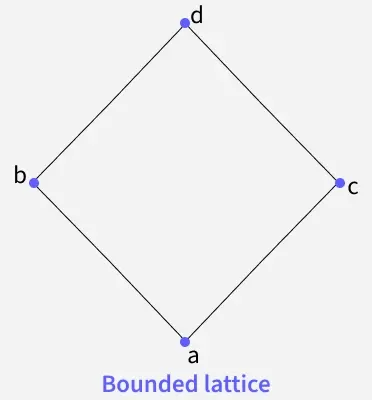
Note: Every Finite lattice is always bounded. (because they have a least element and a greatest element)
2. Complemented Lattice
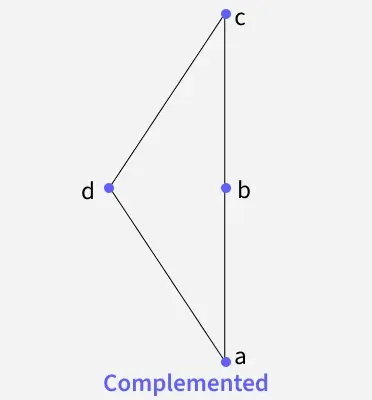
A bounded lattice L is complemented if every element a ∈ L has at least one complement b such that:
- a ∧ b = 0 (bottom)
- a ∨ b = 1 (top)
Complements may not be unique in general complemented lattices.
Example (Complemented): Elements {a, b, c, d} with a (bottom), d (left middle), b (right middle), c (top). Here, b is the complement of d (d ∧ b = a, d ∨ b = c), d is the complement of b, c is the complement of a (c ∧ a = a = bottom, c ∨ a = c = top), and a is the complement of c.
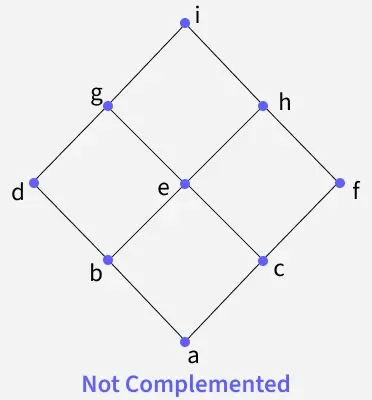
Example (Not Complemented): A larger lattice with elements {a, b, c, d, e, f, g, h, i} where a is the bottom and i is the top. The complement of e does not exist, as no element x satisfies e ∧ x = a and e ∨ x = i without contradictions in the order.
3. Distributive Lattice
If a lattice satisfies the following two distributive properties, it is called a distributive lattice.
- x ∧ (y ∨ z) = (x ∧ y) ∨ (x ∧ z)
- x ∨ (y ∧ z) = (x ∨ y) ∧ (x ∨ z)
A lattice L is distributive if every element in L has "at most one complement".
- A complemented distributive lattice is a Boolean algebra or Boolean lattice.
- A lattice is distributive if and only if none of its sublattices is isomorphic to N5 or M3.
- For a distributive lattice, each element can have at most one complement. This can be used as a theorem to prove that a lattice is not distributive.
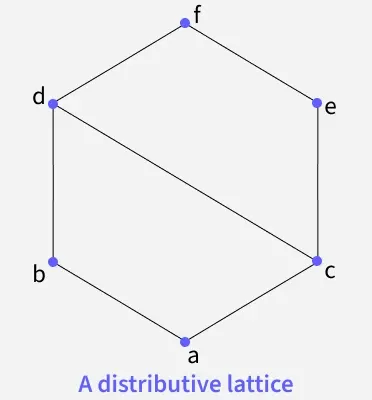
Complement of d: doesn't exist.
Complement of c: doesn't exist
Complement of e is b, and b is e:
- glb(b, e) = glb(e, b) = a
- lub(b, e) = lub(e, b) = f
Similarly complement of a is f, and f is a.
Therefore, every element in the given lattice has at most one complement.
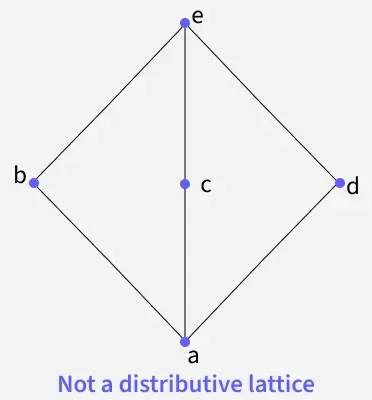
Complement of b is c and d:
- glb(b, c) = glb(b, d) = a
- lub(b, c) = lub(b, d) = e
Therefore, some element in the given lattice has more than one complement.
4. Modular Lattice
A lattice is called a modular lattice if it satisfies the following property:
- a ∨ (b ∧ c) = (a ∨ b) ∧ c whenever a ≤ c for all a, b, c ϵ L.
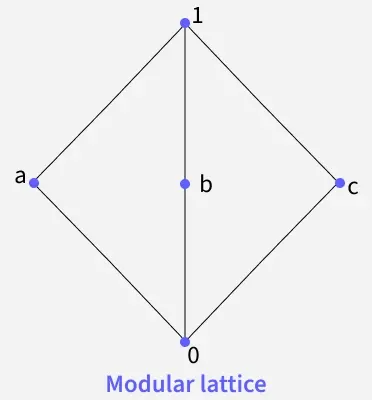
For (0, b, 1):
0 ∨ (b ∧ 1) = (0 ∨ b) ∧ 1
0 ∨ (b) = (b) ∧ 1
b = b
Similarly, in the given condition, it is true for every combination.
5. Complete Lattice
A lattice is complete if every subset (not just pairs) has a meet (infimum) and join (supremum).
- Every complete lattice is bounded (the join of all elements is top; the meet is bottom).
- However, the converse is false: a bounded lattice may not be complete if infinite subsets lack bounds.
- Counter-example: Rational numbers in [1, 2] under the usual order. Bounded (1 bottom, 2 top), but the subset of rational approximations to √2 < 2 has no supremum in the set.
- Finite lattices are always complete.
Properties
Lattices satisfy several algebraic properties, which hold for all elements a, b, c ∈ L:
1. Idempotent Laws: Joining or meeting an element with itself gives the same element.
- a ∨ a = a
- a ∧ a = a
2. Commutative Laws: Order of operands does not matter.
- a ∨ b = b ∨ a
- a ∧ b = b ∧ a
3. Associative Laws: Grouping of operations does not matter.
- a ∨ (b ∨ c) = (a ∨ b) ∨ c
- a ∧ ( b ∧ c) = (a ∧ b) ∧ c
4. Absorption Laws: An element absorbs another through a join /meet in this pattern.
- a ∨ (a ∧ b) = a
- a ∧ (a ∨ b) = a
These properties ensure that (L, ∨) and (L, ∧) form semilattices, linked by absorption.
➢Practice: Solved Examples
