

In graph theory, a matching is a way of pairing up vertices so that each vertex is included in at most one pair. Matchings are used in various applications, including network design, job assignments, and scheduling.
A matching in a graph is a set of edges such that no two edges share a common vertex.
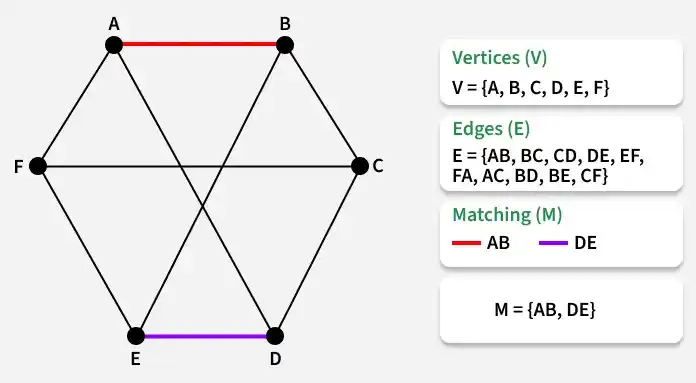
For a graph G = (V, E), a matching M satisfies the following: M ⊆ E, such that no two edges in M are incident on the same vertex.
Example: Consider a graph with vertices V = {A, B, C, D, E, F} and edges E = {AB, BC, CD, DE, EF, FA, AC, BD, BE, CF}. The set M = {AB, DE} is a valid matching because the selected edges do not share any common vertex. Therefore, each vertex is incident to at most one edge in the matching.
Cardinality of Matching
The number of edges present in a matching is called the cardinality or size of the matching.
If a matching contains (k) edges, then |M| = k.
The size of the largest possible matching in a graph is called the matching number of the graph.
Properties
- No two edges in a matching share a common vertex.
- Every perfect matching is a maximum matching.
- A maximal matching need not be a maximum matching.
- Bipartite graphs are commonly used in matching problems.
- Matchings are used to model pairing and allocation problems.
Types of Matching
Maximal Matching
A maximal matching is a matching to which no additional edge can be added without violating the matching condition.
A maximal matching is not always the largest possible matching.
Maximum Matching
A maximum matching is a matching that contains the largest possible number of edges.
Example: For the same graph G, a maximum matching could be M = {(u1,v1),(u2,v2)}, assuming there are no other edges connecting u3 to V.
Perfect Matching
A perfect matching is a matching where every vertex in the graph is connected to exactly one edge in the matching.
Example: For the bipartite graph G = (U, V, E) where U = {u1, u2, u3} and V = {v1, v2, v3}, a perfect matching could be M = {(u1, v1), (u2, v2),(u3, v3)}
Maximum Bipartite Matching
In a bipartite graph, a maximum bipartite matching covers the maximum number of vertices in both partitions.
Example: For the bipartite graph G, a maximum bipartite matching could be M={(u1,v1),(u2,v2),(u3,v3)}
Algorithms for Finding Matchings
Hungarian Algorithm: The Hungarian algorithm is used to find the maximum matching in a bipartite graph.
Steps:
- Initialize the matching M to be empty.
- Find augmenting paths and increase the size of the matching.
- Repeat until no more augmenting paths can be found.
Hopcroft-Karp Algorithm: The Hopcroft-Karp algorithm is an efficient algorithm for finding maximum matchings in bipartite graphs.
Steps:
- Perform a breadth-first search to find the shortest augmenting path.
- Perform a depth-first search to augment the matching along the path.
- Repeat until no more augmenting paths can be found.
Blossom Algorithm: The Blossom algorithm, developed by Jack Edmonds, is used to find maximum matchings in general graphs (non-bipartite).
Steps:
- Find augmenting paths using the concept of blossoms (odd-length cycles).
- Contract blossoms into single vertices.
- Repeat the process until no more augmenting paths can be found.
Applications
- Network Design: Efficient routing and resource allocation.
- Job Assignment: Assigning jobs to machines or workers.
- Scheduling: Optimal scheduling of tasks.
- Resource Allocation: Resources can be assigned to users or processes without conflicts.
➢Practice: Solved Examples
