

Rings, integral domains, and fields are fundamental algebraic structures in abstract algebra.
- A ring is a set with addition and multiplication operations satisfying specific axioms.
- Integral domains and fields are special classes of rings with additional properties.
- These structures provide the foundation for studying number systems, polynomial algebra, and many advanced mathematical concepts.
Ring
A ring is an algebraic structure equipped with two binary operations, usually called addition and multiplication, satisfying certain properties. A non-empty set R together with two binary operations + (addition) and . (multiplication) is called a ring if
- (R, +) is an abelian group
- (R, .) is a semigroup
- For any three elements a, b, c \in
\epsilon R, the left distributive law is a(b+c) = a.b + a.c, and the right distributive property is (b+c). a = b.a + c.a holds.
Ring Axioms
A non-empty set R is a ring with respect to binary operations addition (+) and multiplication(⋅) iff the following conditions are satisfied.
- Closure under Addition: For all a, b ϵ R, a+b ϵ R.
- Associativity of Addition: For all a, b, c ϵ R, a + (b+c) = (a+b)+c,
- Existence of Additive Identity: There exists an element in 0 ϵ R, such that a+0 = 0+a for all a ϵ R.
- Existence of Additive Inverse: For every a ϵ R, there exists an element −a ∈ R such that a + (-a) = (-a)+a = 0
- Commutativity of Addition: a + b = b + a for all a, b ϵ R.
- Closure under Multiplication: a.b ϵ R for all a, b ϵ R.
- Associativity of Multiplication: (b.c) = (a.b).c for all a, b, c ϵ R
- Distributive Laws: For any three elements a, b, c ϵ R, a.(b + c) = a.b + a.c (left distributive law) and (b + c). a = b.a + c.a (right distributive law).
Example: The set S = {0, 1, 2, 3, 4} is a ring with respect to the operations of addition modulo 5 & multiplication modulo 5.
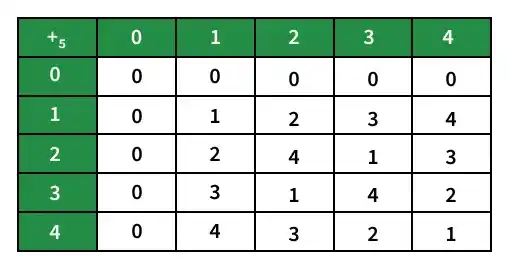
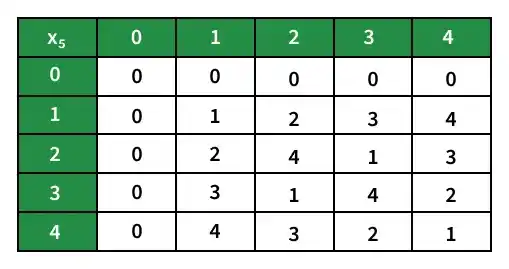
(S, +5) is an Abelian Group. From the above 1st composition table, we can conclude that (S, +5) satisfies the following:
- Closure: a ∈ S, b ∈ S => a + 5b ∈ S; ∀ a,b ∈ S
- Associativity: (a+5b)+5c = a+5(b+5c); ∀ a,b,c ∈ S.
- Existence of identity 0: (a+5b)+5c = a+5(b+5c); ∀ a,b,c ∈ S.
- Existence of inverse: The Inverse of 0, 1, 2, 3, and 4 are 0, 4, 3, 2, and 1, respectively.
- Commutative: (a+5b) = (b+5a); ∀ a,b ∈ S
(S, *5) is a semigroup. From the above 2nd composition table, we can conclude that (S, *5) satisfies the following:
- Closure: a ∈ S, b ∈ S => a * 5 b ∈ S; ∀ a,b ∈ S
- Associativity: (a*5b)*5c = a*5(b*5c); ∀ a,b,c ∈ S
Multiplication is distributive over addition:
(a) Left Distributive: ∀ a, b, c ∈ S:
a*5 (b + 5 c) = [a * (b + c)] mod 5 = [a*b + a*c] mod 5 = (a * 5 b) +5 (a * 5 c)
⇒ Multiplication modulo 5 is distributive over addition modulo 5.
Similarly , Right Distributive law can also be proved.
So, we can conclude that (S, +5, *5) is a Ring.
Types of Ring
Null Ring: A ring containing only one element, 0, is called a null ring or zero ring.
In a null ring, 0+0 = 0 and 0⋅0 = 0
The singleton set {0} forms a null ring.
Ring with Unity: A ring R is called a ring with unity if there exists an element 1 ∈ R such that
1⋅a = a⋅1 =a,, for every a ∈ R
The element 1 is called the multiplicative identity or unity of the ring.
Commutative Ring: A ring R is called a commutative ring if multiplication is commutative, that is,
a⋅b = b⋅a, for all a,b ∈ R.
Boolean Ring: A ring R is called a Boolean ring if every element of R is idempotent, i.e.,
a = a for all a ∈ R.
Integral Domain
A non-trivial commutative ring with unity and without zero divisors is called an integral domain.
Thus, a ring R is an integral domain if:
- R is commutative,
- R contains a multiplicative identity 1 ≠ 0, and
- R has no zero divisors, i.e.,
b=0, ab=0⇒ a=0 or b=0 , for all a,b ∈ R
Example: The ring (Z, +, ⋅)
is an integral domain because
- addition and multiplication are commutative.
- the multiplicative identity 1 exists, and
- there are no zero divisors in Z.
Field
A non-trivial ring F with unity is called a "field" if:
- multiplication in F is commutative, and
- every non-zero element of F has a multiplicative inverse.
Thus, a field is a commutative ring with unity in which every non-zero element is a unit.
Properties
For all a,b,c ∈ F:
- a + b ∈ F and a⋅b ∈ F
- Addition and multiplication are associative.
- Addition is commutative: a+b = b+a
- Multiplication is commutative: a⋅b = b⋅a
- There exists an additive identity, 0, such that a + 0 = a + 0.
- Every element a ∈ F has an additive inverse (−a).
- There exists a multiplicative identity 1 ≠ 0 such that, a⋅1 = 1⋅a
- Every non-zero element has a multiplicative inverse.
- Multiplication is distributive over addition: a⋅(b+c) = a⋅b+a⋅c
Examples - The rings (
