
A relation is a mathematical concept that describes the connection between elements of two sets.
Relations can be represented using graphs and matrices, which provide a clear and systematic way to visualize and analyze these connections.
1. Representing Using Graphs
There are different types of graphs used for this purpose, including directed graphs (digraphs) and undirected graphs. Let R be a relation on a set A. If (a, b) ∈ R, then the digraph contains a directed edge (an arrow) from vertex a to vertex b.
Directed Graphs (Digraphs)
A directed graph consists of nodes or vertices connected by directed edges or arcs.
Example: The relation R = {(a, a), (a, b), (b, b), (b, c), (c, c), (c, b), (c, a)} is represented as
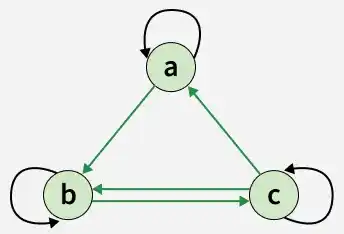
Since there is a loop at every vertex
- Relation is reflexive.
- It is not symmetric because (a, b) ∈ R but (b, a) ∉ R.
- It is not antisymmetric because both (b, c) and (c, b) belong to R, where b ≠ c.
- The relation is not transitive because (a, b) and (b, c) belong to R, but (a, c) ∉ R.
Properties
- A relation R is reflexive if there is a loop at every node of a directed graph.
- A relation R is irreflexive if there is no loop at any node of directed graphs.
- A relation R is symmetric if, for every edge between distinct nodes, an edge is always present in the opposite direction.
- A relation R is asymmetric if there are never two edges in opposite directions between distinct nodes.
- A relation R is transitive if there is an edge from a to b and b to c, then there is always an edge from a to c.
Undirected Graphs
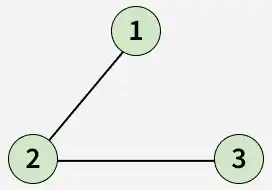
In an undirected graph, edges have no direction. This type of representation is used when the relation is symmetric, meaning if a is related to b, then b is also related to a.
Example: If the relation R on set A = {1, 2, 3} is such that R = {(1, 2), (2, 3)}, the undirected graph will have vertices 1, 2, and 3, with edges between 1 and 2, and 2 and 3.
2. Representing Using a Matrix
An adjacency matrix (also called a relation matrix) is a matrix used to represent a relation between two finite sets. It provides a simple and organized way to show whether a relation exists between the elements of the sets.
Suppose
- A = {a₁, a₂, ..., aₘ} is a finite set with m elements.
- B = {b₁, b₂, ..., bₙ} is a finite set with n elements.
- R is a relation from set A to set B.
The relation R can be represented by an m × n matrix, where:
R_{ij}=\begin{cases}1, & \text{if } a_i\,r\,b_j,\\0, & \text{otherwise}.\end{cases}
Thus, each row represents an element of set A, each column represents an element of set B, and the entries (0 or 1) indicate whether a relation exists between the corresponding elements.
Example: Let A = {2, 5, 6} and let R = {(2, 2), (2, 5), (5, 6), (6, 6)} be a relation on A. Represent the relation R using an adjacency matrix.
Solution:
Since the relation is defined on the same set A, the rows and columns of the matrix are labeled in the order 2, 5, 6.
Check each ordered pair in the relation:
- (2, 2) ∈ R, so R₁₁ = 1
- (2, 5) ∈ R, so R₁₂ = 1
- (2, 6) ∉ R, so R₁₃ = 0
- (5, 2) ∉ R, so R₂₁ = 0
- (5, 5) ∉ R, so R₂₂ = 0
- (5, 6) ∈ R, so R₂₃ = 1
- (6, 2) ∉ R, so R₃₁ = 0
- (6, 5) ∉ R, so R₃₂ = 0
- (6, 6) ∈ R, so R₃₃ = 1
Therefore, the adjacency matrix of the relation is:
R=\begin{pmatrix}1 & 1 & 0\\0 & 0 & 1\\0 & 0 & 1\end{pmatrix}
Applications in Engineering
Relations help in analyzing connections, organizing data, and solving complex problems efficiently.
- Network Analysis: Graphs and matrices are used to study communication networks, transportation systems, and electrical circuits. They help engineers understand connections and the flow of information or resources.
- Control Systems: In control engineering, graphs and matrices represent system states and transitions, making it easier to analyze and design control systems.
- Data Structures and Algorithms: Graphs and matrices are widely used in computer science for designing algorithms related to searching, pathfinding, optimization, and data organization.
- Database Management: Relations are the foundation of relational databases, where tables are used to store, organize, and manage data efficiently.
