
The angle bisector theorem states the following:
If a line bisects (divides into two equal parts) an angle of a triangle, then it divides the opposite side into segments proportional to the lengths of the other two sides.
For the given triangle ABC,
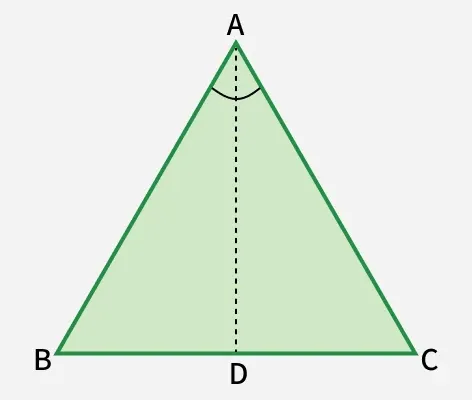
The formula for the angle bisector theorem is given by:
Proof
Consider the below figure triangle PQR, with the interior angle bisector PS
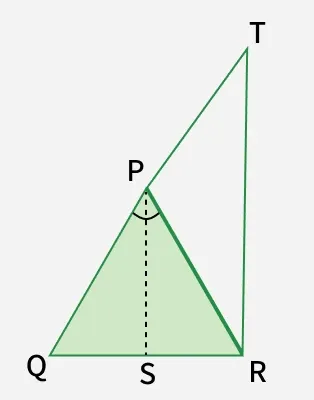
To Prove: QS / SR = PQ / PR
Draw line RT parallel to PS and extend T so that it meets P as shown in the figure.
PR is the traversal of RT || PS. So, by the property, alternate interior angles are equal.
∠ SPR = ∠ PRT [interior angles] -------(1)
∠QPS = ∠PTR [corresponding angles] -------(2)
In the figure, PS is the angle bisector of P.
∠QPS = ∠ SPR ------(3)
From (2) and (3)
∠PTR = ∠ SPR ------(4)
From (1) and (4)
∠PRT = ∠PTR ------(5)
Equation (5) implies that triangle PRT is an isosceles triangle. Hence,
PT = PR.
Since PS ∥ RT, by the Basic Proportionality Theorem,
QS / SR = QP / PT
Since, PT = PR
QS / SR = PQ / PR
Hence Proved
Converse of Angle Bisector Theorem
If a point on one side of a triangle divides that side in the same ratio as the other two sides of the triangle, then the line joining the opposite vertex to that point bisects the angle at that vertex.
In triangle ABC, if D lies on BC and
If AB /AC = BD / DC then, AD is the angle bisector of the angle A
Proof
Consider the below figure triangle PQR, with the interior angle bisector PS
To Prove: PS is angle bisector of ⦟QPR
Since, PS divides QR into two parts
PQ / PR = QS / SR --------(1)
Draw RT || PS and extend PQ to meet T
Since, PS || RT
∠ QPS = ∠ PTR (corresponding angles are equal)
∠SPR = ∠ ∠PRT (alternate interior angles are equal)
Consider triangle QRT
By Thales' theorem
QP / PT = QS / SR ------(2)
By equation (1) and (2)
PQ / PR = PQ / PT
PR = PT
Therefore, triangle PRT is an isosceles triangle
∠ PTR = ∠ PRT
From equation (3) and (4)
∠QPS = ∠SPR
Therefore, PS is angle bisector of ⦟QPR
Hence, proved.
