
Categorical Data is a type of qualitative data that classifies information into distinct groups or categories based on common characteristics. It represents data using names or labels rather than numerical values.
Categorial Data is mainly divided into two categories:
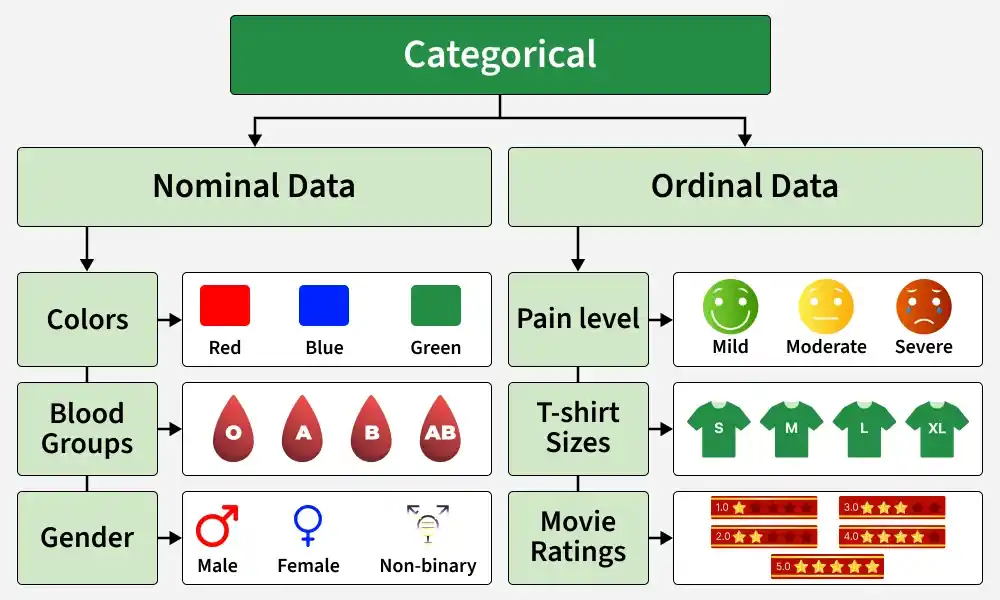
They can be represented in pie charts and bar graphs, respectively.
1. Nominal Data
Nominal Data is a type of categorical data that classifies information into distinct categories without any specific order or ranking.
- It is used to label or identify variables rather than measure them numerically.
- Examples: Hair color, gender, blood group, nationality, place of residence, and college major.
2. Ordinal Data
Ordinal Data is a type of categorical data in which the categories have a natural order or ranking, but the differences between the ranks are not necessarily equal or measurable.
- Examples: Education level (High School, Bachelor's, Master's, PhD), customer satisfaction (Poor, Fair, Good, Excellent), and class rankings.
- This type of data can be easily represented using Bar Graphs, Histograms, Pie Charts, etc.
Analysis of Categorical Data
Analysis of categorical data involves using statistical techniques to study data that is grouped into categories. The main objective is to identify patterns, relationships, and trends among different categories.
Common Methods for Analyzing Categorical Data
- Frequency Tables: Display the count or frequency of each category.
- Crosstabulation: Examines the relationship between two categorical variables.
- Chi-Square Test: Determines whether there is a significant association between categorical variables.
- Contingency Tables: Show the frequency distribution of two or more categorical variables.
- Bar Charts and Pie Charts: Visually represent the distribution of categories.
- Odds Ratio: Measures the strength of association between two categorical variables.
- Logistic Regression: Models the relationship between a categorical outcome and one or more predictor variables.
- Multiple Correspondence Analysis (MCA): Analyzes relationships among multiple categorical variables.
- ANOVA (Analysis of Variance): Compares the means of different groups to study the effect of categorical variables.
- Regression Analysis: Evaluates how categorical predictors influence a continuous outcome.
➢Practice: Solved Examples
