

Cross-multiplication is a mathematical method used to solve equations involving two equal fractions or ratios. It provides a quick and efficient way to solve proportional relationships without first finding a common denominator.
- The numerator of the first fraction is multiplied by the denominator of the second fraction.
- Denominator of the first fraction is multiplied by the numerator of the second fraction.
- If the resulting products are equal, the proportion is true.
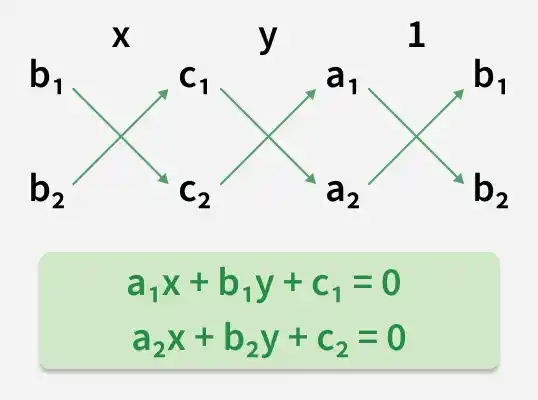
If the given pair of linear equations is,
- (a)1x + (b)1y + (c)1 = 0
- (a) 2x + (b) 2y + (c) 2 = 0
By using cross multiplication, the values of x and y will be
x=\frac{b_1c_2-b_2c_1}{b_2a_1-b_1a_2}\\[3pts]y=\frac{c_1a_2-c_2a_1}{b_2a_1-b_1a_2} where b2a1 - b1a2 ≠ 0
The required cross-multiplication formula is,
\frac{x}{b_1c_2 - b_2c_1} = \frac{-y}{a_1c_2-a_2c_1 } = \frac{1}{b_2a_1 - b_1a_2}
Derivation
We can easily derive the cross-multiplication method formula for a pair of linear equations in two variables by simply solving the linear equations by making their coefficients equal.
Let's take two linear equations as
(a)1x + (b)1y + (c)1 = 0...(i)
(a)2x + (b)2y + (c)2 = 0...(ii)
To solve the above pair of linear equations, we make the coefficient of y in both equations equal.
Multiplying b2 to eq(i) and b1 to eq(ii)
(b2)(a)1x + (b2)(b)1y + (b2)(c)1 = 0...(iii)
(b1)(a)2x + (b1)(b)2y + (b1)(c)2 = 0...(iv)
Subtracting equations (iii) and (iv) we get
(b2a1 - b1a2)x + (b2c1 - b1c2) = 0
Solving for x we get, x = (b1c2 - b2c1)/(b2a1 - b1a2).........(1) where, (b2a1 - b1a2) ≠ 0
Similarly solving eq (i) and eq (ii) for y we get, y = (c1a2 - c2a1)/(b2a1 - b1a2)...........(2) where, (b2a1 - b1a2) ≠ 0
Combining eq.(1) and eq.(2) we get,
\frac{x}{b_1c_2 - b_2c_1} = \frac{y}{c_1a_2 - c_2a_1} = \frac{1}{b_2a_1 - b_1a_2} This is the required cross-multiplication formula.
Conditions for Solutions of Linear Equations
Unique Solution: We get a unique solution to the pair of linear equations if the given pair of lines is consistent. For any two lines a₁x + b₁y = -c₁ and a₂x + b₂y = -c₂ to be consistent, the required condition is,
\frac{a_1}{a_2}\neq\frac{b_1}{b_2} ora_1b_1 - a_2b_2 = 0
The line for two equations will intersect at a unique point, which is the solution of the two equations.
No solution (Inconsistent Solution): We can have no solution to the pair of linear equations if the given pair of lines are parallel but their y-intercepts are not equal. For any two lines a₁x + b₁y = -c₁ and a₂x + b₂y = -c₂ to have no solution, the required condition is,
\frac{a_1}{a_2}=\frac{b_1}{b_2} \neq \frac{c_1}{c_2} ora_1b_2-a_2b_1=0 ora_1c_2-a_2c_1\neq0
In case there is no solution, the graphs of two equations will be parallel, and hence no solution is derived.
Infinitely Many Solutions: We can have Infinitely Many solutions to the pair of linear equations if the given pair of lines are parallel but their y-intercepts are also multiples of each other. For any two lines a₁x + b₁y = -c₁ and a₂x + b₂y = -c₂ to have infinite solutions, the required condition is,
\frac{a_1}{a_2}=\frac{b_1}{b_2} = \frac{c_1}{c_2} or
a1b2 - a2b1 = 0 , b1c2 - b2c1 = 0 , a1c2 - a2c1 = 0
In the case of Infinitely many solutions, the two graphs will be overlapping each other, thus giving infinitely many solutions.
Solved Examples
Example 1: Solve the following linear equations using the cross-multiplication method.
- 2x - 3y = 6
- 5x - 6y = 8
Given equations are,
2x - 3y = 6 and 5x - 6y = 8
Comparing with a1x + b1y = -c1 and a2x + b2y = -c2
a1 = 2, b1 = -3, c1 = -6
a2 = 5, b2 = -6, c2 = -8
Using Cross Multiplication Method,
x/(b1c2 - b2c1) = y/(c1a2 - c2a1) = 1/(b2a1 - b1a2)
Substituting all the values
x/[(-3).(-8) - (-6).(-6)] = y/[(-6).(5) - (-8).(2)] = 1/[(-6).(2) - (-3).(5)]
x/[24 - 36] = y/[-30 + 16] = 1/[-12 + 15]
x/(-12) = y/(-14) = 1/(3)
x/(-12) = 1/3
x = -4
y/(-14) = 1/(3)
y = -14/3
Thus, the value of x = -4 and -14/3
Example 2: Solve the following linear equations using the cross-multiplication method.
- 3x + 4y = 5
- x + 2y = 6
Given equations are,
3x + 4y = 5 and x + 2y = 6
Comparing with a1x + b1y = -c1 and a2x + b2y = -c2
a1 = 3, b1 = 4, c1 = -5
a2 = 1, b2 = 2, c2 = -6
Using Cross Multiplication Method,
x/(b1c2 - b2c1) = y/(c1a2 - c2a1) = 1/(b2a1 - b1a2)
Substituting all the values
x/[(4).(-6) - (2).(-5)] = y/[(-5).(1) - (-6).(3)] = 1/[(2).(3) - (4).(1)]
x/[-24 + 10] = y/[-5 + 18] = 1/[6 - 4]
x/(-14) = y/(13) = 1/(2)
x/(-14) = 1/2
x = -7
y/(13) = 1/(2)
y = 13/2
Thus, the value of x = -7 and 13/2
Example 3: Check whether 2x + 3y = 5 and 3x + y = 7 yields a unique solution or not.
Given Equation,
- 2x + 3y = 5
- 3x + y = 7
Comparing with a1x + b1y = -c1 and a2x + b2y = -c2
a1 = 2, b1 = 3
a2 = 3, b2 = 1
Using the condition
a1/a2 ≠ b1/b2
2/3 ≠ 3/1
As the condition holds true the given equations give the unique solution.
Practice Problems
Problem 1: Solve the pair of equations: 2x+y = 7 and 3x−y = 8
Problem 2: Find the values of x and y: 4x+5y=18 and 2x−y=4.
Problem 3: Solve the following system of equations: 3x+2y = 12 and 5x−y = 7
Problem 4: Using the Cross Multiplication Method, find the solution of: 7x + 3y = 20 and 2x + y = 5
Problem 5: Determine the values of x and y: 5x−2y = 16 and 3x+4y = 18
