
De Morgan's Laws are fundamental rules in Boolean algebra that describe how negation (complement) interacts with AND and OR operations. They are used to simplify Boolean expressions and logic circuits.
- They describe the relationship between complement, AND, and OR operations.
- They simplify Boolean expressions and logic circuits.
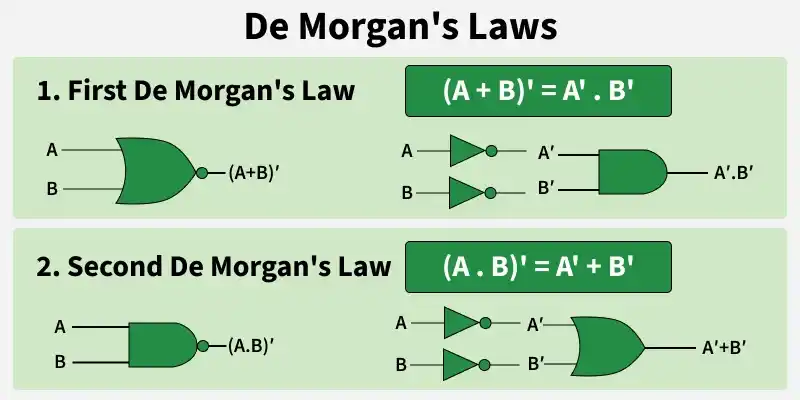
De Morgan's Laws in Set Theory
De Morgan's Laws in Set Theory describe the relationship between union, intersection, and complement of sets.
There are two De Morgan's Laws in set theory:
- First De Morgan's Law (Law of Union)
- Second De Morgan's Law (Law of Intersection)
First De Morgan's Law (Law of Union)
The complement of the union of two sets is equal to the intersection of their complements.
Formula
(A ∪ B)' = A' ∩ B'
where,
- ∪ represents the union of two sets.
- ∩ represents the intersection of two sets.
- ' represents the complement of a set.
Proof
Let,
- X = (A ∪ B)'
- Y = A' ∩ B'
To prove X = Y:
Let p ∈ X
⇒ p ∈ (A ∪ B)'
⇒ p ∉ (A ∪ B)
⇒ p ∉ A and p ∉ B
⇒ p ∈ A' and p ∈ B'
⇒ p ∈ A' ∩ B' = YTherefore,
X ⊆ Y
Now let q ∈ Y
⇒ q ∈ A' ∩ B'
⇒ q ∉ A and q ∉ B
⇒ q ∉ (A ∪ B)
⇒ q ∈ (A ∪ B)' = XTherefore,
Y ⊆ X
Since X ⊆ Y and Y ⊆ X,
(A∪B)′ = A′∩B′
Proof using a Venn Diagram
Venn Diagram for (A ∪ B)'
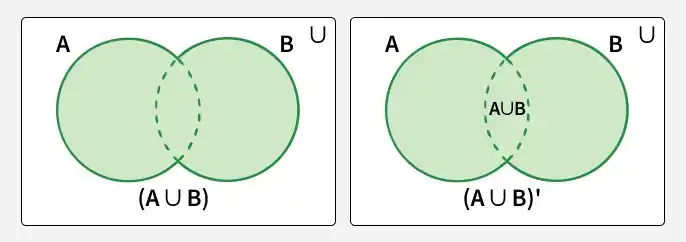
Venn Diagram for A' ∩ B'
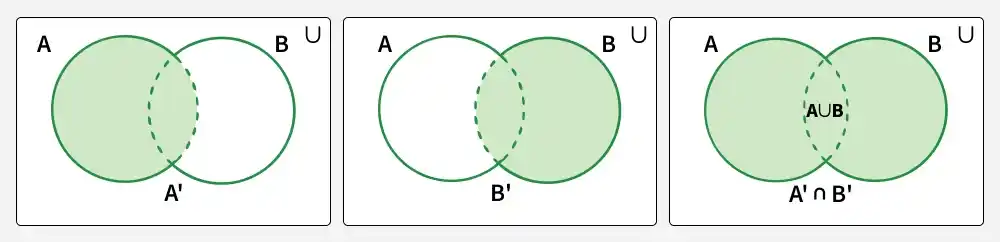
From the Venn diagrams, the shaded regions of (A∪B)′ and A′∩B′ are identical. Therefore,
(A∪B)′ = A′∩B′
Hence, the First De Morgan's Law is verified using a Venn diagram.
Second De Morgan's Law (Law of Intersection)
The complement of the intersection of two sets is equal to the union of their complements.
Formula
(A∩B)′ = A′∪B′
where,
- ∩ represents the intersection of two sets.
- ∪ represents the union of two sets.
- ' represents the complement of a set.
Proof
Let,
- X = (A ∩ B)'
- Y = A' ∪ B'
To prove X = Y:
Let p ∈ X
⇒ p ∈ (A ∩ B)'
⇒ p ∉ (A ∩ B)
⇒ p ∉ A or p ∉ B
⇒ p ∈ A' or p ∈ B'
⇒ p ∈ A' ∪ B' = YTherefore,
X ⊆ Y
Now let q ∈ Y
⇒ q ∈ A' ∪ B'
⇒ q ∈ A' or q ∈ B'
⇒ q ∉ A or q ∉ B
⇒ q ∉ (A ∩ B)
⇒ q ∈ (A ∩ B)' = XTherefore,
Y ⊆ X
Since X ⊆ Y and Y ⊆ X,
(A∩B)′ = A′∪B′
Proof using Venn Diagram
Venn Diagram for (A ∩ B)'
Venn diagram for A' ∪ B'
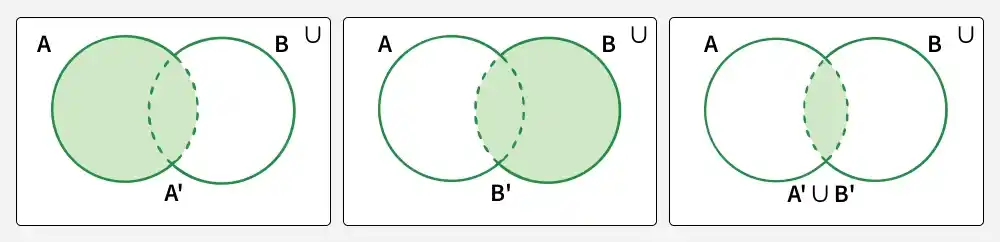
From the Venn diagrams, the shaded regions of (A∩B) and A′∪ B′ are identical. Therefore,
(A∩B)′ = A′∪B′
Hence, the Second De Morgan's Law is verified using a Venn diagram.
De Morgan's Law in Boolean Algebra
De Morgan's Laws in Boolean algebra describe the relationship between AND (·), OR (+), and complement (') operations. These laws are widely used to simplify Boolean expressions and design digital logic circuits.
There are two De Morgan's Laws in Boolean algebra:
- First De Morgan's Law
- Second De Morgan's Law
First De Morgan's Law
The complement of the OR of two variables is equal to the AND of their complements.
Formula
(A + B)' = A' . B'
where,
- + represents the OR operation.
- · represents the AND operation.
- ' represents the complement operation.
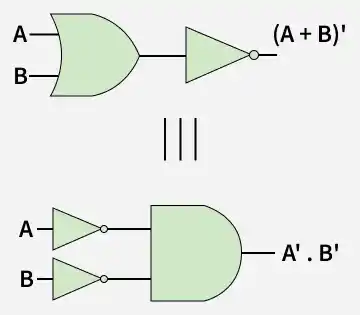
Truth Table
A | B | A + B | (A + B)' | A' | B' | A'. B' |
|---|---|---|---|---|---|---|
0 | 0 | 0 | 1 | 1 | 1 | 1 |
0 | 1 | 1 | 0 | 1 | 0 | 0 |
1 | 0 | 1 | 0 | 0 | 1 | 0 |
1 | 1 | 1 | 0 | 0 | 0 | 0 |
Observation
From the truth table, the values of (A + B)' and A' · B' are identical.
Therefore,
(A+B)′ = A′⋅B′
Second De Morgan's Law
The complement of the AND of two variables is equal to the OR of their complements.
Formula
(A⋅B)′ = A′+B′
where,
- · represents the AND operation.
- + represents the OR operation.
- ' represents the complement operation.
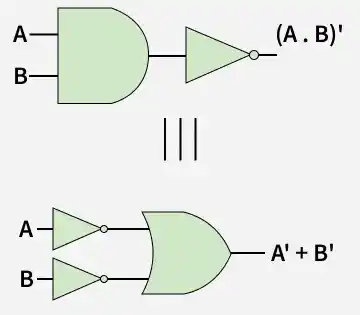
Truth Table
A | B | A . B | (A. B)' | A' | B' | A' + B' |
|---|---|---|---|---|---|---|
0 | 0 | 0 | 1 | 1 | 1 | 1 |
0 | 1 | 0 | 1 | 1 | 0 | 1 |
1 | 0 | 0 | 1 | 0 | 1 | 1 |
1 | 1 | 1 | 0 | 0 | 0 | 0 |
Observation
From the truth table, the values of (A · B)' and A' + B' are identical.
Therefore,
(A⋅B)′ = A′+B′
Solved Question
Question 1: Given that U = {2, 3, 7, 8, 9}, A = {2, 7} and B = {2, 3, 9}. Prove De Morgan's Second Law.
Solution:
U = {2, 3, 7, 8, 9}, A = {2, 7} and B = {2, 3, 9}
To Prove: (A ∩ B)' = A' ∪ B'
(A ∩ B) = {2}
(A ∩ B)' = {3, 7, 8, 9}
A' = U - A = {2, 3, 7, 8, 9} - {2, 7}
A' = {3, 8, 9}
B' = U - B = {2, 3, 7, 8, 9} - {2, 3, 9}
B' = {7, 8}
A' ∪ B' = {3, 8, 9} ∪ {7, 8}
A' ∪ B' = {3, 7, 8, 9}Hence, (A ∩ B)' = A' ∪ B'
Question 2: Simplify the Boolean Expression: Y = [(A + B).C]'
Solution:
Y = [(A + B).C]'
Applying De Morgan's law (A . B)' = A' + B'
Y = (A + B)' + C'
Applying De Morgan's law (A + B)' = A'. B'
Y = A'. B' + C'
