
The Extreme Value Theorem (EVT) guarantees the existence of both a maximum value and a minimum value of a continuous function on a closed interval. It ensures that a continuous function does not grow indefinitely within a finite closed interval and must attain its highest and lowest values at least once.
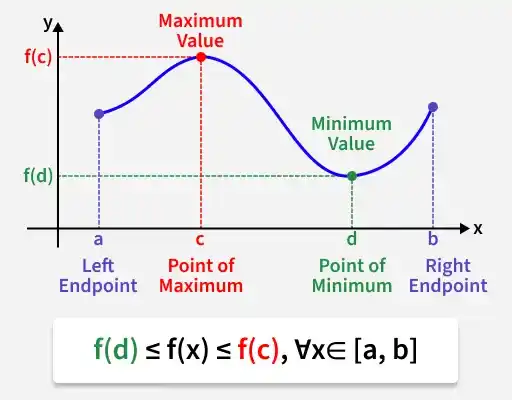
If a function f(x) is continuous on a closed interval [a,b], then there exist points c and d in [a,b] such that
f(c)\leq f(x)\leq f(d) , for every x ∈ [a,b]where,
- f(c) is the absolute minimum value.
- f(d) is the absolute maximum value.
Thus, a continuous function on a closed interval always attains both its maximum and minimum values.
The Extreme Value Theorem is valid only when the following conditions are satisfied:
- The function must be continuous.
- The interval must be closed.
- The interval must be bounded.
Proof
Let f be continuous on the closed interval [a,b].
Step 1: Use the Boundedness Theorem
Since f is continuous on a closed interval, it is bounded. Therefore, there exist real numbers m and M such that m ≤ f(x) ≤ M, for all x ∈ [a,b]
Step 2: Let M be the Least Upper Bound
Assume M is the least upper bound (supremum) of the set of function values. We must show that there exists a point c ∈ [a,b] such that f(c)=M.
Step 3: Assume the Contrary
Suppose no point c ∈ [a,b] satisfies , f(c)=M
Then, f(x) < M, for every x ∈ [a,b]
Step 4: Define a New Function
Consider,
g(x)=\frac{1}{M-f(x)} Since f(x)<M, the denominator is positive, and g(x) is continuous on [a,b].
Step 5: Apply Boundedness Again
Because g is continuous on a closed interval, it is bounded.
Thus, there exists k>0 such that g(x) ≤ k.
Hence,
\frac{1}{M-f(x)}\leq k Rearranging,
f(x)\leq M-\frac{1}{k} Step 6: Reach a Contradiction
The quantity
M-\frac{1}{k} is smaller than M, which contradicts the fact that M is the least upper bound.Therefore, our assumption is false, and there exists a point c ∈ [a,b] such that f(c) = M
Similarly, one can prove that f attains its minimum value.
Hence, the theorem is proved.
Steps to Use Extreme Value Theorem
To find the absolute maximum and minimum values of a function on a closed interval:
Step 1: Verify that the function is continuous on the closed interval [a,b][a,b][a,b].
Step 2: Find the derivative f′(x).
Step 3: Determine all critical points in (a,b) by solving f′(x)=0 or where f′(x) does not exist.
Step 4: Evaluate the function at all critical points.
Step 5: Evaluate the function at the endpoints a and b.
Step 6: Compare all obtained values.
Step 7: The largest value is the absolute maximum, and the smallest value is the absolute minimum.
Solved Examples
Example 1: Find the extreme values of the function f(x) = x3 - 4x2 + 4x + 6 in the interval [-1, 5].
f(x) = x3 - 4x2 + 4x + 6
First, find f'(x) and equate it to zero.
f'(x) = 3x2 - 8x + 4
3x2 - 8x + 4 = 0
x = 2, 2/3
The critical points of function are 2, 2/3.
Now, find the value of f(x) by putting critical points and range of interval.
f (2) = 23 - 4(2)2 + 4(2) + 6 = 6
f (2/3) = (2/3)3 - 4(2/3)2 + 4(2/3) + 6 = 6.741
f (-1) = (-1)3 - 4(-1)2 + 4(-1) + 6 = -3
f (5) = 53 - 4(5)2 + 4(5) + 6 = 51
So, the maximum value of the function is 51 at x = 5 and the minimum value of function is -3 at x = -1.
Example 2: Find the extreme values of the function p(x) = x2 - 8x + 6 in the interval [2, 5].
p(x) = x2 - 8x + 6
First find p'(x) and equate it to 0
p'(x) = 2x - 8
2x - 8 = 0
2x = 8
x = 4
The critical point of the function p(x) is 4.
Now, find the value of the function p(x) at critical points and the range of interval.
p(4) = 42 - 8(4) + 6 = -10
p(2) = 22 - 8(2) + 6 = -6
p(5) = 52 - 8(5) + 6 = -9
Extreme values are -6 (maximum at x = 2) and -10 (minimum at x = 4).
Example 3: Find the extreme value of the function g(x) = 2sin x - 1 in the interval [0, 2π/3]
g(x) = 2sin x - 1
First find g'(x) and equate it 0.
g'(x) = 2cos x
2cos x = 0
cos x = 0
x = π / 2
Now, find the values of the function at critical point and range of the interval.
g(π / 2) = 2sin ( π / 2) - 1 = 1
g(0) = 2 sin(0) - 1 = -1
g(2π/3) = 2sin(2π/3) - 1 = √3 - 1
Extreme values of the function g(x) are -1 (minimum x = 0) and 1 (maximum at x = π / 2)
Example 4: Find the extreme values of the function f(x) = x + cos x in the interval [0, π]
f(x) = x + cos x
first find f'(x) and equate it to 0
f'(x) = 1 - sin x
1 - sin x = 0
sin x = 1
x = π / 2
The critical point of the function f(x) is π/2
Now, find the values of the function at critical point and range of interval'
f(π/2) = (π/2) + cos (π/2) = π/2
f(0) = 0 + cos 0 = 1
f(π) = π + cos π = π - 1
Extreme values of the function f(x) are 1 (minimum at x = 0) and π - 1 (maximum at x = π).
Practice Questions
Q1. Find the extreme values of the function f(x) = 2x3 - 9x2 + 2x + 10 in the interval [1, 6].
Q2. Find the extreme values of the function t(x) = x2 - 9x + 2 in the interval [1, 4].
Q3. Find the extreme values of the function r(x) = sin x + cos x in the interval [0, π/2].
Q4. Find the extreme values of the function s(x) = x4 - 5x3 + x2 - 2x -3 in the interval [0, 7].
