

A first-order differential equation is the simplest type of differential equation because it contains only the first derivative.
- Does not involve higher derivatives.
- These equations help model many real-world phenomena such as population growth, radioactive decay, the cooling of objects, and electrical circuits.
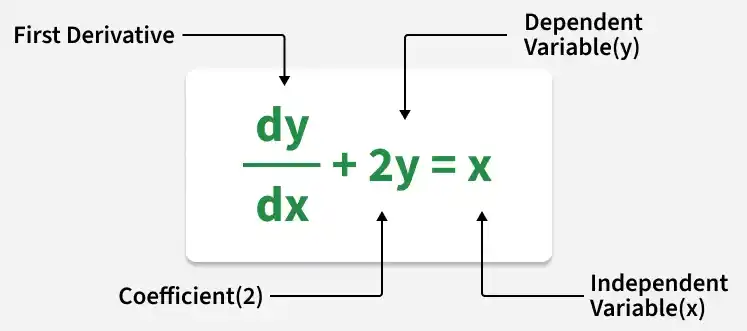
A first-order differential equation is a differential equation in which the highest derivative present is the first derivative(dy/dx) of the unknown function(y).
Differential equations of first order are written as:
y’ = f(x, y)\\[3pts]\frac{dy}{dx} = f(x, y)
where,
- x is the independent variable.
- y is the dependent variable.
\frac{dy}{dx} represents the first derivative of y with respect to x.
Example: dy/dx = 2x, here the highest derivative is dy/dx
Types of First-Order Differential Equations
First-order differential equations can be classified based on their form and method of solution.
1. Linear Differential Equation
A first-order differential equation is linear differential equation if the dependent variable and its derivative appear only to the first power.
\frac{dy}{dx} + P(x)y = Q(x)
where,
- P(x) and Q(x) may be functions of x
2. Homogenous First Order Differential Equation
A differential equation is homogeneous if it involves a function and its derivatives in a way that maintains a consistent degree. It can be written as :
\frac{dy}{dx}=F(\frac{y}x)
3. Exact Differential Equations
A differential equation of the form M(x,y)dx + N(x,y)dy = 0 , is Exact Equations if
\frac{\partial M}{\partial y} = \frac{\partial N}{\partial x}
4 .Separable Differential Equations
A differential equation is called Separable Equations if the variables can be separated on opposite sides of the equation. It can be written in the form of:
\frac{dy}{dx} = f(x)g(y)
where x and y are the variables and are explicitly separated from each other.
Once the variables have been separated, it is simple to find the differential equation's solution by integrating both sides of the equation.
Methods for Solving First-Order Differential Equation
Method 1: Separation of Variables
Step 1. Rearrange the equation to separate variables.
Step 2. Integrate both sides.
Step 3. Add the constant of integration.
Step 4. Simplify the solution.
Example:
Separating variables: dy=2x dx
Integrating both sides
\int dy=\int 2x\,dx\\[3pts]y=x^2+C
Method 2: Integrating Factor Method
When the equation is in form:
Steps to solve
- Find the integrating factor using formula Integrating Factor:
IF=e^{\int P(x)\,dx} - Multiply the entire equation by the integrating factor.
- Write the left side as a derivative of a product.
- Integrate both sides.
Example:
Integrating factor(IF)
IF=e^{\int 1\,dx}=e^x Multiplying by ex:
e^x\frac{dy}{dx}+e^xy=e^{2x}\\[3pts]\frac{d}{dx}(ye^x)=e^{2x} Integrating both sides:
ye^x=\frac{e^{2x}}{2}+C\\[3pts]y=\frac{e^x}{2}+Ce^{-x}
Method 3: Exact Equation Method
Steps to solve
- Write the equation as Mdx + Ndy = 0
- Verify the exactness condition.
- Integrate M with respect to x.
- Determine the remaining function using N.
- Form the final solution.
Example:
Since ,
\frac{\partial M}{\partial y} = 2x+2y and
\frac{\partial N}{\partial x} = 2x+2y the equation is exact.
Method 4: Homogeneous Equation Method
Steps to solve
- Verify the equation is homogeneous.
- Substitute y=vx.
- Replace
\frac{dy}{dx} withv+x\frac{dv}{dx} .- Solve the resulting separable equation.
Example:
Substitute y=vx and solve.
Solved Examples
Example 1: Solve the following separable differential equation: dy/dx = x/y2
First, we separate the variables: y2.dy = x.dx
Integrating both sides:
∫y2.dy = ∫x.dx
y3/3 = x2/2 + C
Example 2: Solve the following linear differential equation: dy/dx + 2xy - x = 0
Equation in the standard form: dy/dx + 2xy - x = 0
Now, we can use an integrating factor to solve it:
f(x) = e ∫2xdx
f(x) =
e^{x^2} Multiplying both sides by the integrating factor:
e^{x^2} \frac{dy}{dx} + 2xye^{x^2} - xe^{x^2} = 0
\frac{d}{dx} (ye^{x^2}) - xe^{x^2} = 0 Integrating both sides:
ye^{x^2} = \frac{x^2}{2} + C
Example 3: Solve the first-order differential equation x3y' = x + 2
x3y' = x + 2
⇒ y' = (x + 2)/x3
Integrating both sides w.r.t. x
⇒ ∫(dy/dx) dx = ∫ {(x + 2)/x3} dx
⇒ y = -1/x - 1/x2 + C
Practice Problem
1. For differential equation dy/dx + yx2 = sin x find integrating factor.
2. Find the solution of differential equation dy/dx = y2(x2+1).
3. Solve the differential equation dy/dx + 2x3y = x.
