
A heptagon is a two-dimensional closed figure with seven sides and seven angles. It is distinguished by its unique structure, which includes different parts that affect its geometry.
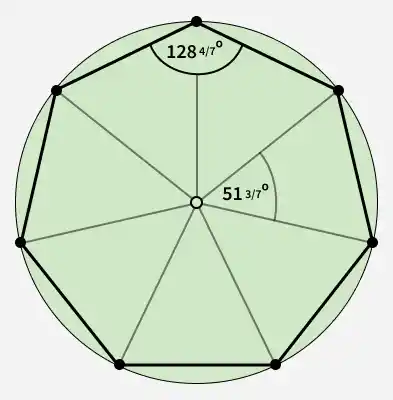
Key Properties
- Perimeter of Heptagon = 7 × Sides of Heptagon (for Regular Heptagon)
- For irregular heptagons, we need to add all seven sides individually.
- Area of Regular Heptagon = 3.643 × (side)2
- Sum of interior angles: (7 − 2) × 180° = 900°
- Regular heptagon (all sides and angles equal): each interior angle = 900° ÷ 7 ≈ 128.57°
- Sum of exterior angles: always 360° (true for any polygon)
- A regular heptagon has 7 lines of symmetry and rotational symmetry of order 7
Note: For an irregular heptagon the interior and exterior angles will vary.
Heptagons Based on Side Length
A heptagon may have all seven sides the same length, or they may be different lengths. Hence, based on side length, the heptagons are classified as follows:
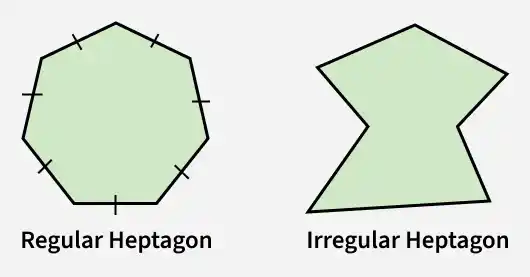
Regular Heptagon
A heptagon with equal sides and equal angles. It has no parallel sides.
Properties:
- Sum of exterior angles = 360°
- Each interior angle ≈ 128.57°
- 14 diagonals
- Divides into 5 triangles
- Central angle ≈ 51.43°
- Rotational symmetry of order 7
Irregular Heptagon
A seven-sided closed shape with sides and angles that are not all equal. It has no specific angle or side measure, and no lines of symmetry.
Heptagon Based On Angle Measurement
Based on the measurement of angles, Heptagon is classified as
Convex Heptagon
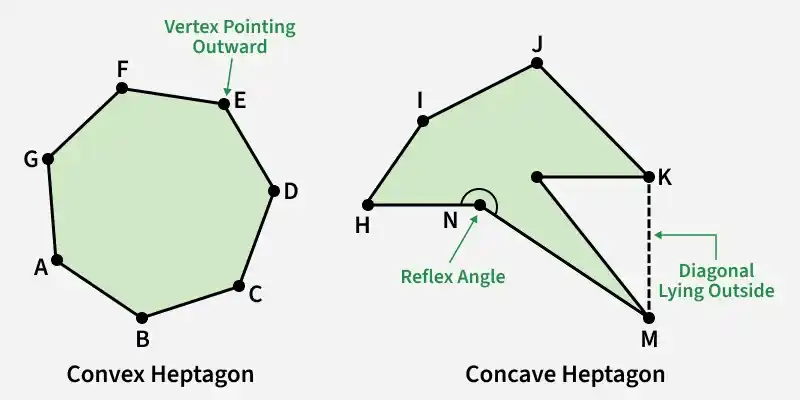
A heptagon where every interior angle is less than 180°.
Properties:
- All diagonals lie inside the shape
- A regular heptagon is always convex; an irregular one can be too
- May or may not be symmetrical
Concave Heptagon
A heptagon with at least one interior (reflex) angle greater than 180°.
Properties:
- Always irregular and asymmetrical
- At least one diagonal lies outside the shape
Note: Regularity (equal sides/angles) and convexity (angle direction) are independent classifications, an irregular heptagon can still be convex.
Solved Examples
Example 1: If the area of a regular heptagon is 714 cm2, what is its side?
Solution:
Area of Heptagon = 3.643 × side × side
Here, we have area = 714 cm2
⇒ 714 = 3.643 × side × side
⇒ Side2 = 714/3.63 = 196.69
⇒ Side = √196.69 ≈ 14When we solve the above equation, we get the side equals to 14 cm, approximately.
Example 2: Find the area of the heptagon whose side is 8 cm.
Solution:
We know, Area of heptagon = 3.643 (side)2
⇒ Area of heptagon = 3.643 × 8cm × 8cm = 233.1 cm2So, the area of heptagon with side 8cm will be 233.1 cm2
Example 3: Find the perimeter of the heptagon whose side is 8 cm.
Solution:
Perimeter of heptagon is 7 × side.
Here side = 8 cm
So, Perimeter = 7 × 8 = 56 cmThe perimeter of heptagon with side 8cm will be 56cm.
