
A linear equation is known as an algebraic equation that represents a straight line. It is composed of variables and constants.
There are various ways to represent the linear equations, such as,
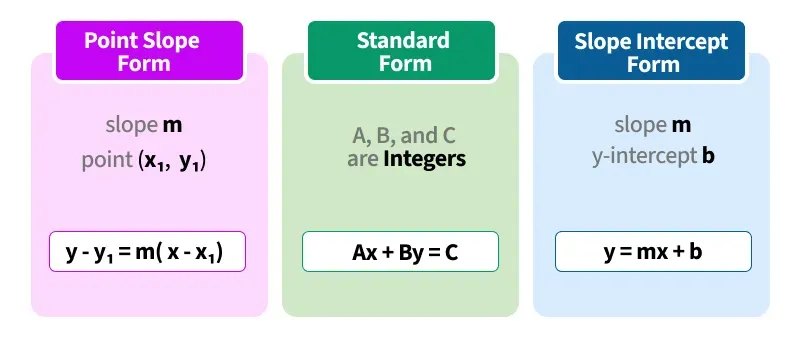
Standard Form
The most generalized form of a linear equation in two variables is:
Ax + By = C where A, B, and C are constants, and x and y are variables.
This form is particularly useful for quickly determining the intercepts and is common in algebraic problems.
Example: Convert the equation y = 2/3x - 4 into standard form.
Solution:
We start with the given equation: y = 2/3x − 4
Multiply everything by 3 to eliminate the fraction: 3y = 2x − 12Rearrange to get it in Ax + By = C form: 2x − 3y = 12
Slope-Intercept Form
This is another highly popular form for representing linear equations, especially when graphing:
y = mx + by where m is the slope of the line, and b is the y-intercept.
This form directly shows how y changes with x and where the line crosses the y-axis.
Example: Find the equation of a line with slope m = −5m and y-intercept b = 7.
Solution:
Since we are given the slope and y-intercept, we directly substitute into the equation:
y = −5x + 7
Point-Slope Form
Useful for when you know a point on the line (x1, y1) and the slope
m: y − y1 = m(x − x1)
This form is handy for writing the equation of a line when you are given a point on the line and the slope.
Example: Find the equation of the line passing through (3, -2) with a slope of 4.
Solution:
Using the point-slope formula: y − (−2) = 4(x − 3)
Simplify: y + 2 = 4x − 12
Subtract 2 from both sides:
y = 4x − 14 (which is also in slope-intercept form)
Intercept Form
If the line intercepts the axes at (a, 0) and (0, b), then the equation can be expressed as:
\frac{x}{a} + \frac{y}{b} = 1
This is useful when you know where the line crosses the x-axis and y-axis.
Example: Find the equation of the line that intercepts the x-axis at (6,0) and the y-axis at (0, 4).
Solution:
Using the formula:
\frac{x}{a} + \frac{y}{b} = 1 Substituting a = 6 and b = 4:
\frac{x}{6} + \frac{y}{4} = 1
Solved Examples
Question 1: Solve for y, 6y – 3 = 0
Solution:
Solving for the value of y,
Adding 3 to both sides of the equation,
⇒ 6y - 3 + 3 = 3
⇒ 6y = 3Dividing both sides of the equation by 6
⇒ y = 3/6Simplifying the equation,
⇒ y = 1/2
Question 2: Solve the equation in x, 4/5x -5 = 15
Solution:
4/5x - 5 = 15
Taking constants to RHS,
4/5x = 15 + 5
4/5x = 20
x = 100/4
x = 25
Question 3: There are two numbers, one equal to 7/6 and the other equal to 1/3 times some number x. The sum of these two numbers is 1. Find x.
Solution:
The sum of both the numbers is 1 so the equation will be, 7/6 + 1/3x = 1
Taking all the constants to the R.H.S of the equation.
1/3x = 1 - 7/6
1/3x = -1/6Multiplying both the side of the equation by 3
3 (1/3x) = 3 × (-1/6)
x = -1/3
Question 4: Solve the equation in x, 3x + 5y = 33, where y = 3
Solution:
We have been provided with an equation 3x + 5y = 33
We have to find the value of x as the value of y is provided in the question y= 3
So, putting the value of y in the equation
3x + 5(3) = 33
3x + 15 = 33By taking all the constants to the R.H.S of the equation.
3x = 33 - 15
3x = 18
x= 18/3
x = 6So here the value of x is 6
Question 5: There are two numbers, one equal to 2/4 some number y, and the other equal to 1/3 times some number x. The sum of these two numbers is 3. Find y. And the value of x is x = 2
Solution:
The sum of both the numbers is 3 so the equation will be, 2/4y + 1/3x= 3
Pitting the value of x the equation will be
2/4y + 1/3(2)= 3
2/4y + 2/3= 3Taking all the constants to the R.H.S of the equation.
2/4y = 3-2/3
2/4y = 4/3
y= 4*4/3*2
y = 16/6
y = 8/3So, the value of y will be 8/3
Practice Problems
Question 1: Solve for x: 5x + 7 = 12.
Question 2: Solve for y: 9y − 4 = 23.
Question 3: Solve for z: 3z + 11 = 2z + 7.
Question 4: Solve for x: 7x − 5 = 2x + 20.
Question 5: Solve for y: 12y + 4 = 8y − 16.
