
The octal number system is a base-8 system using digits (0–7): 0, 1, 2, 3, 4, 5, 6, and 7.
- 'OCTAL' is derived from the Latin word 'OCT,' which means eight.
- The number system has a base of 8 and symbols ranging between 0 to 7.
- Each digit of an octal number represents a power of 8.
For example: 228, 138, 178, etc, are octal numbers.
It is widely used in computer programming as a compact representation of binary numbers, where each octal digit corresponds to three binary digits.
Octal Number System Table
The table below shows the relationship between octal and binary numbers (each octal digit represents 3 bits in binary):
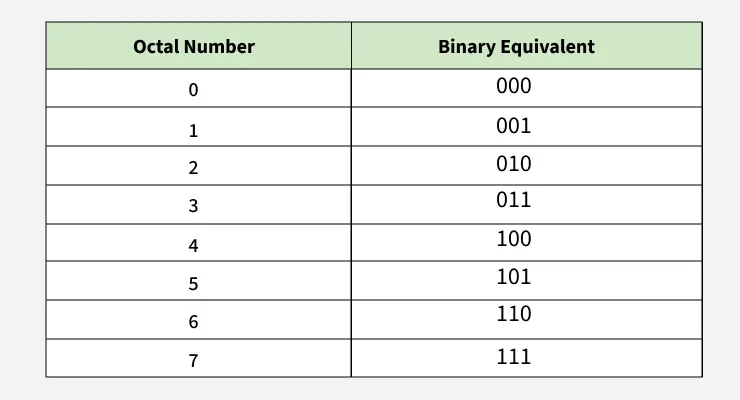
For example, an octal number (10)8 is equivalent to 8 in the decimal number system, 001000 in the binary number system and 8 in the hexadecimal number system.
Conversion from Octal to Other Number Systems
Conversion of a number system means conversion from one base to another. Following are the conversions of the Octal Number System to other Number Systems:
Octal to Decimal Conversion
Octal numbers are represented in base 8, but the decimal numbers are of base 10. Hence, to convert an octal number to a decimal number, the base of that number is to be changed.
Example: (247)8 is to be converted to decimal:
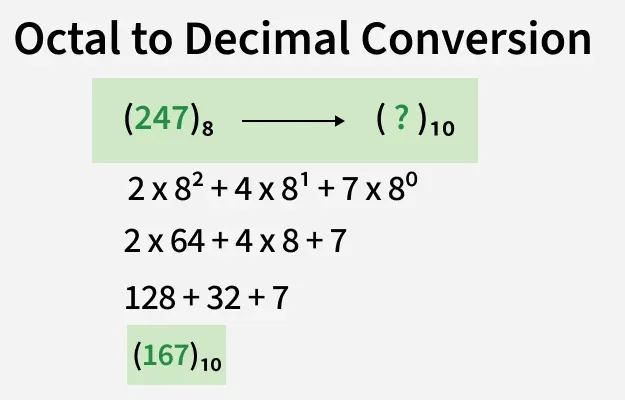
Follow the steps given below:
- Step 1: Multiply each digit of the Octal number with the place value of that digit, starting from right to left i.e. from LSB to MSB.
- Step 2: Add the result of this multiplication and the decimal number will be formed.
Octal to Binary Conversion
Octal numbers are represented in base 8, but the binary numbers are of base 2. Hence, to convert an octal number to a binary number, the base of that number is to be changed.
Example: (247)8 is to be converted to binary
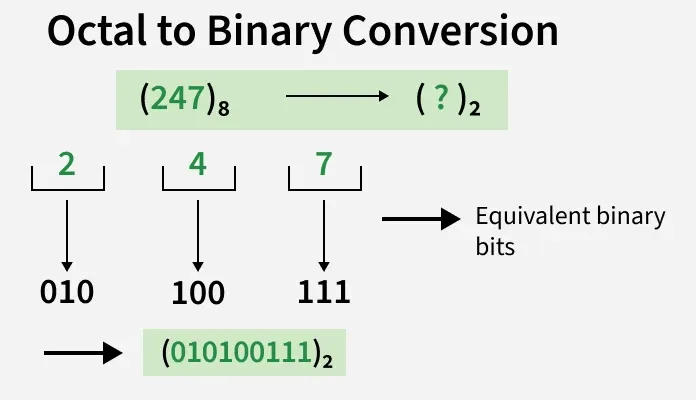
Follow the steps given below:
- Step 1: Write each digit of the octal number separately.
- Step 2: Convert each digit into an equivalent group of three binary digits.
- Step 3: Combine these groups to form the whole binary number.
Octal to Hexadecimal Conversion
Octal numbers are represented in base 8, but the hexadecimal numbers are of base 16. Hence, to convert an octal number to a hex number, the base of that number is to be changed.
Example: (5456)8 is to be converted to hex
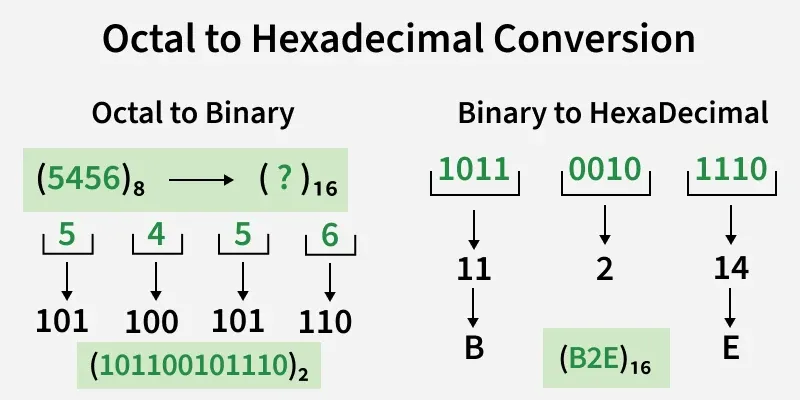
Follow the steps given below:
- Step 1: We need to convert the Octal number to Binary first. For that, follow the steps given in the above conversion.
- Step 2: Now to convert the binary number to Hex number, divide the binary digits into groups of four digits starting from right to left i.e. from LSB to MSB.
- Step 3: Add zeros before MSB to make it a proper group of four digits(if required)
- Step 4: Now convert these groups into their relevant decimal values.
- Step 5: For values from 10-15, convert it into Hex symbols i.e from A-F
Decimal to Octal Conversion
The image added below shows binary to octal conversion.
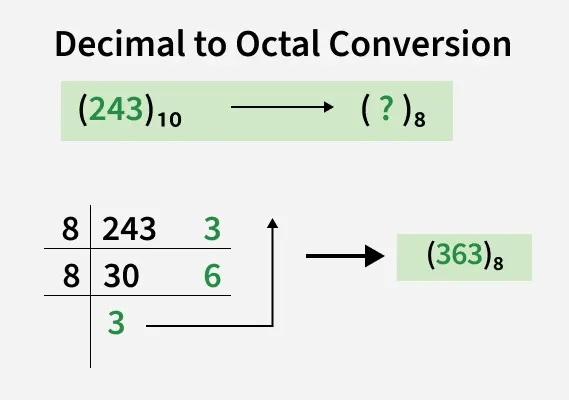
Follow the steps given below:
To convert a decimal number to an octal number follow these simple steps:
- Step 1: Divide the given decimal number by 8.
- Step 2: Write down the quotient and remainder obtained.
- Step 3: Divide the quotient obtained by 8.
- Step 4: Repeat step 2 and step 3 until the quotient becomes 0.
- Step 5: Write the obtained remainder in reverse order.
Octal Multiplication Table
× | 0 | 1 | 2 | 3 | 4 | 5 | 6 | 7 |
|---|---|---|---|---|---|---|---|---|
0 | 0 | 0 | 0 | 0 | 0 | 0 | 0 | 0 |
1 | 0 | 1 | 2 | 3 | 4 | 5 | 6 | 7 |
2 | 0 | 2 | 4 | 6 | 10 | 12 | 14 | 16 |
3 | 0 | 3 | 6 | 11 | 14 | 17 | 22 | 25 |
4 | 0 | 4 | 10 | 14 | 20 | 24 | 30 | 34 |
5 | 0 | 5 | 12 | 17 | 24 | 31 | 36 | 43 |
6 | 0 | 6 | 14 | 22 | 30 | 36 | 44 | 52 |
7 | 0 | 7 | 16 | 25 | 34 | 43 | 52 | 61 |
➢Practice: Solved Examples
