

Probability formulas are essential mathematical tools used in calculating probability.
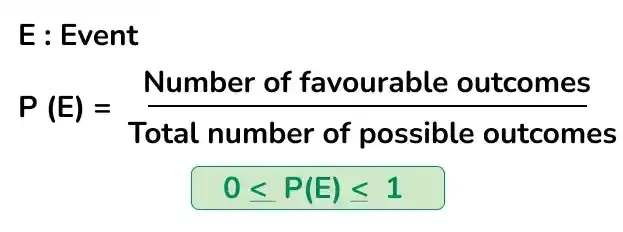
Probability of an Event = (Count of favorable outcomes) / (Total number of possible outcomes for the event)
P(A) = n(E) / n(S)
0 ≤ P(A) ≤ 1
Here, P(A) signifies the probability of an event A, where n(E) is the count of favorable outcomes, and n(S) is the total number of possible outcomes for the event.
The different probability formulas are discussed below:
Classical Probability Formula
P(A) = Number of Favorable Outcomes/Total Number of Possible Outcomes
When we deal with an event that is the union of two separate events, for example, A and B, the probability of the union will be:
- P(A or B) = P(A) + P(B) – P(A∩B)
- P(A ∪ B) = P(A) + P(B) – P(A∩B)
Joint Probability Formula
It represents the common elements that constitute the distinct subsets of both events A and B. The formula can be expressed as:
P (A ∩ B) = P(A∣B) P(B) = P(B∣A)P(A)
- P(A∩B) is the joint probability, meaning the probability that both events A and B occur.
- P(A∣B) is the conditional probability of A given that B has already occurred.
- P(B∣A) is the conditional probability of B given that A has already occurred.
- P(A) and P(B) are the probabilities of events A and B occurring individually.
Addition Rule for Mutually Exclusive Events
If events A and B are mutually exclusive, that means they cannot happen at the same time; the probability of either event occurring is equal to the sum of their respective probabilities, then:
P(A∩B) = 0
Thus, the Addition Rule for mutually exclusive events becomes:
P(A∪B) = P(A) + P(B)
Complementary Rule Formula
If A is an event, then the probability of not A is expressed by the complementary rule:
P(not A) = 1 – P(A) or P(A’) = 1 – P(A).
P(A) + P(A′) = 1.
- P(A) is the probability that event A occurs.
- P(A') is the probability that event A does not occur.
- Since an event either happens or it doesn’t, their probabilities must add up to 1.
Some probability formulas based on complementary rules are as follows:
- P(A∩A′) = 0
- P(A′∩B) = P(B)−P(A∩B)
- P(A∩B′) = P(A)−P(A∩B)
- P(A∪B) = P(A∩B′) + P(A′∩B) + P(A∩B)
- P(A∩B) + P(A′∩B′) = 1 (Not always true)
Conditional Rule Formula
In the case where the occurrence of event A is already known, the probability of event B is going to occur, referred to as conditional probability. It can be calculated using the formula:
P(B∣A) = P(A∩B)/P(A)
P (B/A): Probability of event B when event A has already occurred.
Relative Frequency Formula
The relative frequency formula is based on frequencies observed in real-world data. This formula is given as
P(A) = Number of Times Event A Occurs/Total Number of Trials or Observations
Probability Formula with the Multiplication Rule
The Multiplication Rule is used to find the probability of two or more events occurring together (simultaneously or in sequence). The formula depends on whether the events are independent or dependent.
- P(A ∩ B) = P(A)⋅P(B) (in case of independent events)
- P(A ∩ B) = P(A)⋅P(B∣A) (in case of dependent events)
Disjoint Event
Two events A and B are disjoint (or mutually exclusive) if they cannot happen at the same time. This means their intersection is empty:
P(A∩B) = 0
Bayes' Theorem
Bayes' Theorem calculates the probability of event A given the occurrence of event B.
P(A∣B)= P(B∣A) × P(A)/ P(B)
- P(A∣B) = Probability of A happening given that B has occurred (posterior probability).
- P(B∣A) = Probability of B happening given that A has occurred.
- P(A) = Probability of A happening (prior probability).
- P(B) = Probability of B happening (total probability of evidence).
Dependent Probability Formula
When two events depend on each other, the probability of one event affects the probability of the other. The formula for dependent probability is:
P(B and A) = P(A) × P(B | A)
- P(A∩B) = Probability of both A and B occurring.
- P(A) = Probability of A occurring first.
- P(B∣A) = Probability of B occurring, given that A has already occurred.
Independent Probability Formula
Two events A and B are independent if the occurrence of one does not affect the probability of the other.
For independent events, the probability of both occurring is:
P(A and B) = P(A) × P(B)
Binomial Probability Formula
The Binomial Probability Formula is given as
P(x) =
{}^nC_k· p^x (1 − p)^{n−x} P(x) =
[\frac{n!}{x!(n−x)!}]· p^x (1 − p)^{n−x} Where,
n = Total number of events
x = Total number of successful events.
p = Success Probability in a single trial.
nCr = [n!/r!(n−r)]!
1 – p = Probability of failure.
Normal Probability Formula
The Normal probability formula is given by:
P(x) =
(1/√2π)e^{(-x^2/2)}
Experimental Probability formula
The formula for the experimental probability is;
Probability P(x) = Number of times an event occurs / Total number of trials.
Theoretical Probability Formula
The Theoretical Probability Formula is,
P(x) = Number of Favorable outcomes/ Number of Possible outcomes.
Standard Deviation Probability Formula
The Standard Deviation Probability Formula is given as
P(x) =
(1/σ\sqrt{2\Pi}) e^{-(x-μ)^2/2σ^2}
Bernoulli Probability Formula
A random variable X will have a Bernoulli Distribution with probability p; the formula is,
P(X = x) = px (1 – p)1−x, for x = 0, 1 and P(X = x) = 0 for other values of x
Here, 0 is failure and 1 is the success.
Formulas Overview
The various formulas used in Probability are tabulated below:
Various Probability Formulas | |
|---|---|
Experimental or Empirical Probability Formula | P(E) = Number of times an event occurs / Total number of trials. |
Classical or Theoretical Probability Formula | P(E) = Number of Favorable Outcomes/Total Number of Possible Outcomes |
Addition Probability Formula | P(A ∪ B) = P(A) + P(B) – P(A∩B) |
Joint Probability Formula | P (A ∩ B) = P (A) . P (B) |
Addition Rule for Mutually Exclusive Events | P(A or B) = P(A) + P(B) |
Complementary Rule Formula | P(not A) = 1 – P(A) or P(A’) = 1 – P(A). P(A) + P(A′) = 1 |
Conditional Rule Formula | P(B∣A) = P(A∩B)/P(A) |
Relative Frequency Formula | P(A) = Number of Times Event A Occurs/Total Number of Trials or Observations |
Disjoint Event | P(A∩B) = 0 |
Bayes' Theorem | P(A∣B) = P(B∣A) × P(A)/ P(B) |
Dependent Probability Formula | P(B and A) = P(A) × P(B | A) |
Independent Probability Formula | P(A and B) = P(A) × P(B) |
Binomial Probability Formula | P(x) = nCx · px (1 − p)n−x or P(r) = [n!/r!(n−r)!]· pr (1 − p)n−r |
Normal Probability Formula | P(x) = (1/√2П) e(-x2/2) |
Standard Deviation Probability Formula | P(x) = (1/σ√2П) e-(x-μ)^2/2σ^2 |
Bernoulli Probability Formula | P(X = x) = px (1 – p)1-x, for x = 0, 1 and P(X = x) = 0 for other values of x. |
