
Probability theory is a branch of mathematics that studies uncertainty and measures how likely events are to occur. It provides tools such as sample space, random variables, and probability distributions to analyze random experiments and predict possible outcomes.
Example: When flipping a fair coin, there are two possible outcomes: heads or tails. Since both outcomes are equally likely, the probability of getting heads is 1/2, and the probability of getting tails is also 1/2.
Different Approaches in Probability Theory
Probability theory studies random events and tells us about their occurrence. The main approaches for studying probability theory are the following:
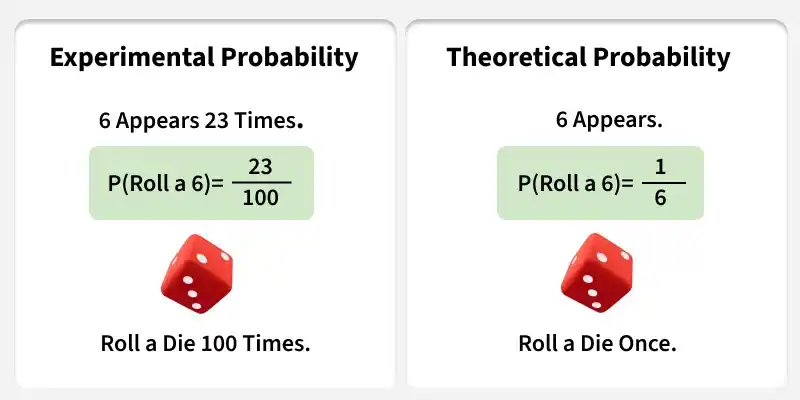
Theoretical Probability
Theoretical probability deals with assumptions to avoid unfeasible or costly repetition of experiments. The theoretical Probability for an event A can be calculated as follows:
P(A) = \frac{\text {Number of outcomes favorable to Event A}} {\text {Number of all possible outcomes}}
Here we assume the outcomes of an event as equally likely.
Now, as we learn the formula, let's put this formula in our coin-tossing case. In tossing a coin, there are two outcomes: Head or Tail. Hence, The Probability of the occurrence of a Head on tossing a coin is P(H) = 1/2
Similarly, The Probability of the occurrence of a Tail on tossing a coin is P(T) = 1/2
Experimental Probability
Experimental Probability is found by performing a series of experiments and observing their outcomes. These random experiments are also known as trials. The experimental probability for Event A can be calculated as follows:
P(A) = \frac{\text{Number of times event A happened(p)}} {\text{Total number of trials(n)}}
Now, as we learn the formula, let's put this formula in our coin-tossing case. If we tossed a coin 10 times and recorded heads 4 times and tails 6 times, then the Probability of occurrence of heads on tossing a coin: P(H) = 4/10
Similarly, the Probability of Occurrence of Tails on tossing a coin: P(T) = 6/10
Basics of Probability Theory
Some important concepts of probability theory are:
Random Experiment
In probability theory, any event that can be repeated multiple times and whose outcome is not hampered by its repetition is called a Random Experiment.
For example, tossing a coin, rolling the dice, etc., are random experiments.
Sample Space
The set of all possible outcomes for any random experiment is called the sample space.
For example, throwing dice results in six outcomes, which are 1, 2, 3, 4, 5 and 6. Thus, its sample space is (1, 2, 3, 4, 5, 6)
Event
The outcome of any experiment is called an event. Various types of events used in probability theory are,
- Independent Events: The events whose outcomes are not affected by the outcomes of other future and/or past events are called independent events.
For example, the output of tossing a coin in repetition is not affected by its previous outcome.
- Dependent Events: The events whose outcomes are affected by the outcome of other events are called dependent events.
For example, picking oranges from a bag that contains 100 oranges without replacement.
- Mutually Exclusive Events: The events that can not occur simultaneously are called mutually exclusive events.
For example, obtaining a head or a tail in tossing a coin, because both (head and a tail can not be obtained together.
- Equally likely Events: The events that have an equal chance or probability of happening are known as equally likely events.
For example, observing any face in rolling the dice has an equal probability of 1/6.
Random Variable
A variable that can assume the value of all possible outcomes of an experiment is called a random variable in Probability Theory. Random variables in probability theory are of two types, which are discussed below,
Discrete Random Variable
Variables that can take countable values, such as 0, 1, 2, ..., are called discrete random variables.
Examples: The number of heads when flipping 3 coins, the number of cars arriving at a parking lot in an hour or the number of correct answers on a test.
Continuous Random Variable
Variables that can take an infinite number of values in a given range are called continuous random variables.
Examples: The height of a person, the time it takes for a chemical reaction to occur or the temperature of a substance.
Probability Theory Formulas
Various formulas are used in probability theory and some of them are discussed below,
- Theoretical Probability Formula: (Number of Favorable Outcomes) / (Number of Total Outcomes)
- Empirical Probability Formula: (Number of times event A happened) / (Total number of trials)
- Addition Rule of Probability: P(A ∪ B) = P(A) + P(B) - P(A∩B)
- Complementary Rule of Probability: P(A') = 1 - P(A)
- Independent Events: P(A∩B) = P(A) ⋅ P(B)
- Conditional Probability: P(A | B) = P(A∩B) / P(B)
- Bayes' Theorem: P(A | B) = P(B | A) ⋅ P(A) / P(B)
Probability Theory in Statistics
Probability has various applications in Statistics.
- Descriptive Statistics: Probability theory helps in understanding and interpreting data summaries and distributions.
- Inferential Statistics: This forms the basis for making inferences about populations from samples, including hypothesis testing and the construction of confidence intervals.
- Regression Analysis: Probability distributions of errors are used to estimate the relationships between variables.
- Bayesian Statistics: Uses probability to represent uncertainty about the parameters of interest and updates this uncertainty as more data becomes available.
Applications
Probability theory is widely used in our lives. It helps answer various types of questions, such as: Will it rain tomorrow? What are the chances of landing on the Moon? What are the chances of human evolution? And others. Some of the important uses of probability theory are,
- Probability theory is used to predict the performance of stocks and bonds.
- In casinos and gambling, probability theory is used to find the chances of winning.
- Probability theory is used in weather forecasting.
- Probability theory is used in Risk mitigation.
- In consumer industries, the risk of product failure is mitigated by using Probability theory.
➢Practice: Solved Examples
