
Product rule is used to find the derivative of a function that is expressed as the product of two differentiable functions.
If a function is written as the product of two functions, we cannot differentiate each function separately and multiply the results.
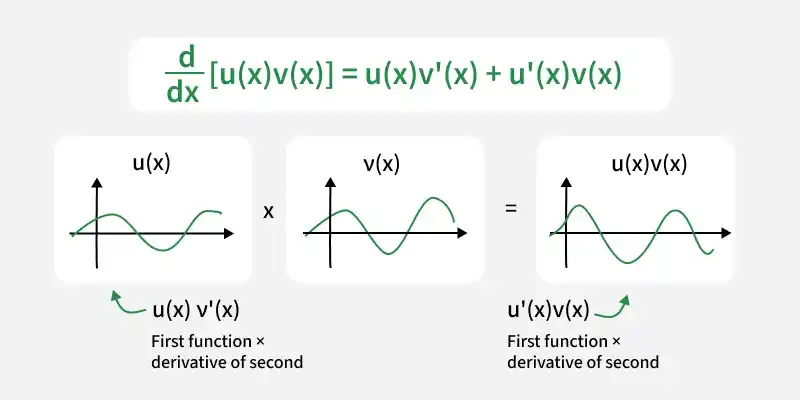
For two functions y = u(x)v(x), the derivative is obtained using the Product Rule:
\frac{d}{dx}[u(x)v(x)] = u(x)\frac{dv}{dx} + v(x)\frac{du}{dx}\\[3pts]\text{or}\\[3pts](uv)′= uv′+vu′ Where,
- u(x) and v(x) are the differential functions
- u'(x) is the derivative of u(x)
- v'(x) is the derivative of v(x)
Steps to Apply Product Rule
Step 1: Identify the function f(x) and g(x)
Step 2: Find the derivative functions f'(x) and g'(x)
Step 3: Use the formula: {f(x).g(x)}' = f(x).g'(x) + f'(x).g(x)
Step 4: Simplify the final expression.
Proof
Let function , y = u(x)v(x)
Using the definition of a derivative,
\frac{dy}{dx} = \lim\limits_{\Delta x\to 0} \frac{u(x+\Delta x)v(x+\Delta x)-u(x)v(x)} {\Delta x} Add and subtract u(x)v(x+Δx) in the numerator:
\lim\limits_{\Delta x\to 0} \frac{ u(x+\Delta x)v(x+\Delta x)-u(x)v(x+\Delta x) + u(x)v(x+\Delta x)-u(x)v(x) } {\Delta x} Factor the terms:
\lim_{\Delta x\to 0} \left[ \frac{(u(x+\Delta x)-u(x))v(x+\Delta x)} {\Delta x} + u(x)\frac{v(x+\Delta x)-v(x)} {\Delta x} \right] Apply the limit to each term:
v(x)\lim\limits_{\Delta x\to 0} \frac{u(x+\Delta x)-u(x)} {\Delta x} + u(x)\lim\limits_{\Delta x\to 0} \frac{v(x+\Delta x)-v(x)} {\Delta x} Using the definition of derivatives,
v(x)u'(x)+u(x)v'(x) Therefore,
\frac{d}{dx}[u(x)v(x)] = u'(x)v(x)+u(x)v'(x) Hence, the Product Rule is proved.
Product Rule for Products of More Than Two Functions
Product rule for more than two functions is simply found using the product of two functions. And then applying the product rule again,
For three functions, y = u(x)v(x)w(x)
the derivative is
\frac{d}{dx}[uvw] = u'vw + uv'w + uvw'
Solved Examples
Example 1: Find the derivative of the function y = ex sinx
y = ex.sinx
By Using Product Rule
y′(x) = (exsinx)′
⇒ y′(x) = (ex)′sinx + ex(sinx)′
⇒ y′(x) = exsinx + ex(cosx)
⇒ y′(x) = ex(sinx + cosx)
Example 2: Find the derivative of the function Z= (y³ + 2y²- y)(eʸ - 1 ).
Z = (y³ + 2y²-y)(eʸ - 1 )
Thus, Zʹ(x) = ((y³ + 2y²-y)(eʸ - 1 ) ) ʹ
⇒ Zʹ(x) =(y³ + 2y²-y)(eʸ - 1 ) ʹ + (y³ + 2y²-y) ʹ (eʸ - 1 )
⇒ Zʹ(x) =(y³ + 2y²-y)(eʸ ) + ( 3y² + 4y -1 )(eʸ - 1 )
⇒ Zʹ(x) =(y³ + 5y²-3y-1 )(eʸ) -( 3y² + 4y -1 )
Example 3 : Find the derivative of the function y = x2 3x.
Given y = x23x
f(x) = x2 and f'(x) = 2x
g(x) = 3x and g'(x) =3xlog3
Now
⇒ y' = f(x)g'(x) + f'(x)g(x)
⇒ y' = x23xlog3 + 2x3x
⇒ y' = 3xx(xlog3 + 2)
Example 4 : Find the differentiation of y = ex(cosx - sinx).
y = ex(cosx - sinx)
Let f(x) =ex then f'(x) = ex
and g(x) = cosx - sinx , then g' (x) = -sinx -cosx
So
y' = f(x) g'(x) + f'(x) g(x)
⇒ y' = ex(-sinx - cosx ) + ex (cosx - sinx)
⇒ y' = -2sinxex
Example 5 : Find the derivative of y = u.v.w , where u,v,w,y are function of x.
Given y = u . v . w
Let f(x) = u and g(x) = v.w
then f'(x) = u' and g'(x) =vw' + v'w
So, y' = f(x)g'(x) + f'(x) g(x)
⇒ y' =u(vw' + v'w ) + u'(vw)
Practice Problems
1. Find the derivative of f(x) = x²sin(x) using the product rule.
2. Differentiate g(x) = (x³ + 2x)(4x - 1) using the product rule.
3. Find d/dx [e^x · ln(x)] using the product rule.
4. Determine the derivative of h(x) = x(x² + 1)³ using the product rule.
5. Calculate the derivative of f(x) = (x + 2)(x² - 3x + 1) using the product rule.
