

In mathematics, a limit is the value that a function or sequence approaches as the input gets closer to a particular number.
Properties of limits tell us how limits behave when we perform different operations on them.
- These properties make it easier to calculate limits by breaking down complex expressions into simpler parts.
- By using these rules, we can add, subtract, multiply, and divide functions while still working with their limits.
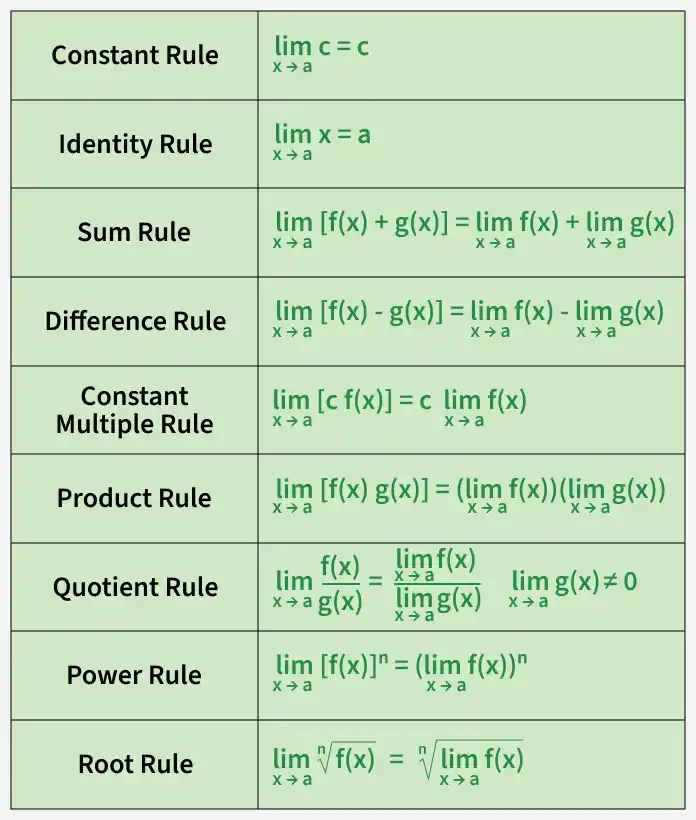
Let's say we have two functions, f(x) and g(x). We know that,
1. Sum of Limits: The limit of the sum of two functions is the sum of the limits of both functions.
\lim_{x \to a}[f(x) + g(x)] = \lim_{x \to a}f(x) + \lim_{x \to a}g(x)
2. Difference of Limits: The limit of the difference of two functions is the difference of the limits of both functions.
\lim_{x \to a}[f(x) - g(x)] = \lim_{x \to a}f(x) - \lim_{x \to a}g(x)
3. Product of Limits: The limit of the product of two functions is the product of the limits of both functions.
\lim_{x \to a}[f(x).g(x)] = \lim_{x \to a}f(x). \lim_{x \to a}g(x)
4. Quotient of Limits: The limit of the quotient of two functions is the quotient of limits of both functions.
\lim_{x \to a}[\dfrac{f(x)}{g(x)}] = \dfrac{\lim_{x \to a}f(x)}{ \lim_{x \to a}g(x)}
5. Constant Multiple: If f(x) has a limit as x → c, then:
\lim_{x \to c} [k \cdot f(x)] = k \cdot \lim_{x \to c} f(x)
Where k is constant.
7. Power of a Function: The limit of a power equals the power of the limit.
\lim_{x \to c} \left[ f(x) \right]^n = \left( \lim_{x \to c} f(x) \right)^n
for any integer n.
8. Function as Exponent
\lim _{x \rightarrow a}[f(x)]^{g(x)} = \left[\lim _{x \rightarrow a} f(x)\right]^{\lim _{x \rightarrow a} g(x)}
9. Limit as Constant
\lim _{x \rightarrow a} \ c = c , c is any real number
10. Identity Property
\lim _{x \rightarrow a} \ x = a
11. Power Property
\lim _{x \rightarrow a} \ x^n = a^n
12. Limit of Composite Functions : The composition of two functions f(x) and g(x) is denoted by (f o g)(x), which means the range of the function g(x) should lie in the domain of the function f(x):
\lim_{x \to a}(f o g)(x) = \lim_{x \to a}f(g(x)) = f(\lim_{x \to a}g(x))
Solved Examples
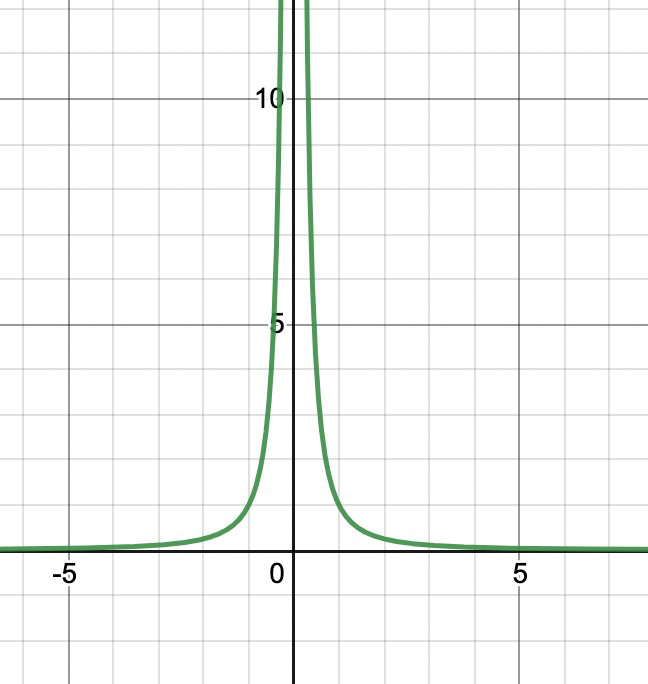
Example 1: Given the function f(x) =
Let's see this limit graphically,
We can see from the graph while approaching the function from either of the sides towards zero. Values start going diverges to infinity.
\lim_{x \to 0^-}f(x) = \lim_{x \to 0^+}f(x) = \infty
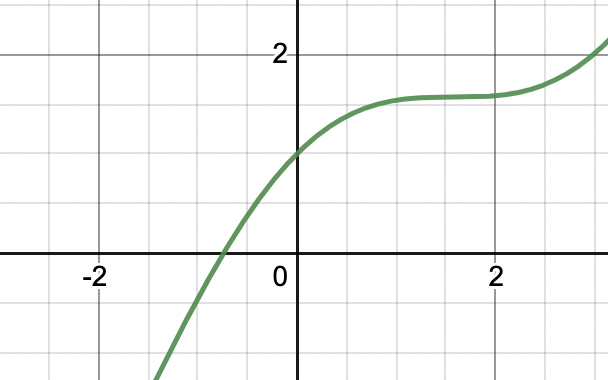
Example 2: Find the value of the limit of the function f(x) = x + cos(x) when x ⇢ 0.
The figure below shows the graph of the function,
We know that f(x) is a combination of two different functions. We can use the properties studied above, property 1 works for our case.
\lim_{x \to a}[f(x) + g(x)] = \lim_{x \to a}f(x) + \lim_{x \to a}g(x) We know f(x) = x + cos(x). Let's say h(x) = x and g(x) = cos(x) and using the above property we get.
\lim_{x \to 0}[h(x) + g(x)] = \lim_{x \to 0}h(x) + \lim_{x \to 0}g(x)
\lim_{x \to 0}x + \lim_{x \to 0}cos(x) =0 + 1 = 1
Example 3: Find the value of the limit of the function f(x) = (x2 + x +1)ex when x ⇢ 0.
We know that f(x) is a combination of two different functions. We can use the properties studied above, property 3 works for our case.
\lim_{x \to a}[f(x).g(x)] = \lim_{x \to a}f(x). \lim_{x \to a}g(x) We know f(x) = (x2 + x +1)ex Let's say h(x) = x2 + x +1 and g(x) =ex and using the above property we get.
\lim_{x \to 0}[h(x).g(x)] =( \lim_{x \to 0}h(x))(\lim_{x \to 0}g(x))
\lim_{x \to 0}x^2 + x + 1 \times \lim_{x \to 0}e^x = 1 × 1 = 1
Example 4: Find the value of the limit of the function f(x) =
We know that f(x) is a combination of two different functions. We can use the properties studied above, property 4 works for our case.
\lim_{x \to a}[\frac{f(x)}{g(x)}] = \frac{\lim_{x \to a}f(x)}{ \lim_{x \to a}g(x)} We know f(x) =
\frac{cos(x)}{x^2 + x + 4} Let's say g(x) = x2 + x +4.
\lim_{x \to a}[\frac{f(x)}{g(x)}] = \frac{\lim_{x \to a}f(x)}{ \lim_{x \to a}g(x)} =
\frac{\lim_{x \to 0}cos(x)}{\lim_{x \to 0}x^2 + x + 4} =
\frac{cos(0)}{0 + 0 + 4} =
\frac{1}{4}
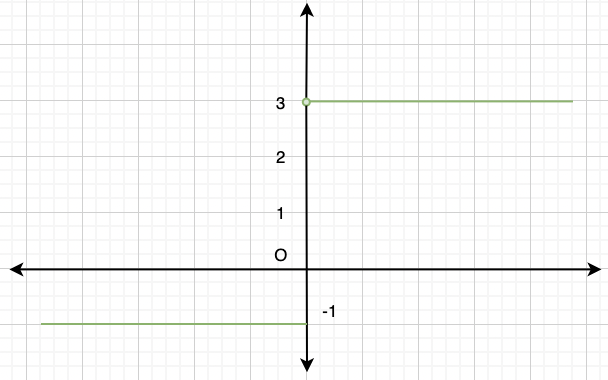
Example 5: Find the value of the limit of the function from left-hand side and right-hand side when x ⇢ 0, f(x) =
Let's see this limit graphically,
Notice in the graph that while approaching from the left-hand side, the functions seems to take value -1 and while approaching from the right-hand side, functions seems to taking value 3.
Thus,
\lim_{x \to 0^-}f(x) = -1
\lim_{x \to 0^+}f(x) = 3
Practice Problem
Question 1: Given the function
Question 2: Find the value of the limit of the function f(x) = x + tan(x) when x→0.
Question 3: Find the value of the limit of the function f(x) = (x2 + 1)ex when x→0.
Question 4: Find the value of the limit of the function
Question 5: Find the value of the limit of the function from the left-hand side and right-hand side when x→0:
