
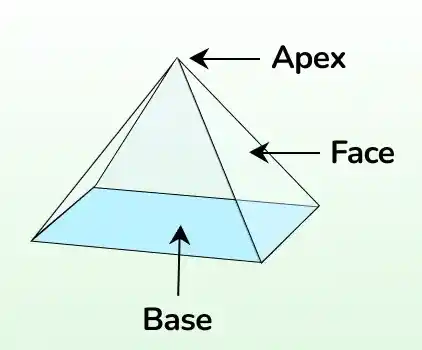
A pyramid is a 3D shape with a polygonal base and triangular faces that meet at a single point, the apex.
- The pyramid's height is the perpendicular distance from the base to the apex.
- Pyramids can have different base shapes (e.g., square, triangular) and are studied in geometry for their volume and surface area.
Types of Pyramid
Pyramids have different types based on their base shape, like squares, triangles, and pentagons. Each type has its special geometric features.
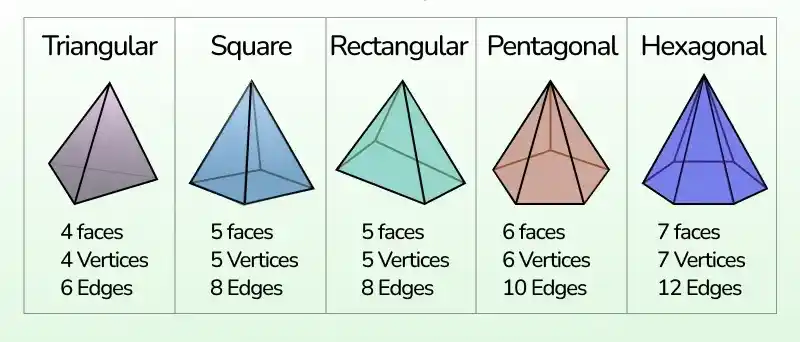
- Triangular Pyramid: A pyramid with a three-sided base, forming a point at the top, similar to a tent with a triangular base.
- Square Pyramid: A pyramid with a square bottom and sides that make a triangle shape, like the Great Pyramid of Giza.
- Rectangular Pyramid: A Pyramid in which the base is rectangular in shape and the side faces are triangular
- Pentagonal Pyramid: A pyramid with a base that has five sides, converging to a point at the top, seen in some ancient Mayan temples.
- Hexagonal Pyramid: A pyramid with a hexagon base and has 6 triangular faces.
Right Pyramid vs Oblique Pyramid
In a right pyramid, all triangular sides meet the base at right angles, while in an oblique pyramid, at least one side doesn't.
Regular vs Irregular Pyramid
A regular pyramid has equal sides and angles with a regular base shape, while an irregular pyramid can have varying sides and angles with an irregular base.
Pyramid Formulas
A pyramid is a 3D shape with a flat, polygonal base and triangular sides meeting at a point.
Volume of a Pyramid
To find the volume of a pyramid, you take the area of its base, multiply it by the height, and then divide the result by 3.
V= 1/3 × Base Area × Height
Surface Area of a Pyramid
The formula for finding the surface area (A) of a pyramid is to add the area of its base to the sum of the areas of its triangular sides.
Area of Base (B) of Pyramid
- For a square base, use the formula: B = (side)2
- For a rectangular base, use: B = length × width
- For a triangular base, use: B = (1 / 2) × base length × height
The sum of Areas of Triangular Sides (T)
Add up the areas of each triangular side using:
T = ∑ [(1 / 2) × (base length of each side) × (slant height of each side)]
Finally, calculate the total surface area A by adding B and T.
Total surface area of Pyramid A = B + T
Net of a Pyramid
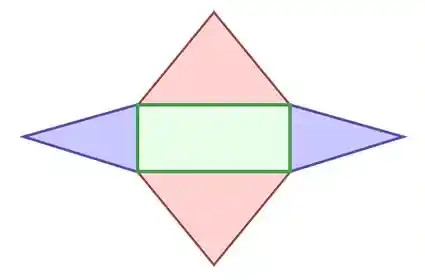
The net of a pyramid is a flat (2D) layout that can be folded to form a three-dimensional pyramid. It shows the base and all the triangular faces connected along their edges.
Properties
The properties of the Pyramid are mentioned below:
- Base Shape: The base is a flat shape with straight sides, like a simple drawing.
- Triangular Sides: The sides are like triangles, connecting the corners of the base to a point at the top.
- Apex: The apex is just the very top point where all the triangles meet.
- Height: The height is how tall the pyramid is, measured straight down from the top to the bottom.
- Surface Area: The surface area is how much space the pyramid covers, including the bottom and the triangular sides.
- Volume: The volume is how much stuff can fit inside the pyramid, found by multiplying the base size by the height and then dividing by 3.
- Symmetry: The pyramid looks the same if you turn it around, whether you look from the top or the bottom.
- Diagonals: Lines connecting non-adjacent corners on the base.
- Euler's Formula: For a pyramid with a flat shape at the bottom, the number of corners (V), sides (E), and faces (F) satisfy the rule: V - E + F = 2.
