
Sampling error is the difference between the result obtained from a sample and the actual value of the entire population.
- It occurs because a sample represents only a part of the population and may not perfectly reflect the characteristics of the whole population.
- In general, using a larger and more representative sample helps reduce sampling error.
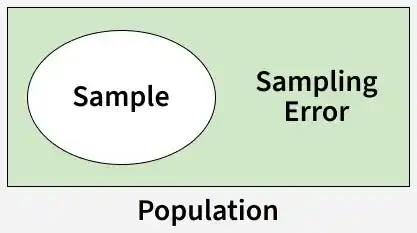
The image above shows that sampling error occurs when a sample differs from the population it represents.
The sampling error can be estimated using the following formula:
SE = Z \times \frac{\sigma}{\sqrt{n}} where,
- Z denotes the score value
- σ refers to the population standard deviation
- n is the sample size
Sample Problems
Question 1. Find the sampling error at a 95% confidence level, given the standard deviation of the population is 0.23 and the sample size is 2145.
Solution:
Given: Z = 95%, σ = 0.23 and n = 2145
Since, SE = Z x σ/√n
= 1.96 x (0.23/√2145)
= 1.96 x 0.00496608
SE = 0.009733
Question 2. Find the sampling error at a 90% confidence level, given the standard deviation of the population is 0.2 and the sample size is 100.
Solution:
Given: Z = 92%, σ = 0.2 and n = 100
Since, SE = Z x σ/√n
= 1.645 x (0.2/√100)
= 1.645 x 0.02
SE = 0.0329
Question 3. Find the sampling error at a 99% confidence level, given the standard deviation of the population is 0.2, and the sample size is 36.
Solution:
Given: Z = 99%, σ = 0.2 and n = 100
Since, SE = Z x σ/√n
= 2.58 x (0.2/√36)
= 2.58 x 0.0333
SE = 0.085914
Question 4. Find the sampling error at a 99% confidence level given the standard deviation of the population is 0.9, and the sample size is 49.
Solution:
Given: Z = 99%, σ = 0.9 and n = 49
Since, SE = Z x σ/√n
= 2.58 x (0.9/√49)
= 2.58 x 0.1285
SE = 0.33153
Question 5. Find the sampling error at a 95% confidence level, given the standard deviation of the population is 0.3 and the sample size is 81.
Solution:
Given: Z = 95%, σ = 0.3 and n = 81
Since, SE = Z x σ/√n
= 1.96 x (0.3/√81)
= 1.96 x 0.03333
SE = 0.0653268
Question 6. Find the sampling error at a 95% confidence level, given the standard deviation of the population is 0.15 and the sample size is 225.
Solution:
Given: Z = 95%, σ = 0.15 and n = 225
Since, SE = Z x σ/√n
= 1.96 x (0.15/√225)
= 1.96 x 0.01
SE = 0.0196
Question 7. Find the sampling error at a 90% confidence level, given the standard deviation of the population is 0.5 and the sample size is 400.
Solution:
Given: Z = 90%, σ = 0.5 and n = 400
Since, SE = Z x σ/√n
= 1.645 x (0.5/√400)
= 1.645 x 0.025
SE = 0.041125
Question 8. Find the sampling error at a 95% confidence level, given the standard deviation of the population is 0.4 and the sample size is 64.
Solution:
Given: Z = 95%, σ = 0.4 and n = 64
Since, SE = Z x σ/√n
= 1.96 x (0.4/√64)
= 1.96 x 0.05
SE = 0.098
Question 9. Find the sampling error at a 99% confidence level, given the standard deviation of the population is 0.35, and the sample size is 121.
Solution:
Given: Z = 99%, σ = 0.35 and n = 121
Since, SE = Z x σ/√n
= 2.58 x (0.35/√121)
= 2.58 x 0.0314
SE = 0.081012
Question 10. Find the sampling error at a 90% confidence level, given that the population standard deviation is 0.25 and the sample size is 50.
Solution:
Given: Z = 90%, σ = 0.25 and n = 50
Since, SE = Z x σ/√n
= 1.645 x (0.25/√50)
= 1.645 x 0.0354
SE = 0.058227
Practice Questions
1. A survey estimates the mean height of students in a school to be 160 cm with a standard deviation of 12 cm. If the sample size is 100 students, calculate the sampling error at a 95% confidence level.
2. In a poll of 400 voters, the proportion of peoplfavour favor a new policy is 0.45. Calculate the sampling error for the proportion at a 90% confidence level.
3. A sample of 250 households reports an average monthly electricity bill of $120 with a standard deviation of $15. Determine the sampling error at a 99% confidence level.
4. A researcher surveys 50 students to find the average time spent on homework per week. The mean time reported is 6 hours with a standard deviation of 1.5 hours. Calculate the sampling error at a 95% confidence level.
5. In a study, the mean weight of 200 apples is found to be 150 grams with a standard deviation of 20 grams. Find the sampling error at a 95% confidence level.
6. A random sample of 500 people indicates that 60% of them prefer online shopping. Calculate the sampling error for the proportion at a 95% confidence level.
7. The mean annual salary of a sample of 80 teachers is $50,000 with a standard deviation of $5,000. Determine the sampling error at a 90% confidence level.
8. In a survey, a sample of 150 customers reports a mean satisfaction score of 4.2 out of 5 with a standard deviation of 0.8. Calculate the sampling error at a 95% confidence level.
9. A study finds that the average lifespan of 30 electronic devices is 5 years with a standard deviation of 1 year. Determine the sampling error at a 99% confidence level.
10. A sample of 120 students shows that the average number of books read per year is 10 with a standard deviation of 3 books. Calculate the sampling error at a 95% confidence level.
