
The Sandwich (Squeeze) Theorem works by "sandwiching" a given function between two other functions whose limits are easier to determine.
It states that let functions f(x), g(x), and h(x) be real-valued functions such that h(x) ≤ f(x) ≤ g(x) for all x in some neighborhood of a (except possibly at a).
If
\lim\limits_{x\rightarrow a}h(x)=\lim\limits_{x\rightarrow a}g(x)=L, then\lim\limits_{x\rightarrow a}f(x)=L .
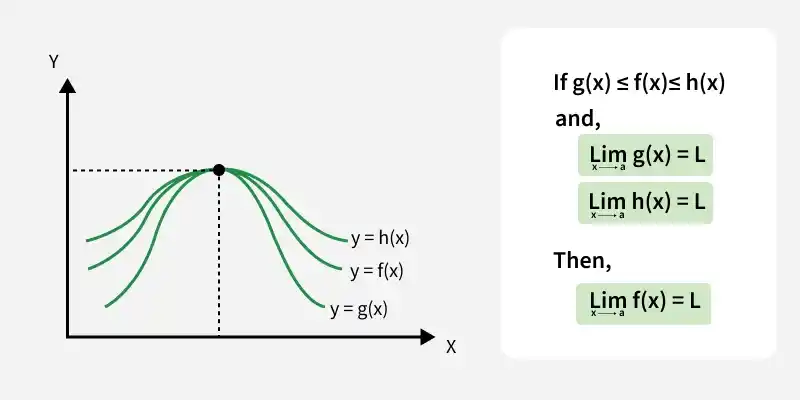
The function f(x) lies between h(x) and g(x), and hence h(x) and g(x) are called the lower bound and upper bound of f(x).
Conditions
The Sandwich Theorem can be applied only when the following conditions are satisfied:
- There exist functions h(x), f(x), and g(x) such that h(x) ≤ f(x) ≤ g(x)in a neighborhood of the point of interest.
- The lower and upper bounding functions approach the same limit:
\lim_{x\to a}h(x)=\lim_{x\to a}g(x)=L - The inequality remains valid near the point a.
When these conditions hold, the middle function must have the same limit L.
Proof
Assume three real-valued functions g(x), f(x), and h(x) such that g(x) ≤ f(x) ≤ h(x) and limx→a g(x) = limx→a h(x) = L.
Then by the definition of limits,
limx→a g(x) = L signifies ∀ ε > 0, ∃ δ1 > 0 such that |x - a| < δ1 ⇒ |g(x) - L| < ε
|x - a| < δ1 ⇒ - ε < g(x) - L < ε ... (i)
limx→a h(x) = L signifies ∀ ε > 0, ∃ δ2 > 0 such that |x - a| < δ2 ⇒ |h(x) - L| < ε
|x - a| < δ2 ⇒ - ε < h(x) - L < ε ... (ii)
Given, g(x) ≤ f(x) ≤ h(x)
Subtracting L from each side of the inequality
g(x) - L ≤ f(x) - L ≤ h(x) - L
Taking δ = minimum {δ1, δ2}, Now if |x - a| < δ,
-ε < g(x) - L ≤ f(x) - L ≤ h(x) - L < ε ...........[using (i) and (ii)]
-ε < f(x) - L < ε
limx→a f(x) = L
Thus, this proved the Sandwich Theorem.
Important Limits Using the Sandwich Theorem
Some important limits which can be proved using Sandwich theorems are,
- limx→a (sin x / x) = 1
- limx→a (1-cos x / x) = 0
Proof of limx→a (sin x / x) = 1
From the inequality, we proved that
From this equation, we understand that (sin x/x) always lies between cos x and 1. So (sin x/x) is sandwiched between 1 and cos x. We know that
Proof of limx→a (1 - cos x)/x = 0
To prove this limit we use the trigonometric identity
1-\cos x=2\sin^2(\dfrac{x}{2})\\\qquad\\ \lim\limits_{x\rightarrow0}\dfrac{1-\cos x}{x}\\=\lim\limits_{x\rightarrow0}\dfrac{2\sin^2\frac{x}{2}}{x}\\=\lim\limits_{x\rightarrow0}\dfrac{\sin \frac{x}{2}}{\frac{x}{2}}.\sin\frac{x}{2}\\\qquad\\=\lim\limits_{x\rightarrow0}\dfrac{sin\frac{x}{2}}{\frac{x}{2}}\lim\limits_{x\rightarrow0}\sin \dfrac{x}{2}\ \\= 1 × 0\\ =0\\\qquad\\ \implies 1-\cos x=2\sin^2(\dfrac{x}{2})\ =\ 0
Solved Examples
Example 1: Find the value of limx→ 0 f(x) if 9 - x2 ≤ f(x) ≤ 9 + x2
Now,
limx→ 0 9 - x2
= 9 - 02 = 9limx→ 0 9 + x2
= 9 + 02
= 9Now, if limx→ 0 9 - x2 = limx→ 0 9 + x2 = 9
Then using Sandwich Theorem we can say that,
limx→ 0 9 - x2 = limx→ 0 f(x) = limx→ 0 9 + x2
Thus the limit of limx→ 0 f(x) = 9
Example 2: Find the limit limx→ 0 x2 sin (1/x)
As we know, the range of the sin function is [-1, 1] then,
-1 ≤ sin x ≤ 1
⇒ -1 ≤ sin (1/x) ≤ 1 (x ≠ 0)Multiplying x2 on each side
-x2 ≤ x2sin (1/x) ≤ x2
Now, limx→ 0 -x2 = -02 = 0
and limx→ 0 x2 = -02 = 0
Now, if limx→ 0 - x2 = limx→ 0 x2 = 0
Then using Sandwich Theorem we can say that,
limx→ 0 - x2 = limx→ 0 x2 sin (1/x) = limx→ 0 x2
Thus the limit of limx→ 0 x2 sin (1/x) = 0
Practice Problems
1. Evaluate:
2. If
3. Evaluate:
4. If
5. Evaluate:
(Hint: Bound the expression between 0 and x2)
