

The Vector Triple Product is the cross product of one vector with the cross product of two other vectors.
If A, B, and C are three vectors, then the vector triple product is:
\mathbf{A}\times(\mathbf{B}\times\mathbf{C})
Since the operation contains two cross products and three vectors, it is called a vector triple product. Unlike the scalar triple product, whose result is a scalar quantity, the result of a vector triple product is always a vector.
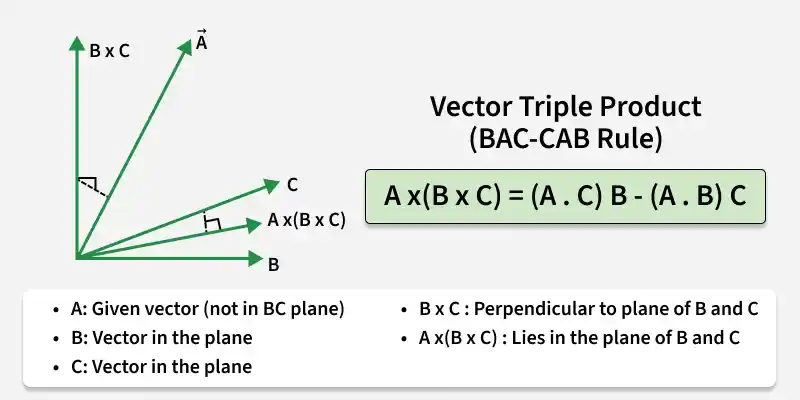
Interpretation of the Formula
- (A⋅C) is a scalar.
- (A⋅B) is a scalar.
- The result is a linear combination of vectors B and C.
Therefore, the result is a vector lying in the plane formed by B and C or coplaner to BC.
Proof
Let 3 vectors be:
\mathbf{A}=(a_1,a_2,a_3),\quad \mathbf{B}=(b_1,b_2,b_3),\quad \mathbf{C}=(c_1,c_2,c_3) We want to prove that
\mathbf{A}\times(\mathbf{B}\times\mathbf{C})=(\mathbf{A}\cdot\mathbf{C})\mathbf{B}-(\mathbf{A}\cdot\mathbf{B})\mathbf{C} Step 1: Find
\mathbf{B}\times\mathbf{C} Using the cross product formula,
\mathbf{B}\times\mathbf{C}=(b_2c_3-b_3c_2, b_3c_1-b_1c_3, b_1c_2-b_2c_1) Step 2: Compute (
\mathbf{A}\times(\mathbf{B}\times\mathbf{C}) )Let,
\mathbf{D}=\mathbf{B}\times\mathbf{C} Then ,
\mathbf{A}\times\mathbf{D}
\mathbf{A}\times(\mathbf{B}\times\mathbf{C}) = \begin{vmatrix} \mathbf{i} & \mathbf{j} & \mathbf{k}\\ a_1 & a_2 & a_3\\ D_1 & D_2 & D_3 \end{vmatrix} Expanding and simplifying gives
\mathbf{A}\times(\mathbf{B}\times\mathbf{C}) = \Big( b_1(\mathbf{A}\cdot\mathbf{C}) - c_1(\mathbf{A}\cdot\mathbf{B}),b_2(\mathbf{A}\cdot\mathbf{C}) - c_2(\mathbf{A}\cdot\mathbf{B}),b_3(\mathbf{A}\cdot\mathbf{C}) - c_3(\mathbf{A}\cdot\mathbf{B}) \Big) Step 3: Factor the Common Terms
Taking common factors from each component,
(\mathbf{A}\cdot\mathbf{C}) (b_1,b_2,b_3)- (\mathbf{A}\cdot\mathbf{B}) (c_1,c_2,c_3) Step 4: Write in Vector Form
Since
\mathbf{B}=(b_1,b_2,b_3) , \mathbf{C}= (c_1,c_2,c_3) ,we obtain\mathbf{A}\times(\mathbf{B}\times\mathbf{C})=(\mathbf{A}\cdot\mathbf{C})\mathbf{B}-(\mathbf{A}\cdot\mathbf{B})\mathbf{C} This is known as the BAC–CAB identity or the Vector Triple Product Formula.
Properties
These property are useful for simplifying complex vector expressions.
1. Resultant Vector: The vector triple product always produces a vector quantity.
2. The Result Lies in the Plane of B and C: Since A×(B×C) = (A⋅C)B − (A⋅B)C, the resulting vector is a linear combination of B and C. Therefore, it always lies in the plane formed by B and C.
3. Cross Product is Not Associative: The order of operations cannot be changed i.e., A × (B×C) ≠ (A×B) × C
4. Becomes Zero When B and C are Parallel: If B and C are parallel, then B×C = 0
Therefore, A×(B×C) = A×0=0
5. Distributive Property: The vector triple product is distributive over vector addition. A×[(B+D)×C] = A×(B×C)+A×(D×C)
Solved Examples
Example 1: Given three vectors
Solution: Find
\vec{b} \times \vec{c}
\vec{b} \times \vec{c} = \begin{vmatrix} \hat{i} & \hat{j} & \hat{k} \\ 1 & -1 & 1 \\ 1 & 1 & 1 \end{vmatrix} = 2\hat{i} - 2\hat{j} Multiply by
\vec{a}
\vec{a} \times (\vec{b} \times \vec{c}) = \begin{vmatrix} \hat{i} & \hat{j} & \hat{k} \\ 1 & 2 & -1 \\ 2 & -2 & 0 \end{vmatrix} = -2\hat{i} + 4\hat{j} + 6\hat{k} Therefore,
\vec{a} \times (\vec{b} \times \vec{c}) = -2\hat{i} + 4\hat{j} + 6\hat{k}
Example 2: Verify whether the equation
Solution: Calculate
\vec{r} \times \vec{s} :
\vec{r} \times \vec{s} = \begin{vmatrix} \hat{i} & \hat{j} & \hat{k} \\ 1 & 3 & 2 \\ 0 & 0 & 1 \end{vmatrix} = -\hat{j} + \hat{k} Multiply by
\vec{q}
\vec{q} \times (\vec{r} \times \vec{s}) = \begin{vmatrix} \hat{i} & \hat{j} & \hat{k} \\ 2 & -1 & 0 \\ -1 & 1 & 0 \end{vmatrix} = \hat{k} Compare with
\vec{p}
\vec{p} = \hat{i} + \hat{j} and\vec{q} \times (\vec{r} \times \vec{s}) = \hat{k} Since
\vec{p} and\vec{q} \times (\vec{r} \times \vec{s}) are not equal, the equation\vec{p} = \vec{q} \times (\vec{r} \times \vec{s}) does not hold true.
Practice Problems
Problem 1. Given three vectors
Problem 2. Determine the unit vector that is coplanar with
Problem 3. Verify whether the equation
Problem 4. If
Problem 5. Given non-coplanar vectors
